



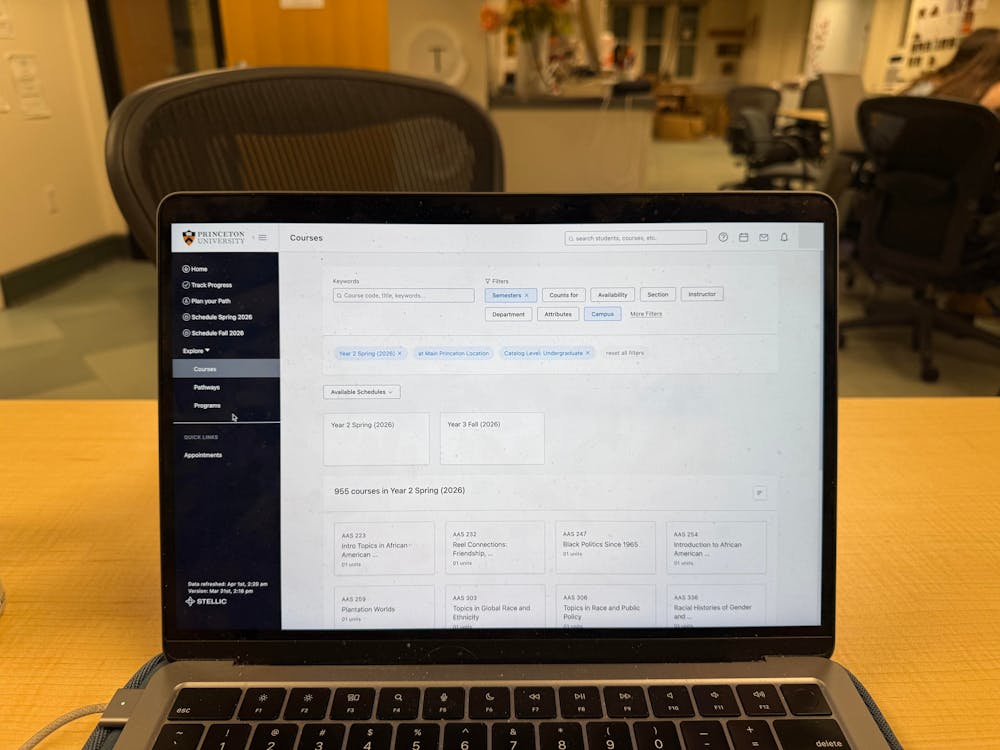
Stellic, a degree-management platform, is set to replace TigerHub for student course selection beginning in Fall 2026. The platform is also a centralized hub where students can track degree progress, plan different schedules, and make appointments with advisors.
Stellic, designed at Carnegie Mellon University, is used at various peer universities including Columbia University and the University of Chicago. Graduate students have used Stellic for about a year. Undergraduates have had access to Stellic since last fall, but this semester will be the first time the site is used for undergraduates, including course selection.
“They’ve always been doing [course planning] with pen and paper or with spreadsheets or with other apps, but [Stellic provides] a cool opportunity to actually see how your current coursework fits into a different department,” said Cecily Swanson, the associate dean for undergraduate affairs for the School of Engineering and Applied Science.
Course selection and other academic functions, including planning courses, accessing degree progress reports, and parts of the Academic Planning Form, are currently done on TigerHub. TigerHub will still remain active for other student actions, such as electing pass/D/fail and requesting official transcripts. Course schedules will automatically be transferred to the site after registration is completed in Stellic.
“We think it's an improvement to what we had built, which was mostly a homegrown system, and it's ever evolving,” said Deputy Registrar Justin Bronfeld.
The main uses of Stellic can be broken down into three categories: registration, planning, and tracking.
Course registration
Students on Stellic will have the opportunity to search courses by course code and add them to a weekly schedule planner, where they will be able to see their lectures, precepts, seminars, and classes mapped on a divided-by-hour weekly calendar.

Students will be able to register for their courses straight from the website. In the fall, there will be a course ranking option, where students will be able to rank their courses from most wanted to least wanted. This will make it easier for students to enroll directly into their second or third-choice courses, in case they do not get into their first-choice courses. This feature is still in its "preview phase," and will be available to students for course registration in the fall.
Previously, students needed to externally prepare replacement courses and input their course codes into TigerHub after they had completed the initial attempt at course registration, often missing the crucial first few seconds of course enrollment.
Students will be able to change precept or lab section times on the site as well.
“There will be a button that says change registration, and you just pick the precept [or lab section] that you want to change into,” said Graduate Student Systems Specialist TJ Branin.
Additionally, these courses can be added to the academic plan, under the “Plan your Path” tab.
Academic Planning

Frequently, students use various student-created apps, such as TigerJunction and TigerPath, to plan their courses for each semester. Now, the functions of each app are centralized in one website. One difference between TigerHub and Stellic is that the site will allow students to view what requirements they have satisfied for a certain distribution, major, or minor.
Within the “Plan your Path” section, students can view the courses they have completed each semester, and add classes to future semesters.
The program also offers a feature where students can search for all courses that satisfy a general requirement, such as Social Analysis (SA).
Stellic also includes a schedule generator, which can help sort or add courses into a schedule that works time-wise for the student.
Branin noted that this feature is particularly helpful for students who are interested in lots of courses.“If you’re thinking about a lot of courses, and you click that auto generate it’ll tell you, ‘what days do you want to be in classes? Do you want to lean more towards the morning, the night?’ So there’s options there,” Branin said.
Stellic lets students parallel plan multiple semesters simultaneously and compare different academic paths. Users can evaluate different majors, and see their progress in various departments.
“You can make a couple different plans, and think about what it would be like to major in English versus Comparative Literature versus History,” Swanson said.
Tracking
Students are able to track their degree progress using the “track progress” button, which displays a student’s major requirements, distribution requirements, and courses that will count towards their degree.
Students can also auto-generate a different academic plan for a different major, to see how many of a student’s currently completed courses would fulfill the requirements for that major.
Branin emphasized that Stellic is intended to be very user-responsive, and operates using feedback from students.
“[Stellic] takes our feedback and [students’] feedback on course items as well,” said Branin.
The administrators who spoke with the ‘Prince,’ including Swanson and Natalia Córdova Sánchez, the assistant dean for studies for Mathey College, have used Stellic for making appointments with students, as well as to see their course plans, which they say has been making engaging with undergraduates much easier.
Course selection for current juniors will be on Wednesday, April 15. For current sophomores, it will be on Thursday, April 16, and for current first-years, it will be on Friday, April 17.
Clara Docherty is the assistant News editor for the ‘Prince’ leading faculty, graduate students, and alumni coverage. She is from Lafayette, N.J., and can be reached at clara.docherty[at]princeton.edu.
Luke Grippo is a head News editor for the ‘Prince.’ He is from South Jersey, and typically covers high-profile interviews and University and town politics. He can be reached at luke.grippo[at]dailyprincetonian.com.
Please send any corrections to corrections[at]dailyprincetonian.com.
A correction was made on April 2, 2026: A previous version of this article described the "course ranking" feature as presently available, but in fact, the feature will not be available until the fall. The 'Prince' regrets this error.
Read More

Princeton’s Baked Bear: a new standout or just bearable?
Alexis ChoiContributing writer for The Prospect Alexis Choi reviews the new Baked Bear location in downtown Princeton.
Contributing writer for The Prospect Alexis Choi reviews the new Baked Bear location in downtown Princeton.

Building community one porch at a time at Princeton Porchfest 2026
Kellen FisherContributing writer for the Prospect Kellen Fisher shares his experience at Princeton Porchfest 2026.
Contributing writer for the Prospect Kellen Fisher shares his experience at Princeton Porchfest 2026.

Princeton Council restricts ICE actions on municipal-owned grounds
Reem TelhaouiCouncil members voted unanimously to bar federal immigration officers from non-public, municipally owned land without a judicial warrant. Residents also urged the Council to reverse its 2024 ban on skating at Lake Carnegie, a decision the municipality is now reconsidering.
Council members voted unanimously to bar federal immigration officers from non-public, municipally owned land without a judicial warrant. Residents also urged the Council to reverse its 2024 ban on skating at Lake Carnegie, a decision the municipality is now reconsidering.