



The following is a guest contribution and reflects the authors’ views alone. For information on how to submit a piece to the Opinion section, click here.
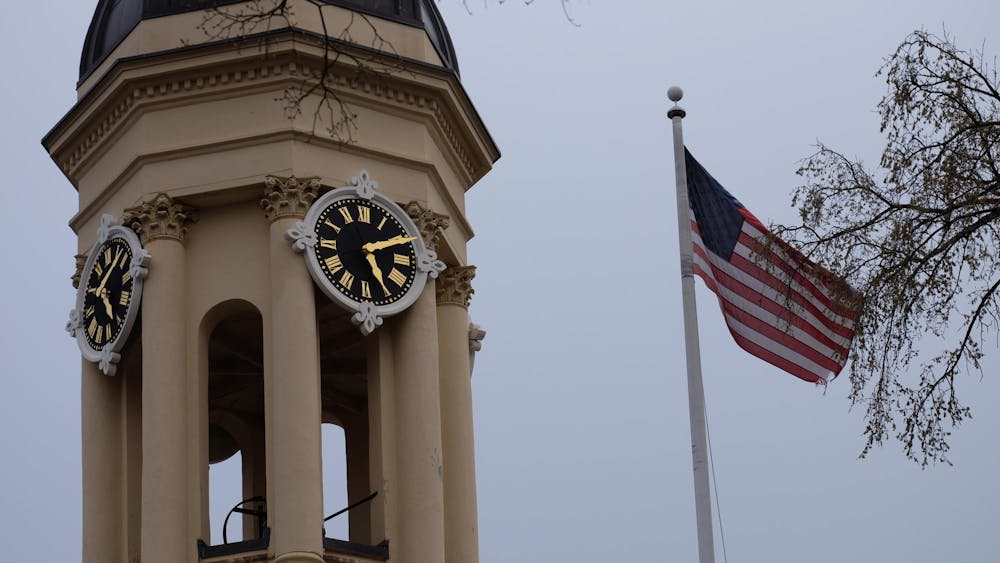
Princeton recently hosted the New Jersey General Assembly for a special session in the Faculty Room of Nassau Hall, celebrating the 250th anniversary of the independent legislature’s first meeting in August 1776. At the time of that inaugural session, Nassau Hall was still unravaged by the horrors of war. By the time the Continental Congress arrived in 1783, the Battle of Princeton had left the town and campus in utter ruin: Libraries had been sacked, windows shattered, and personal collections raided. Though victory had been achieved, the union of states that had hitherto managed to “hang together” threatened to “hang separately.” In the centuries that followed, the college would be restored to its former glory, and the campus, like the new country it planted, blossomed around it.
Something else has happened in those 250 years: Students were kicked out of Nassau Hall. The place where they used to live, dine, pray, and learn is now an untouchable “inner sanctum.” The Faculty Room’s jutting figure, itself the product of a 19th-century renovation, is to most just an edificial curiosity. Nassau Hall is the heart of many Orange Key tours — “where Alexander Hamilton’s cannonball decapitated the portrait of George II!” — but few of the future Princetonians who hear those words will enter its walls and stand beneath the portrait’s replica.
You might be surprised to find out that during most hours of the workday, students can technically walk through the building’s main doors. Tour groups sometimes even get the chance to peek into the hallowed Faculty Room. For most, though, this is the most they will ever access the building. In four years, a student may take a hesitant walk around Nassau’s first floor and, possibly, sneak a brief view of the inner sanctum. But the dim lighting, the Faculty Room’s locked doors, and the specter of roaming administrators will likely shorten the stay.
Luckily for us, we have both entered the storied chamber, each time for a class. Dean Alec Dun GS ’04 teaches the Freshman Seminar FRS 179: “Before Hamilton: Power and History” and Professor Michael Blaakman teaches HIS 372: “Revolutionary America.” Both classes host a session in the Faculty Room, allowing students the rare opportunity to learn as the earliest Princetonians once did.
Though the current space is different from its 18th-century forerunner, the history lingers like a ghost. There, we reflected upon the significance of the room — its renovated grandeur, its arrangement of portraits, its parliamentary layout. The layers of time and meaning that accumulated with dust upon the space. We were face-to-face with the history of our nation, and the legacy of our forefathers. Despite the theoretical nature of our class discussions, we found ourselves in awe of our surroundings.
History must be felt to be truly cherished. One could hardly understand the Battle of Princeton without walking its battlefield, nor could the scale of Emanuel Leutze’s “Washington Crossing the Delaware” be felt without taking N.J. Transit to the Met to see it in person. On the train back to Princeton, you could re-trace the Continental Army’s retreat from New York and then behold Charles Willson Peale’s portrait of Washington in the University’s new art museum. An hour southwest of Princeton at Independence Hall in Philadelphia, you can stand in the room where the Declaration and Constitution were born, and an hour east, you can see the drama enacted on the Broadway stage — or, at least, grab a beer at Fraunces Tavern, where Washington bid farewell to his officers.
But when it comes to our University’s own historic buildings, you’re out of luck. The oldest buildings on campus — Nassau, Stanhope, and Clio — are the dominion of University administration.

Closing the doors to such historic buildings repeats the mistake made by too many universities: conflating the institution with its administration. While the University could not function without the work of its leaders and trustees, neither could it live without the flesh, blood, and spirit of its students and faculty. Princeton is not only its current inhabitants — its walls and spires teem with the life of those who have come before. Students should not feel that they need a special reason to enter Nassau Hall.
Even if technically open — however limitedly — Nassau Hall still suffers from a lack of openness. When was the last time a guest lecture or event was held in the Faculty Room? When has the University ever invited students to come inside and see history for themselves? A spirit of hospitality would do much to encourage student exploration. In the Memorial Atrium alone, they can pay remembrance to the emmarbled names of former students who have, since the days of the Revolution, made the ultimate sacrifice. Students should be encouraged, not merely allowed, to honor the most honorable of their predecessors.
There is luckily some hope on the horizon. In April, an exciting new exhibit at Firestone Library will offer the community a rare look into Princeton’s archival treasures. But the gap between the University’s past and present should be bridged beyond just the celebration of the country’s 250th anniversary. What better way than by actively promoting Nassau Hall as a space for students? What’s more, why not invite more Princetonians to experience the same sense of awe we felt inside the Faculty Room? In this effort of “going back to Nassau Hall,” we will not pursue Alexander Hamilton’s tactic of cannonade — unlike that famous Princeton reject, we cherish “Nassau’s walls.” But the same patriotic spirit that led him to fire upon Nassau Hall should compel us to open it once more.
Zach Gardner is a senior majoring in Politics and minoring in English and History. He is the publisher emeritus of The Princeton Tory. He is from Atlanta.
Samuel Kligman is a senior in the School of Public and International Affairs. He is the former President of the American Whig-Cliosophic Society. He is from El Paso, Texas.
Please send any corrections to corrections[at]dailyprincetonian.com.
Read More

The real crisis on campus isn’t cheating, it’s thinking
Jack GoodmanFurther, a growing body of research confirms that use of generative AI undermines the cognitive effort that is essential to the development of the human brain. As AI use increases, learning, recalling, and critical thinking skills decline.
Further, a growing body of research confirms that use of generative AI undermines the cognitive effort that is essential to the development of the human brain. As AI use increases, learning, recalling, and critical thinking skills decline.

Trust in academia is at a low. Can Writing Seminar help?
Ian RosenzweigAcademia has a PR problem, and no amount of insular critical inquiry is going to solve it. Writing Seminars should live up to their name and teach us not just to solve thorny research problems but also to effectively communicate our solutions through clear and — perhaps more importantly — stylistically compelling prose.
Academia has a PR problem, and no amount of insular critical inquiry is going to solve it. Writing Seminars should live up to their name and teach us not just to solve thorny research problems but also to effectively communicate our solutions through clear and — perhaps more importantly — stylistically compelling prose.
Why is the recording policy being kept secret?
Isaac BarsoumIn denying new students — and faculty and staff, for that matter — the right to know what regulations they are subject to, Princeton makes violations likely and will end up unfairly investigating or disciplining community members who were unaware of the policy’s existence in the first place.
In denying new students — and faculty and staff, for that matter — the right to know what regulations they are subject to, Princeton makes violations likely and will end up unfairly investigating or disciplining community members who were unaware of the policy’s existence in the first place.