



The following is a guest contribution and reflects the author’s views alone. For information on how to submit a piece to the Opinion section, click here.
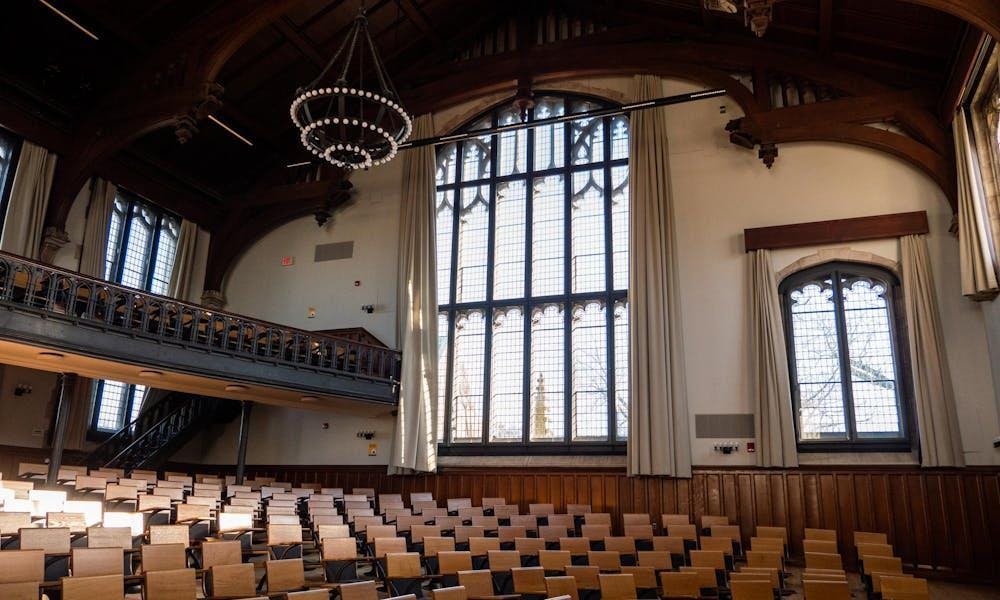
Last Wednesday, I sat in Green Hall having an “ordinary” but peculiar experience: listening to my professor read aloud from her private set of lecture notes, while the class sat and stared at a bare-bones slideshow of historical quotes. Around me, dozens of my classmates were dutifully typing out summaries of every slide. But, as my professor narrated her questions about the origins of the peculiar ideas of sovereignty, my attention was more focused on the origins of the peculiar idea of the lecture.
My professor is a brilliant historian. Is it really the best use of her time and talents to make her stand and narrate her own notes for several hours a week to a hall full of students racing to copy her sentences onto their pages? Why not just publish notes and tell us to read them, at our own pace, in our own time?
It’s time to think about replacing the lecture.
Reading lecture notes offers several advantages over listening to them in person. It’s faster than reading aloud, and we comprehend just as much. It permits individual students to control the flow of their learning, skimming over passages they understand well and digging deep into sections that confuse them. It allows you a second chance at understanding if you miss a detail — just reread! — which doesn’t interrupt everyone else’s learning by making the professor repeat herself. It frees students from the need to copy down basic facts and allows them to take more selective, critical notes.
Admittedly, lectures can have advantages over reading. Some lecturers truly are amazing presenters and explain concepts much better extemporaneously. It’d be an extra burden on their time to make them write out everything they’re going to say in detailed notes. These exceptional professors could audio-record themselves and upload the audio to Canvas, alongside the fairly routine practice of uploading slideshows. There are dozens of excellent and free speech-to-text transcription services for the student who prefers a textual medium, and it’s as simple for the average professor as setting your phone on a lectern and pressing “start.”
Most professors, however, are not significantly better at live teaching than they are at writing ideas down; academia, after all, selects for the latter. Perhaps there are cases where lectures are justified, but it is bizarre to make lectures the assumed default option because of a few really exceptional instructors.
Other advocates of the in-person lecture might point to the ability to ask questions, the human environment of the lecture hall, and fears that students will blow off assigned readings. For many lectures at Princeton, though, these factors are weak. In my STEM classes, the majority of lectures pass without a single student question, while the course precepts, office hours, and Ed Discussion are comparatively overflowing with student engagement. My humanities lectures haven’t been much different: a few more questions here and there, but once you get to a class of 50 or more people, sustained and helpful back-and-forth becomes almost impossible.

If a shared social environment is so important, office hours and study groups are much more natural solutions than a mass of silent notetakers and a single speaker. They permit a truly interactive learning environment, with opportunities to critically engage and receive feedback rather than just acting as a passive recipient. And if students choose to skip their readings, they can suffer the consequences: Test their comprehension and set harsher grades. It is beneath our wonderful professors to make them play babysitter for the brightest students in the country; it is entirely appropriate to expect Princeton students to take some responsibility for their education.
Of course, just because I prefer to read doesn’t mean my classmates do. If lectures are better than independent reading for the majority of students, isn’t that reason enough to keep them? This would be a fair point if lectures were optional: Everyone who benefits can attend, and those who don’t can hit the books. But in most of my classes, absentees are penalized by “participation grades” that assign credit just for sitting in the room while the lecture happens. This is manifestly unfair: A student who checks in to iClicker and watches TikToks in the back of the hall gets a reward, while a diligent independent learner working through the textbook gets nothing. Putting more grade weight into tests and assignments gives credit by the only criterion that matters: how much you’ve learned.
My preferred solution is for the University to abolish lectures, and for professors to instead publish their notes and hold more office hours. A more modest change from current practice also exists, however: Professors can tell students, at the start of the class, that notes will be published and lectures recorded, and that lecture attendance is not mandatory. Add that many students find lectures very helpful, and self-studying will take a great deal of initiative and agency. Warn them that if they choose not to attend, it is their responsibility to keep up with the class, and they may suffer on the exams if they plan poorly.
Let us make our own choices. For a substantial number of classes, there is no need to carry on the assumption that lectures are necessary for learning. A brighter, more independent Princeton will thank you for laying that myth to rest.
Jack Thompson ’27 is a computer science major from East Montpelier, Vt. He can be reached at jackthompson[at]princeton.edu.
Please send any corrections to corrections[at]dailyprincetonian.com.
Read More

The real crisis on campus isn’t cheating, it’s thinking
Jack GoodmanFurther, a growing body of research confirms that use of generative AI undermines the cognitive effort that is essential to the development of the human brain. As AI use increases, learning, recalling, and critical thinking skills decline.
Further, a growing body of research confirms that use of generative AI undermines the cognitive effort that is essential to the development of the human brain. As AI use increases, learning, recalling, and critical thinking skills decline.

Trust in academia is at a low. Can Writing Seminar help?
Ian RosenzweigAcademia has a PR problem, and no amount of insular critical inquiry is going to solve it. Writing Seminars should live up to their name and teach us not just to solve thorny research problems but also to effectively communicate our solutions through clear and — perhaps more importantly — stylistically compelling prose.
Academia has a PR problem, and no amount of insular critical inquiry is going to solve it. Writing Seminars should live up to their name and teach us not just to solve thorny research problems but also to effectively communicate our solutions through clear and — perhaps more importantly — stylistically compelling prose.
Why is the recording policy being kept secret?
Isaac BarsoumIn denying new students — and faculty and staff, for that matter — the right to know what regulations they are subject to, Princeton makes violations likely and will end up unfairly investigating or disciplining community members who were unaware of the policy’s existence in the first place.
In denying new students — and faculty and staff, for that matter — the right to know what regulations they are subject to, Princeton makes violations likely and will end up unfairly investigating or disciplining community members who were unaware of the policy’s existence in the first place.