



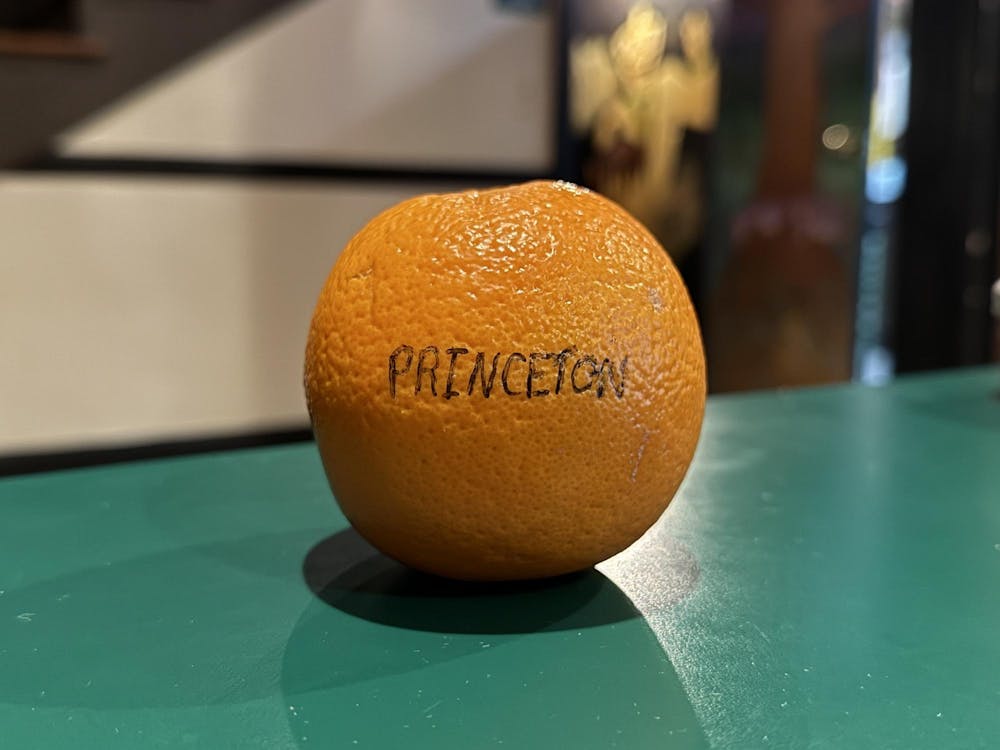
Remember that lifetime membership you paid $35 for at the Princeton University Store (U-Store)? To get your money’s worth, you may want to consider buying the Princeton Custom Made Comfort Blanket for $283.50 (down from $315).
That’s because on Feb. 10, the U-Store functionally ended its membership benefits: members no longer receive a 10 percent discount on food, cleaning supplies, or other staples. Instead, the discount now only applies to Princeton-branded merchandise, like mugs or t-shirts. No longer will drunk students on a night out be able to acquire snacks and rehydrating drinks at a lower price — and generations of future Daily Princetonian writers will have 10 percent fewer snacks in the newsroom.
The purchase of the lifetime membership came accompanied by the promise of lifetime discounts — and, for that matter, self checkout — but neither of those promises has been kept. The U-Store ought to issue a full refund to all those on the receiving end of these egregious changes. Until then, we must boycott it to force its hand.
So why did we buy the membership anyway? The U-Store, for many years, has sold its business model as a way to “[give] discounts to its members” rather than “paying dividends to Wall Street shareholders.” Instead, the U-Store passes the burden of its business model onto non-members, charging exorbitantly high prices while claiming that it redistributes its profits to members through the discount.
And prices at the U-Store, particularly for food, are indeed outrageous. For example, a ‘Prince’ analysis found that flour and potato chips at the U-Store each cost about 2.5 times as much per unit as the next-most-expensive alternative. Overall, “grocery shopping at the U-Store is, on average, more expensive than grocery shopping at large chain supermarkets.”
Before, those prices were charged to non-members and, however insufficiently, redistributed to us; now, we have become the subject of the extortion that once served us.
All along, the U-Store has bragged that it “is a not-for-profit cooperative society whose members share in the profits.” It’s told us, earnestly, and with hints of anti-capitalism, that “as a co-op, it operates differently than an ordinary corporation.”
How exactly, now, is the U-Store operating any differently from any ordinary corporation? Today, in fact, the U-Store has become the worst deal in a town where your other options are Trader Joe’s, Whole Foods, Target, and Wegmans (all of which, conveniently for the U-Store, students can only access for free by bus on the weekend).

No, despite the bluster and pride of a U-Store that once had a credible claim to giving back, the discount appears to be gone for good.
Now, the U-Store has upended its terms and conditions without even bothering to notify its members. “We value all of our members,” says the U-Store, but apparently not enough to inform those very members about a major change in benefits before it broke in the pages of the ‘Prince.’
In a statement explaining the change, U-Store CEO and President June Archer ’85 told the ‘Prince’ that “we understand that our community values the membership discount, and we did not make these changes lightly.”
To be honest, it does not matter how much weight the changes have been given. The U-Store has quietly and shamefully abdicated its promises to its members, many of whom are current students at the University with limited other options for purchasing food or household essentials. Where, I must ask, will the additional revenues go, given that the U-Store maintains its status as a non-profit co-op?
If the U-Store is truly struggling for profit, it might consider a range of other options — raise the price of future memberships, bring back self-checkout to reduce labor costs, ask the University for lower rent costs, or even increment prices overall — but effectively ending the membership is the wrong answer.
To remedy its failure, the U-Store has two paths forward: continue honoring the original terms of membership for those who became members before the policy change was implemented, or issue a full refund to all current members.

Any other path forward, including the U-Store’s current path of refusing to acknowledge the change other than by leaving a sign in the store and making surreptitious adjustments to its website, is wholly unacceptable.
As long as the U-Store does not rectify this issue, I will shop elsewhere. And students, faculty, staff, and other community members who are U-Store members should all take our business elsewhere — from Wawa to Wegmans — until the co-op honors its promises and respects its members, whom, I resubmit, it claims to “value.”
If just 10 percent of us members choose to spend our money elsewhere, then we can erase the extra revenue the U-Store would otherwise make and force their hand towards restoring membership benefits. Most likely, members will save money in the process by shopping elsewhere.
Join me. I hear Wawa is making delicious food this time of year.
Isaac Barsoum ’28 is an associate Opinion editor from Charlotte, N.C., who has frequently enjoyed U-Store popcorn but not enough to pay 11.1 percent more for it. He can be reached at Wawa or at itbarsoum[at]princeton.edu.
A correction was made Feb. 16, 2026: A previous version of this article claimed that the U-Store will generate 10 percent additional profit from the change. In fact, without knowing the existing profit margin and revenue from member purchases, it is not possible to determine this statistic. The ‘Prince’ regrets this error.
Read More

The real crisis on campus isn’t cheating, it’s thinking
Jack GoodmanFurther, a growing body of research confirms that use of generative AI undermines the cognitive effort that is essential to the development of the human brain. As AI use increases, learning, recalling, and critical thinking skills decline.
Further, a growing body of research confirms that use of generative AI undermines the cognitive effort that is essential to the development of the human brain. As AI use increases, learning, recalling, and critical thinking skills decline.

Trust in academia is at a low. Can Writing Seminar help?
Ian RosenzweigAcademia has a PR problem, and no amount of insular critical inquiry is going to solve it. Writing Seminars should live up to their name and teach us not just to solve thorny research problems but also to effectively communicate our solutions through clear and — perhaps more importantly — stylistically compelling prose.
Academia has a PR problem, and no amount of insular critical inquiry is going to solve it. Writing Seminars should live up to their name and teach us not just to solve thorny research problems but also to effectively communicate our solutions through clear and — perhaps more importantly — stylistically compelling prose.
Why is the recording policy being kept secret?
Isaac BarsoumIn denying new students — and faculty and staff, for that matter — the right to know what regulations they are subject to, Princeton makes violations likely and will end up unfairly investigating or disciplining community members who were unaware of the policy’s existence in the first place.
In denying new students — and faculty and staff, for that matter — the right to know what regulations they are subject to, Princeton makes violations likely and will end up unfairly investigating or disciplining community members who were unaware of the policy’s existence in the first place.