



Lea en español aquí.
After 10 years of planning and construction, the wait is nearly over.
The Princeton University Art Museum (PUAM) will reopen its doors in a matter of days, with Princeton students getting the first look on Saturday, Oct. 25, followed by members of the museum on Oct. 26. The museum will open to the public starting at 5 p.m. on Halloween with a 24-hour opening event.
Home to 270 years of collected items, 5,000 years-old art pieces, a 12,000 square feet education center, 32 galleries, and a third-floor restaurant looking out onto campus, the museum “is meant to be welcoming,” Chris Newth, Senior Associate Director for Collections and Exhibitions, told The Daily Princetonian during a pre-opening tour of the building. The building adopts unorthodox techniques to get there — three-quarter-height walls, art in unusual places, and a segmented concrete facade — that largely pay off.
PUAM is composed of nine major pavilions. The ground floor consists of the Haskell Education Center (including the Grand Hall), two artwalks equipped with outlets, chairs, and tables stretching across the museum in two directions, the museum store, and a gallery for temporary exhibitions, currently hosting “Toshiko Takaezu: Dialogues in Clay.”
“We designed this space to be for the community,” Newth said of the artwalks. “We’ll be very happy if someone is just sitting there, doing their work or chatting or honestly, watching Netflix.”
The building will be open from 8 a.m. to 10:45 p.m. The galleries themselves will open at 10 a.m. every day except Sunday, when they will open at noon. They will close at 8 p.m. on Thursdays and Fridays and 5 p.m. on all other days.
Described by Newth as “the heart of the building,” the Grand Hall is a multipurpose space, stretching three floors with skylights opening into the room. The room can be converted into a 250-person lecture hall but typically houses couches and tables.

“If you bring your coffee in, that’s fine. If you bring your bagel in, that’s fine,” Newth said, emphasizing the space as one for community. “People can just camp out and speak with their friends.”
The bulk of the museum’s collections are located on the second floor, accessible via the Grand Stair. Immediately upon reaching the top of the stairs, visitors are surrounded by art in the Orientation Gallery that is not restricted by the gallery hours.
“We acknowledge that not everybody can go to a museum between 10 and five,” Newth said. “This is a great space, and it’s meant to give a glimpse of … a globe-spanning collection.”
The space takes advantage of natural light pouring in from the west side, and showcases a number of stained glass windows from as early as the 13th century using artificial lighting.
“[There are] fun juxtapositions between the building and art to help people not just learn but experience art,” Newth said.
The second floor balcony also exhibits a number of paintings, including Andy Warhol’s “Marilyn Monroe” and Frank Stella’s “River of Ponds II,” and looks out over Nick Cave’s PUAM-commissioned mosaic, “Let me kindly introduce myself. They call me MC Prince Brighton,” his largest work to date.

Seven of the nine pavilions are divided into galleries by walls reaching only most of the way to the ceiling, creating open galleries which merge into one another. The other two pavilions are Marquand Library (central-north pavilion) and the Paul & Heather Haaga Conservation Studios (central-south pavilion).
“I think the designers did a wonderful job creating these walls such that you get that distinction [between galleries],” Newth said. “It doesn’t make you feel like you’re in some confined space [but] I think they also went high enough that it doesn’t seem like some temporary wall.”
Although the art within the pavilions is arranged mostly geographically, some exceptions exist throughout galleries.
“We have very intentionally mixed in some non-European art [into the European pavilion] and that’s true of other pavilions as well,” Newth said.
Newth pointed to two significant artworks on show that have carried over from the previous art museum.
“George Washington at the Battle of Princeton” is positioned in the entrance to the American Art pavilion in the south-west corner of the museum with a bust of George Washington on either side.
“That’s a piece that people come to Princeton for, and we wanted to make sure that people can find it without much challenge,” Newth told the ‘Prince.’
The signature Guanyin sculpture similarly welcomes visitors to the Asian Art pavilion on the west side of PUAM. The sculpture is raised slightly, looking down at visitors.
“We tried to display it in the way that it was meant to be experienced in its original context,” Newth described.
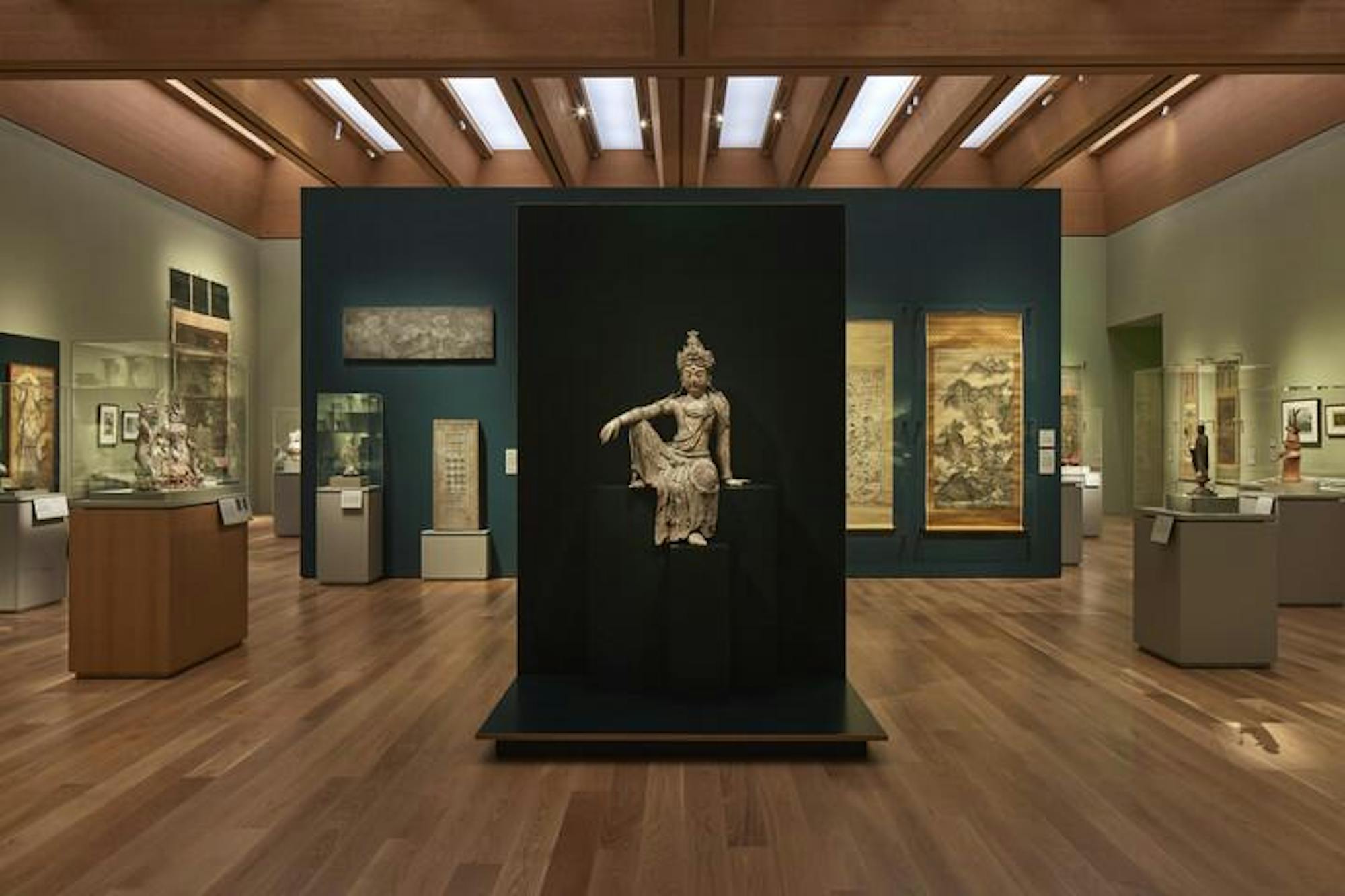
The Guanyin in the Asian Art pavilion.
Courtesy of Richard Barnes
The south-east pavilion of the museum is a second temporary exhibition space. The current exhibition is “Princeton Collects,” celebrating many donations to PUAM over the last four years. The next planned exhibit in the space is “Photography as a Way of Life,” opening April 18, 2026.
The north-east pavilion is dedicated to modern and contemporary art and is also home to one of the three viewing rooms.
The final two pavilions are dedicated to Ancient Mediterranean art (east side) and Art of the Ancient Americas (central, surrounding the Grand Hall). A small section of the second floor is also dedicated to photography.
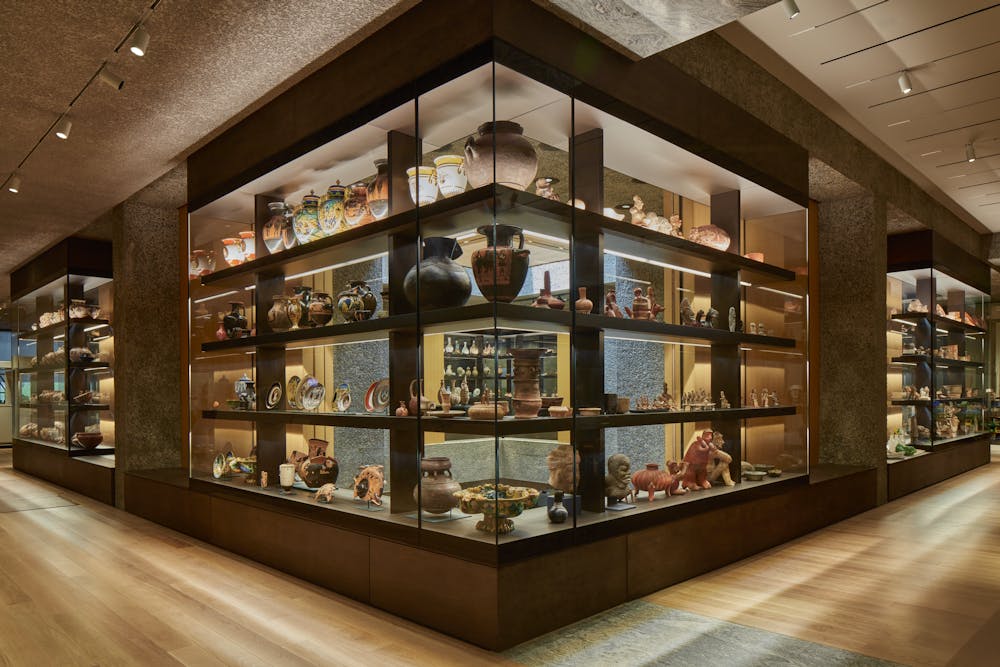
The hallways, meanwhile, feature glass cases embedded in the walls holding “dense displays” — some 400 vases, bowls, and other objects surrounding the Grand Hall from all sides, most aligning with the pavilion the shelving is closest to.
“The curators were asked to put together object displays that visually look very interesting,” Newth said. “It allowed us to bring things out of storage that would otherwise not be on view.”
The second floor also includes three viewing rooms, to take a break, meditate, or get lost in thought, Newth described. Each contains fewer than five pieces of art, with a place to sit and windows looking out onto campus or elsewhere in the museum.
The viewing room attached to the European pavilion additionally houses a grand piano — part of PUAM’s collections — which will be used for programmed recitals, although not for use by a typical visitor.
The museum’s non-gallery space also includes an education center with two so-called “creativity labs” for making art, two seminar rooms, Tuttle Lecture Hall, and five object-study classrooms, with an additional object-study room on the second floor of the museum.
The object-study rooms house additional dense displays of art to be studied in classes throughout the semester. The displays, according to Newth, may change depending on what classes are running.
The previous art museum “hosted about 200 classes a semester,” Newth said. “We’re prepared to use [the object-study rooms] a lot… Students will be able to be in the rooms with the objects on tables.”
Now located in the south pavilion of the building, the conservation studio has been expanded from one room to two floors. The pavilion also contains the sixth object-study room, which will be primarily dedicated to conservation classes.
The third floor of the museum is dedicated to the Mosaic Restaurant and staff offices. Set to open on Nov. 1, the restaurant has both indoor and outdoor seating looking out over the west facade of the art museum and will be open for breakfast and lunch Thursday–Monday.
Smaller details in the museum resonate, too. Scattered throughout the museum, including in the David Nasher Haemisegger Gallery, are a number of wooden benches, carved from trees that were removed during the construction of PUAM. The benches were commissioned as “part of the commitment to sustainability” on campus, Newth said.
The public opening on Oct. 31 will feature movie screenings, Halloween parties and costume contests, and collection tours, among other events.
“If you’re out on the town, please come by afterwards,” Newth said of the Halloween opening. “If people are out and they don’t want to go back to their dorms, they can come over here for a movie.”
Victoria Davies is a head News editor for the ‘Prince.’ She is from Plymouth, England and typically covers University operations and the Princeton University Art Museum.
Please send any corrections to corrections[at]dailyprincetonian.com.
Read More

This Week in History: Murray-Dodge Café Opened Its Doors
Miriam DubeLast week, Murray Dodge Café celebrated 50 years of serving as a relaxed, alcohol-free social space for students. Commemorating decades of free cookies and tea, the ‘Prince’ looks back on how the café overcame various hurdles to open its doors, and the café’s first few months serving students on campus.

‘We still have pride’: Students and faculty react to U.S. News ranking that placed Princeton second
Claire Ding and Albert TanStudents and faculty reacted to Princeton dropping its No. 1 position on U.S. News’s annual university rankings for the first time in 15 years.
Students and faculty reacted to Princeton dropping its No. 1 position on U.S. News’s annual university rankings for the first time in 15 years.

Laptop smashed and TVs damaged in Bowen Hall, investigation ongoing
Sena ChangA laptop and multiple monitors were found damaged in Bowen Hall on Sunday morning. This incident is still under investigation as of Monday.
A laptop and multiple monitors were found damaged in Bowen Hall on Sunday morning. This incident is still under investigation as of Monday.