



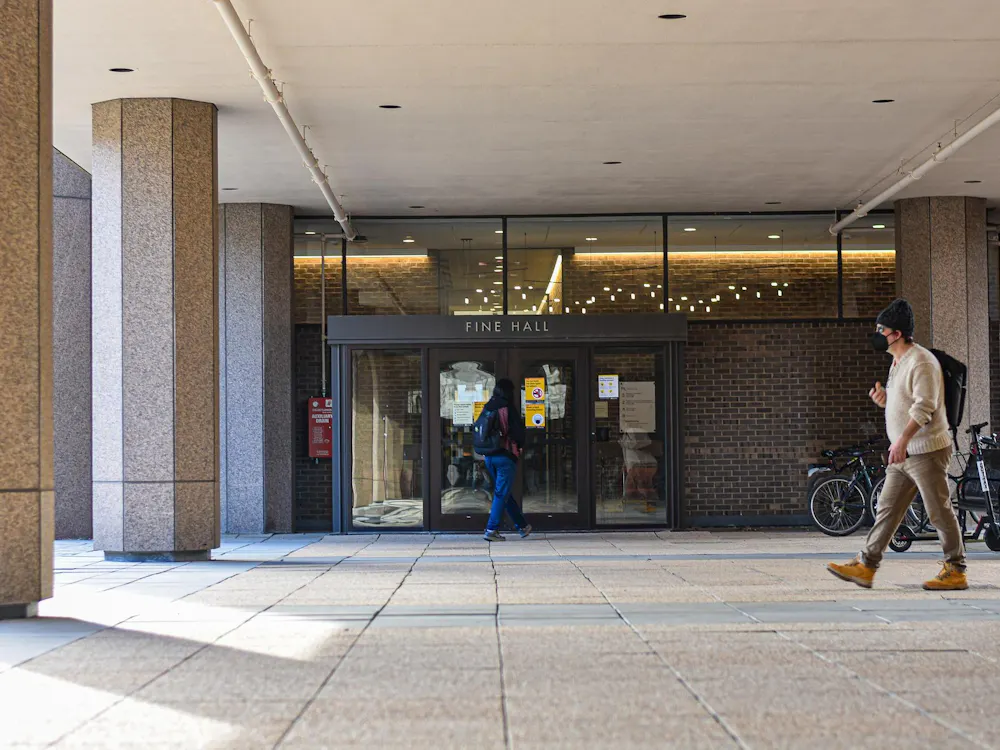
Princeton-born John McPhee '53 "flunked kindergarten in [the] very building" where he spoke last night — 185 Nassau, home to the University's creative writing program and formerly the Princeton Elementary School.
Now a Pulitzer Prizewinning writer and journalism professor associated with the Council of the Humanities, McPhee discussed his writing process and personal history and read excerpts from his work.
He teaches JRN 240: Creative Non-Fiction twice every three years. Many alumni of the class have gone on to successful careers in writing.
English professor William Howarth said McPhee "brings to this context a method that is creative. He has produced 27 books and ... is famous as a reporter who transformed journalism into an art ... McPhee looks at objects closely until they begin to yield ideas."
McPhee began his literary career at Time Magazine and went on to the New Yorker, where he has been a staff writer since 1965. He won the Pulitzer Prize in 1999 and has received two National Book Award nominations along with a 1977 Award in Literature from the American Academy of Arts and Letters.
McPhee opened his reading with a selection from "Notes from Oakmont," an article on the golf U.S. Open published in the Aug. 7 issue of The New Yorker.
He then discussed his personal history, including the time he spent watching football games at the University's old Palmer Stadium, which inspired his career path.
"One miserable afternoon, I looked up at the [heated] press box ... in that moment, I decided to become a writer."

When McPhee writes, he said, "typically I sit all day staring at notes and hoping that something will happen, and eventually, ordinarily, the writing gets going at four or five or even six. If I write two paragraphs I consider myself productive and lucky."
McPhee also read an excerpt from his upcoming book on chalk, which grew out of "Season on the Chalk," an article that ran in The New Yorker in March. The work will meander from graffiti, to vineyards, to Darwin, to geology, using the chalk deposits of Europe and the United Kingdom as a unifying theme.
"He seems like he knows everything about what he's writing about," Emma Ruggiero '11 said. "He goes so in depth [on] the subject."
Read More

NJ AI Hub marks first anniversary with inaugural startup cohort
Zihan (Frank) XuFourteen selected start-ups receive weekly workshops, reverse pitches, corporate introductions, among other guidance over 12 weeks. The “AI accelerator” helps to test each company’s technology and fast-track its path to commercialization.
Fourteen selected start-ups receive weekly workshops, reverse pitches, corporate introductions, among other guidance over 12 weeks. The “AI accelerator” helps to test each company’s technology and fast-track its path to commercialization.
Three Princeton alumni awarded 2026 Fields Medal
Clara DochertyThe three alumni who received the medal are Yu Deng GS ’15, John Pardon ’11, and Jacob Tsimerman GS ’11.
The three alumni who received the medal are Yu Deng GS ’15, John Pardon ’11, and Jacob Tsimerman GS ’11.

Major gift from Leinweber Foundation to strengthen theoretical physics research
Daphne Lewis and Haeon LeeThe University is joining a national network of institutions advancing theoretical physics research, following the major gift. The foundation has committed over $165 million to top fundamental science research institutions during a period of uncertainty for research funding.