News & Notes: 65 students contract gastroenteritis
Ruby ShaoSixty five students have come down with gastroenteritis this month, University Spokesperson Martin Mbugua said.
Sixty five students have come down with gastroenteritis this month, University Spokesperson Martin Mbugua said.
Students at residential colleges will no longer have to sort their recyclable trash. The rest of campus is expected to follow suit by the end of 2014. Unlike the University’s current recycling system, which requires waste to be separated into paper, cans and bottles and “remaining trash,” single-stream recycling only distinguishes between contaminated and non-contaminated materials, Greening Princeton co-president Misha Semenov ’15 said.
Three Princeton graduates launched a nonprofit organization in Sept. 2013 that collects stool samples and provides hospitals withscreened, filtered and frozen material for clinical use. Mark Smith ’09, James Burgess ’09 and Carolyn Edelstein ’10 created OpenBiome, which has already been featured in The New York Times. Edelstein explained that fecal transplants have been proven effective in fighting harmful intestinal bacteria, noting that while antibiotic treatments for the infection are approximately 80 percent effective, fecal matter transplantations, also known as FMTs, are around 89-92 percent effective. Smith explained that the process of an FMT starts far before one heads into the surgical room, noting that an FMT is an extremely complicated process that first requires finding a donor to undergo a very rigorous set of screenings, come in and produce fecal material to be processed.
The Office of Career Services is considering making changes to its current recruiting system by expanding the range of employers and helping students in the recruitment process deal with interviews for different companies that happen at the same time, according to Executive Director Pulin Sanghvi. Sanghvi explained that Career Services will be pursuing a technology strategy inspired by the dating website eHarmony. "We will pursue a strategy inspired by eHarmony, in which we actively capture evolving student interests and preferences, and then use that information to build relationships with the organizations they are most interested in, and create more informed matches," he said.
The University has investigated at least one serious medical case as a potential adverse reaction to the meningitis vaccine, although a link was deemed unlikely in that case. An undergraduate student was sent to the University Medical Center of Princeton at Plainsboro less than 24 hours after receiving the vaccine with a condition ofrhabdomyolysis, an acute breakdown of muscle tissue that causes muscle fiber and protein to be transferred into the bloodstream, risking severe kidney damage. Although the vaccine may have had a temporal correlation with the student getting rhabdomyolysis, specialists at University Health Services and the UMCPP said they do not believe the vaccine directly caused the condition. There has been no past correlation between rhabdomyolysis and the meningitis vaccine in Europe and Australia, where the vaccine was approved for use. Dr. Peter Johnsen, director of medical services at UHS, said that two specialists who observed the case both determined that the student’s illness was not related to the meningitis vaccine. “We posed that question to specialists in the hospital and another specialist, and in both cases, they felt that it was not likely to be related,” Johnsen said.
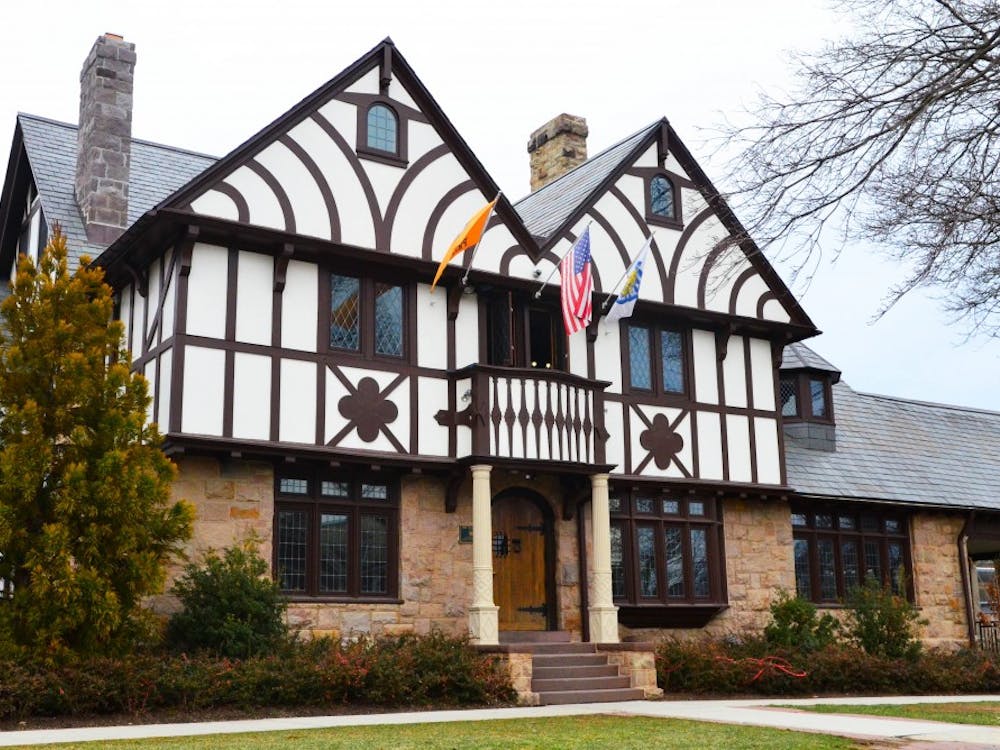
Terrace Club accepted 13 new members during second-round sign-ins, club president Christopher St John '15 wrote in a statement. While Terrace took members in the second round of sign-ins, it did not offer membership to everyone who listed it as a second-round choice, The Daily Princetonian independently confirmed.
Club Nom, an initiative started by Hannah Rosenthal ’15 to facilitate dialogue between upperclassmen in eating clubs and those in other eating options, held its first event at Cloister Inn on Wednesday. The initiative will hold 10 dialogues in each of the participating clubs this semester.
An online petition for a new vegetarian co-op has been circulating on campus since Feb.
James Weldon ’16 will serve as the new Class of 2016 social chair, the 2016 class council announced in an email to the sophomore class on Tuesday. Molly Stoneman ’16 vacated the position after she won her bid for USG vice president in the November elections. Weldon was chosen out of approximately 20 applicants, Class of 2016 president Justin Ziegler ’16 said.
Individuals who received the meningococcal disease vaccine were not originally eligible to donate blood because of the vaccine's unlicensed status in the United States.
Both Forbes College and Whitman College will be participating in a pilot exchange program, Global Exchange, with schools in Hong Kong and Cambridge, United Kingdom this upcoming spring break. Five students from Forbes will spend the break at St.
Despite an increase in the number of bickerees, the overall acceptance rate for selective clubs was higher than last year's with 63.7 percent, or 563 of 884 students, accepted.
An undergraduate student was arrested by the University's Department of Public Safety and charged with drug possession on Sunday night. Thomas Fellowes ’14 was arrested by DPS after officers allegedly found marijuana and prescription drugs in his dorm room, University Spokesperson Martin Mbugua said Thursday.
Hafiz Dhanani ’16, the creator of Luminate, has been accused of borrowing formulas developed by the founders of a supplement company called Natural Stacks without giving due credit.
Members of Terrace F. Club picked up 130 new members Sunday night after the first round of sign-ins, president Christopher St.
Terrace Club is developing plans, still in their early stages, to renovate its clubhouse.
In its final meeting of the year Sunday night, the USG Senate unanimously passed a series of constitutional amendments that require the class governments to report their budgets and hold monthly meetings.
Eating club members now have the opportunity to complete "Agent of Change," a pilot online Sexual Harassment/Assault Advising, Resources and Education course on power-based personal violence. The course wasdesigned to build on the knowledge gained through the course“Unless There’s Consent,”a new program required for all members of the Class of 2017 prior to their arrival on campus.While “Unless There’s Consent” was intended to lay an informational foundation for incoming freshmen prior to orientation week, “Agent of Change” is more interactive, providing education on bystander intervention skills, SHARE director Jacqueline Deitch-Stackhouse said. The hour-long course touches on sexual assault, stalking, domestic violence and degrading language, Jackie Cremos '14, aSHARE Peer Advisor and member of Quadrangle Club, explained.
Hafiz Dhanani ’16 has created a supplement called Luminate that he says helps increase focus, which he hopes to sell to Princeton students. “Luminate is a natural supplement,” Dhanani said.
Three hundred and fifty-six students have registered for the pilot Wintersession program as of Sunday, USG U-Councilor Laura Du ’14 told The Daily Princetonian. According to Du, 35 classes were registered when the website first launched on Dec.