Are "flipped" humanities courses viable?
Aaron RobertsonIt may be time to open Pandora’s box. I am speaking, of course, about the feasibility of integrating mixed modes of learning into Princeton’s humanities courses.
It may be time to open Pandora’s box. I am speaking, of course, about the feasibility of integrating mixed modes of learning into Princeton’s humanities courses.
Updated 11:03 p.m. Nov. 17, 2013 Recently, the Undergraduate Student Government announced the candidates running in its upcoming 2013 elections.
There has been a trend in the past four decades of University students shying away from the humanities in favor of science, technology, engineering and mathematics (STEM). The world is becoming increasingly technology-centric.
I decided my major in literally a split second. I was sitting in a room in 1879 Hall waiting for precept to begin, when I realized—suddenly — I was content.
Princeton’s website explains that distribution requirements “transcend the boundaries of specialization and provide all students with a common language and common skills.”Currently, the University requires A.B.
As I write these articles, I often wonder if this is what I could do for a living. When I wrote for my high school newspaper, I did not muse with such audacity.
It had already been a particularly grating night when I trudged my way to the Wa. I had already set off the fire alarm (twice) burning popcorn in Witherspoon, and the U-Store employees had shut the doors on me as I wildly gesticulated toward my phone, which read 3:59 a.m.
Princeton recently obtained another trophy to place right next to its rank as the No. 1 college in the country: top honors in Trojan’s 2013 Sexual Health Report Card.
Before I came to Princeton, I thought of college as it was portrayed in the movies. Perhaps naively, movies like "A Beautiful Mind"or "Mona Lisa Smile"came to mind.
Whenever today's college students tell people back home (especially of older generations) about what they’re majoring in, the inevitable response (either direct or implied by snide facial expressions) is usually either “good for you; that’ll really put you on the fast track” or “what are you going to do with that after you graduate?” For most people whose major is not an obvious moneymaker, a common justification (though certainly not the only one) is moral or philosophical, something along the lines of "life’s too short" or "I’d always regret it." I think a better justification can be found in economics. Before the mid-20thcentury, conventional economic wisdom said that most people behave as "wealth-maximizers" and, given a choice, would choose the path that gave them the most expected money.
I had a rough start one morning, so I decided to catch the bus from Whitman to Clio Hall to make it to my opening shift at Marquand Library.
For anyone who is a fan of the dying art that is late-night comedy, you might be aware of “Saturday Night Live” member Kenan Thompson’s slightly controversial interview in which he explains why he thinks the show has yet to cast a black female.
I recently had the pleasure of attending a small dinner lecture delivered by W. Barksdale Maynard ’88 on the topic of Princeton’s architectural history, from which I gleaned many a delightful tidbit of information about this place that we students from all four corners of the earth have come to call home.
Last week, The Daily Princetonian published a news article about a petition circulated by graduate students that opposed the demolition of the Butler Apartments.
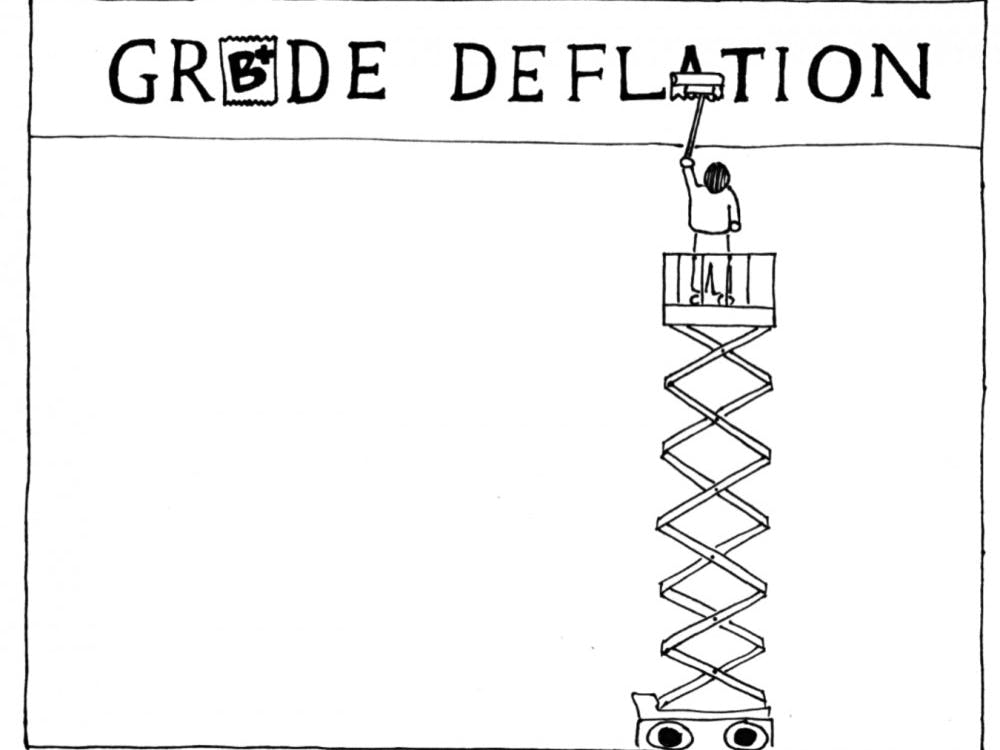
Since President Eisgruber announced his intention to create a committee to re-evaluate the controversial policy known as grade deflation, the initial furor (or excitement, or even optimism, might be better words) among the student body has largely settled down.
Toward the beginning of this academic year, Shawon Jackson sent out an email to the class of 2017 asking if they would like to participate in the Princeton Women’s Mentorship Program, now entering its third year.