



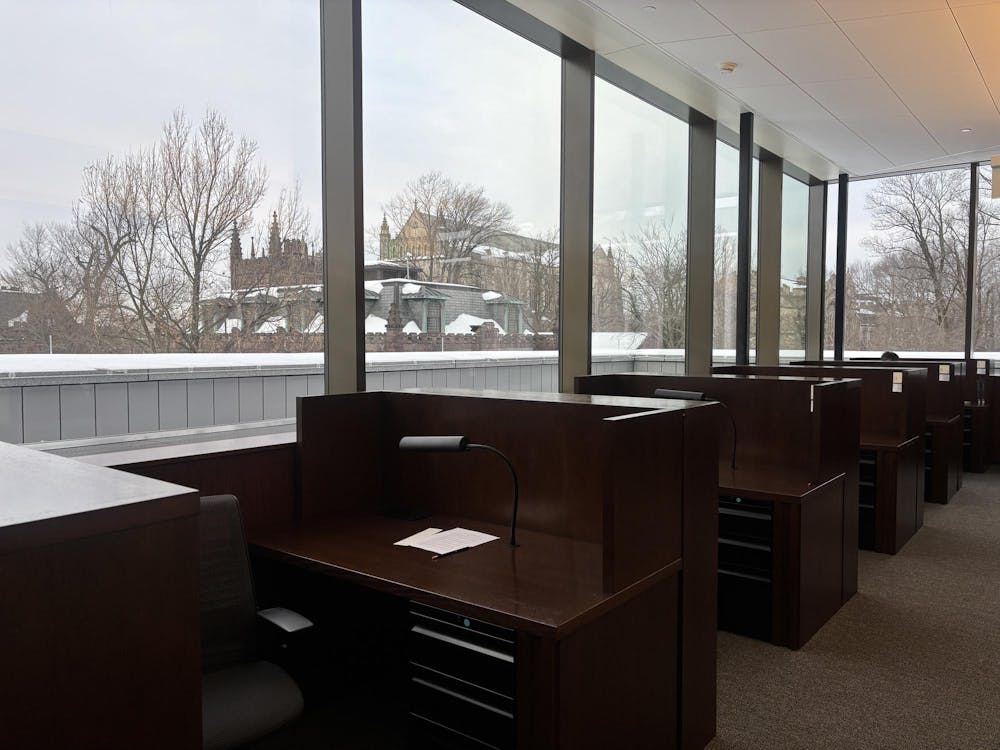
After five years of renovations, the Marquand Library of Art and Archaeology reopened on Tuesday in the Princeton University Art Museum complex. The five-story facility offers new study spaces and improved access to the library’s extensive stacks and rare book collection.
Although the rest of the museum complex was officially opened to the public on Oct. 31, the library’s opening came three months later as additional time was required to move books and special collections from temporary storage.
“This is really one of the most wonderful libraries in the world, and I’m really proud to be the director [because] we are able to serve patrons both here at Princeton and around the world,” Holly Hatheway, the library director, said in an interview with The Daily Princetonian. Hatheway, along with Anne Jarvis, the University librarian, spoke at the library’s opening event on Friday afternoon.
The opening, originally set for Monday, was delayed due to this weekend’s snowstorm.
Marquand Library houses over 500,000 volumes and a special collection of rare books, scrolls, and other ephemera dating back to the 15th century. Four floors of the new space contain stacks open to patrons and organized by book size, ranging from Octavo (standard) to Folio (oversize). Items from the locked Elephant Folio collection can be accessed in the Charles Rufus Morey Rare Book Reading room by request.
The library’s collection was started by Professor Allan Marquand, the founder of the Department of Art and Archaeology and the first director of the University Art Museum. Marquand taught at Princeton for over 40 years before retiring in 1922. He gifted his collection of 5,000 works of mid- to late-19th century literature to the University and endowed the library, according to Hatheway.
“He really was instrumental in the development of this whole discipline at Princeton,” Phoenix Nutter, a collections specialist at the library, said in an interview. Nutter explained that the library has remained “entirely focused on the fine arts,” allowing them to collect “deeply” in those areas.
“We have unique items when it comes to the history of art, unique artists’ books, things that are very special and very beautiful,” Nutter said.

Nutter also emphasized that the library is not solely for those studying Art and Archaeology. “We’ve already had a ton of people come in, and it’s great as a place to study and work. You don’t have to be studying art.”
“There [were] special things that we did for our opening today. We have some swag, some pencils and bookmarks,” Ryan Gerber, Marquand Library Operations Supervisor and Special Collections Coordinator, told the ‘Prince.’
“The special thing was seeing patrons who have been waiting to be in this place for five years, their eyes light up when they see their [study] carrels, or they see the collection,” Gerber said.
Along with long-term library patrons in the Department of Art and Archaeology, many undergraduate and graduate students visited Marquand for the first time to study.
The floor-to-ceiling windows on the first floor drew Maddy Denker ’27 and Sophie Miller ’27 to the new space. “I feel like a lot of the libraries are typically very dark, but this one seems to have a lot of light, and I didn’t realize how big it was,” Denker said.
“It’s so beautiful inside,” Miller told the ‘Prince.’ “I love being able to sit at one of the tables with friends and just do some work and watch the snow on the ground and watch people walking by outside on McCosh Walk.”

“The only thing I don’t like is that you can’t bring your water bottle [inside],” Denker said, referencing the library’s strict no-food and no-beverage policy. However, she and Miller both anticipated returning to study often in Marquand.
Gerber explained that because "there’s no food or drink allowed in this space, it allows us to have more actually in Open Stacks for [students], rather than squirreled away in the vault.”
“Hopefully, undergrad and grad students alike will use the stacks for its unique and vast collection of art history books that is unmatched by most art history libraries in the country,” he said.
Leela Hensler is a staff News writer and a staff Sports writer for the ‘Prince.’ She is from Berkeley, Calif. and can be reached at leela[at]princeton.edu.
Please send any corrections[at]dailyprincetonian.com.
Correction: A previous version of this article said that the library’s opening event was on Tuesday morning. It was, in fact, on Friday afternoon. The ‘Prince’ regrets this error.
Read More

Forbes renovation scope still undecided as Hobson prepares to open
Gus Vogel and Daphne LewisAs Forbes students prepare to become the first cohort to live in Hobson College next year, specifics on Forbes' own renovation remains unsettled by the University nearly six months after the University announced it was accepting consultant bids for a campus-wide dorm renovation plan.
As Forbes students prepare to become the first cohort to live in Hobson College next year, specifics on Forbes' own renovation remains unsettled by the University nearly six months after the University announced it was accepting consultant bids for a campus-wide dorm renovation plan.

Prospect Picks: back to school
Kaichen Chou, Gavin McLoughlin, Mia Mazzeo, Amaya Taylor, Amy Jeon, and Ysabella OlsenEditors of The Prospect write about their recent favorites in media, trends, and food.
Editors of The Prospect write about their recent favorites in media, trends, and food.
Princeton Council details historic guidelines for property owners
Kimberly HutchinsonThe Princeton Council discussed the municipality’s recently-released final draft of historic guidelines at its Monday meeting. These 250-page guidelines seek to provide property owners with greater clarity on the current historic ordinances in Princeton.
The Princeton Council discussed the municipality’s recently-released final draft of historic guidelines at its Monday meeting. These 250-page guidelines seek to provide property owners with greater clarity on the current historic ordinances in Princeton.