




Not two months ago, with a zeal I’m sure was shared by each and every one of my 1,413 incoming classmates, I split the spine of my Princeton-embossed copy of Maryanne Wolf’s “Reader, Come Home”: the annual Pre-read for the Class of 2030.
In a series of nine lengthy letters saturated with neuroscience, philosophical theory, and a whole lot of jargon from both fields, Wolf examines how technology has stymied readers’ ability to generate personal insight and interpretations beyond the texts we encounter. She suggests developing a “biliterate” reading brain: a mental framework allowing for active adjustment and attenuation of readers’ focus as they inevitably flit between print and digital mediums. In this capacity, “Reader, Come Home” meticulously follows the self-help model: It tells you your problem and promises an intellectual regimen to help you solve it.
But it’s precisely its didacticism that makes “Reader, Come Home” the wrong choice for the Pre-read. When a book that is supposedly the institutionally-sanctioned foray into Princeton’s intellectual culture doesn’t carve out any room for nuance, students get little practice in critical thinking nor fodder for meaningful, exciting discussion. If Princeton truly wants its incoming first years to spend meaningful time with a text and ask questions of it, one another, and themselves, it should assign them to read a work of fiction instead.
But because “Reader Come Home” sought to inform more than to challenge, it was the wrong choice for this year’s Princeton Pre-read.
University President Christopher Eisgruber ’83 first launched the Pre-read tradition in 2013, hoping to give incoming first-years a taste of Princeton’s “intellectual life” through a summer reading assignment. Since its inception, the program has included an impressive repertoire, including “This America” by Pulitzer-winning historian Jill Lepore, “The Worlds I See” by AI godmother Fei-Fei Li ’99, and “How to Stand Up to a Dictator” by Nobel laureate Maria Ressa ’86, among others. But selections were consistently dominated by intensely-researched, monograph-like works of nonfiction.
Nonfiction absolutely has the potential to challenge its readers. Particularly, it can encourage them to question aspects of their reality to which they might not otherwise have paid much attention: In Wolf’s case, those are the neurological processes by which we read and succeed or fail to derive meaning — the mechanisms enabling you, right now, to digest this sentence. But such works present arguments, and often attempt to drive home an empirical point, carving less room for a range of responses than fiction would.
A story that’s intellectually ambitious and philosophically provocative doesn’t necessarily have to be nonfiction. A fictional text can help us understand political tensions or erosion of autonomy just as much as an explanatory novel can. Any reader of George Orwell could learn just as much about dictatorship and autonomy as a reader of Maria Ressa.
The pre-read should influence how we think, not what we think. Repeatedly assigning didactic pre-reads indicates the University’s desire to attach itself to trendy issues — digitization of the reading landscape, AI, democracy — more than its commitment to students’ learning. Students would be better served by actually reading and engaging with the work of making meaning from narrative: working through the manifold interpretations of a text’s project, characters, themes, and techniques.

Another advertised goal of the Pre-read — perhaps the ultimate goal — is the discussion with Eisgruber and, most importantly, our peers, both in and out of formal settings. Discussing a novel rather than a didactic text might create more nuanced and expansive discussion as well as help Princetonians learn how to engage in a contentious political climate by defending their varying opinions, interpretations, and readings.
But a significant issue with assigning Wolf’s book, and with the discussion that followed, is that the loop of analysis and discussion was fairly confined: There’s not much to ask about the book besides what it tells about what’s wrong with us, and how it suggests we might fix it. In my small group discussion, our conversation was limited to how we could apply the book to our lives, crowding out more nuanced engagement with abstract principles. Assigning fiction reading would not represent a detachment from the real world and real issues but rather demand that students’ critical thinking skills move up a notch. From fiction comes questions about where we see ourselves in the space and time of the novel, about how human feeling is represented or repressed, and ultimately about how we articulate our experience to ourselves and to others in language.
Nature Magazine lauds “Reader, Come Home” as an “antidote for today’s critical thinking deficit.” But I’d caution against both this assessment and its rhetoric. At its best it is woefully quixotic, and at its worst dangerously fatalistic. Books aren’t messianic bandaid-fixes to societal wounds. They aren’t supposed to be the singular answer to the question of our flawed condition. Ironically, nowhere is this viewpoint more explicit than in Wolf’s text itself: Absent our physical response to the “clarion call” — the recognition that we ought to actively re-engage our “contemplative dimensions” — all we’ve managed to do is outsource our agency to whoever can synthesize the neatest, most digestible instructions. Literature isn’t a panacea for a bigger issue, but texts have the ability to be a space for both attention, imagination, and critical thinking.
Rather than prodigally thinking about why we should read long, challenging books, let’s use the Pre-read to do it. Teach us, through active practice, how to exercise that “atrophying” muscle — as Wolf would say — of critical and close reading. Books aren’t antidotes to all the world’s problems, but the things they inspire us to think and do might just be.
EmmaRose Zilla is a first year contributing Opinion writer from Brookline, Mass. She can be reached at erzilla[at]dailyprincetonian.com.
Read More
Bring back Communiversity
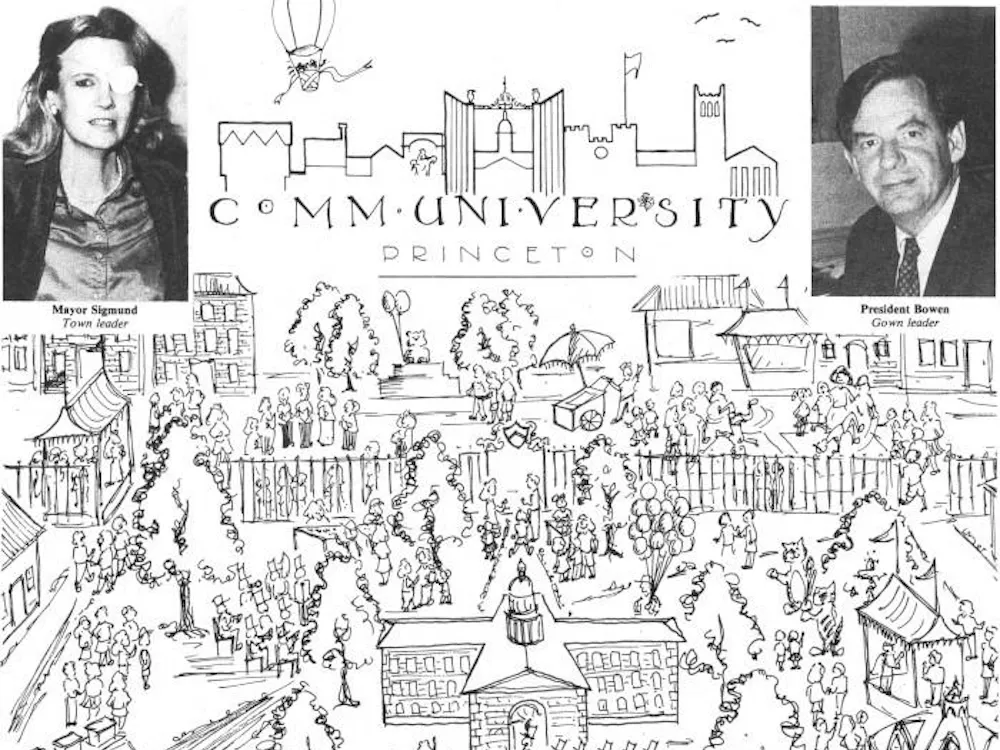
Isaac BarsoumFrom its inception in 1985, when it subsumed the Arts People Party — the Arts Council’s pre-existing festival — Communiversity always aimed to be more than just an arts festival. It was both a physical and symbolic coming-together of the University and the town in a celebration of all that we have in common and all that makes us different.
From its inception in 1985, when it subsumed the Arts People Party — the Arts Council’s pre-existing festival — Communiversity always aimed to be more than just an arts festival. It was both a physical and symbolic coming-together of the University and the town in a celebration of all that we have in common and all that makes us different.

Who rights our rules?
Charlie YaleWith fairness for students in mind, the University must require that all changes to RRR go through the Committee on Rights and Rules.
With fairness for students in mind, the University must require that all changes to RRR go through the Committee on Rights and Rules.
Freedom of speech is a right, not an excuse
Lily Halbert-AlexanderFreedom of speech should function to hold us to a high standard of honesty and transparency, not to excuse abuses of power and influence in the country’s most influential institutions.
Freedom of speech should function to hold us to a high standard of honesty and transparency, not to excuse abuses of power and influence in the country’s most influential institutions.