



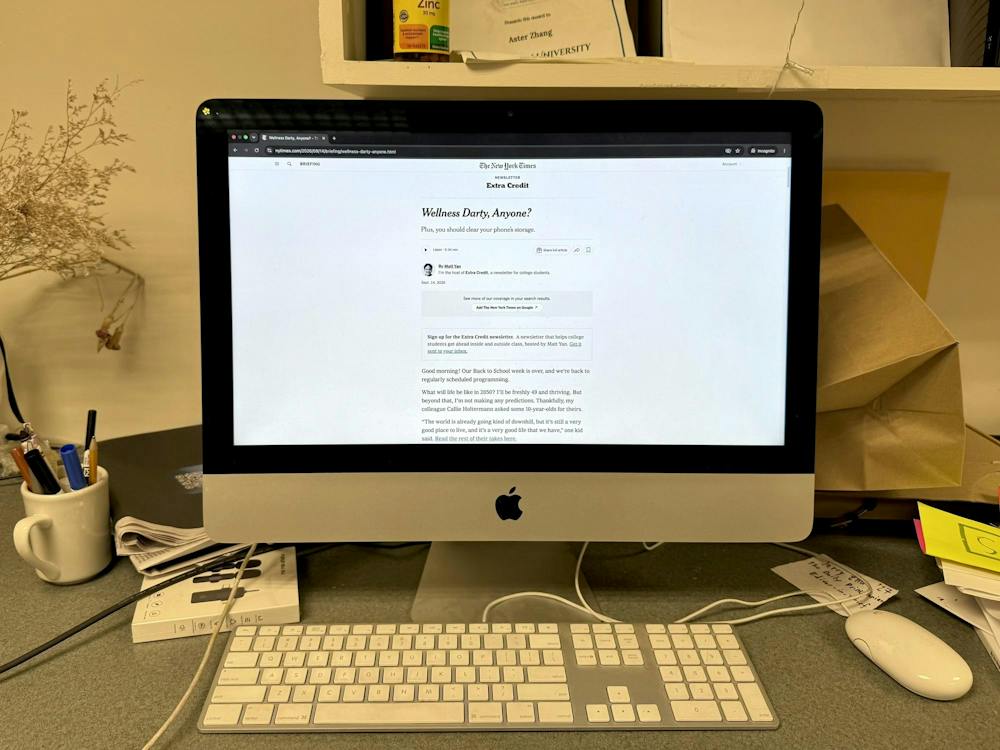
“What you need to know to be the smartest person in class today”. “The stories about to hit your group chat”. A link to share your “class crush” or “fit-check,” or questions about a news story that was too confusing for you to handle. These may sound like they come from the insecure mind of a newly-minted middle school student wearing Jordans three sizes too big, but I’ll have to disappoint you: they’re the features to The New York Times’ rebranded newsletter catering specifically to a collegiate audience, previously termed “In Short” and now newly dubbed “Extra Credit.”
Read alongside the Times’ other newsletters with titles as grand as their scopes of coverage — “On Politics” or “The World,” for example — “Extra Credit” points to a dire reality: The journalists of the most widely-read media outlet in the United States think that college students read the news to be … performative intellectuals? To outperform their (hot) peers in class?
I was initially thrilled to see a newsletter catering to my community through intentional accessibility, but was left feeling patronized and worried. And you should be too, reader. It’s clear from the framing of this newsletter that journalists in the biggest news outlet in America think that college students cannot process or draw meaning from the news without handholding and without the added incentive to perform superficial intelligence to their peers. But perhaps the language of this newsletter is just the visible edge to the deeper and widening problem of media illiteracy. It’s ultimately up to students themselves to continue reading the news for its most critical purpose: to prepare one for an informed and democratic life outside of the classroom.
Newsletters carry a centuries-old legacy, stretching back to handwritten news summaries in the eighteenth century. Their lasting popularity is for a good reason. Newsletters curate an information diet that ensures its readers get the biggest hits, digestible in a time frame that fits into a busy day. You can pick and choose the kinds of newsletters that you know you will read, which land in the exact same place every day: your email inbox. Major outlets like The New York Times, The Guardian, and The Wall Street Journal offer a plethora of newsletters to their readers, and independent writers on platforms like Substack can even create and send their own. Major outlets also provide a balanced and fact-checked overview of the news that matters, which is more than social media can say.
I myself read newsletters more frequently than I do actual news pieces. I often don’t have the time to click on every single headline that strikes my interest, and newsletters do a great job of fulfilling their purpose: summarizing the most important and relevant happenings to me so that I can decide whether I want to read the full piece behind it. (Thank you, by the way, for taking the time out of your day to read this column.) And there’s nothing wrong with a lighthearted newsletter: I love jotting down a good dessert recipe from the Times’ “Bake Time,’’ or seeing I’m not alone in deciding how to confront the writer of a clearly AI-generated piece of writing on “Good Advice.”
Newsletters are everywhere, and they indubitably comprise an important part of the American news diet. So why am I catastrophizing about this one? Is it so wrong that news for college students be a bit more fun or accessible, especially in an era where less and less young people are reading the news at all?
I remain worried about this newsletter’s framing because I know that for many of my peers, a newsletter like “Extra Credit” might be the only source of news they might read outside of social media. Outlets with prominent institutional reputations like The New York Times have the power and responsibility to make readers watch and listen, which means they are in a unique position to help people understand why longform news matters, and why they should read more of it. The problem with “Extra Credit” is that it isn’t operating as a summary or primer which prepares and encourages its readers to engage further — to read interviews, investigations, and essays that make us ask questions and be critical about the world around us.
Instead, it markets itself as enabling low-work, high-reward engagement with the news: You’ll extend the minimum effort and appear, on the surface, to be relatively well-informed. It seems eager to frame itself as a form of news that isn’t itself so different from social media at the precise time when more shortform news is the last thing we need.

The notion that a newsletter should help you look smarter than your peers squanders an opportunity to encourage college students to think and read critically about their world in an era that The Atlantic’s Rose Horowitch has described as postliteracy: passive engagement with short form content. The New York Times is missing an opportunity to ask its readers: Why should you care?
It’s a story I’m sure is familiar to most: The most common way young people are getting the news today, it seems, is to follow political influencers on TikTok or Instagram, or swipe through bite-size summaries of popular articles one can easily digest and repost. But, at risk of pointing out the obvious, social media is prone to mis- and disinformation. You are less likely to get balanced or fact-checked coverage. Importantly, social media posts of news articles depict only a fragment of the argument or information that the author intended to convey. If social media was a good enough source for news, we wouldn’t have journalism longer than three sentences.
Newsletters also convert nuanced pieces into bite-sized nuggets, but they often support engagement with long-form journalism. They are often structured to invite readers to engage with the entire piece, by including direct links to articles instead of directing readers to an entirely different link or application, as it often goes on social media where the article is separated from the medium. They also give a more balanced overview of the issues that matter — you might miss a social media post if you don’t scroll enough at a certain time or if your algorithm sets you against it. And unless you care deeply about your news diet, you’re unlikely to subscribe to a plethora of newsletters from various outlets that truly gives you a balanced and extensive coverage.
Outlets like the Times — and dare I say, outlets like the ‘Prince’ — are unique in their proportionally large readership, even amongst those who might not particularly care much about the aim and purpose of journalism as a whole. I have friends who care very little about journalism as a discipline, but they know and read — at least on occasion — The New York Times. I don’t think the fate of journalism or the world hinges on a Times newsletter, but it’s a symptom of a larger problem that outlets have the power to ameliorate.
It ultimately rests with us, as college students, to work against this newsletter’s assumption about our interests and abilities as newsreaders. So read longform news to be a better scholar, yes, but also a better citizen: someone who cares about the intricate workings of our democracy and our role and power within it. Subscribe to The Daily Princetonian’s newsletter, too. But I hope that, at least on occasion, you read the full pieces that make the newsletter — and the ‘Prince’ as a whole — possible.
Siyeon Lee (she/her) is a senior Opinion writer from Seoul, South Korea studying History. She thinks that good news is food for thought, but newsletters are only the appetizer. You can reach her at siyeonlee[at]dailyprincetonian.com.
Read More

Keep academic advising human only
Shane McCauleyWhen generative AI threatens academia in so many ways, both structurally and symbolically, it’s nonsensical for colleges to encourage its uptake through a tool that doesn’t really work in the first place.
When generative AI threatens academia in so many ways, both structurally and symbolically, it’s nonsensical for colleges to encourage its uptake through a tool that doesn’t really work in the first place.

The real crisis on campus isn’t cheating, it’s thinking
Jack GoodmanFurther, a growing body of research confirms that use of generative AI undermines the cognitive effort that is essential to the development of the human brain. As AI use increases, learning, recalling, and critical thinking skills decline.
Further, a growing body of research confirms that use of generative AI undermines the cognitive effort that is essential to the development of the human brain. As AI use increases, learning, recalling, and critical thinking skills decline.

Trust in academia is at a low. Can Writing Seminar help?
Ian RosenzweigAcademia has a PR problem, and no amount of insular critical inquiry is going to solve it. Writing Seminars should live up to their name and teach us not just to solve thorny research problems but also to effectively communicate our solutions through clear and — perhaps more importantly — stylistically compelling prose.
Academia has a PR problem, and no amount of insular critical inquiry is going to solve it. Writing Seminars should live up to their name and teach us not just to solve thorny research problems but also to effectively communicate our solutions through clear and — perhaps more importantly — stylistically compelling prose.