



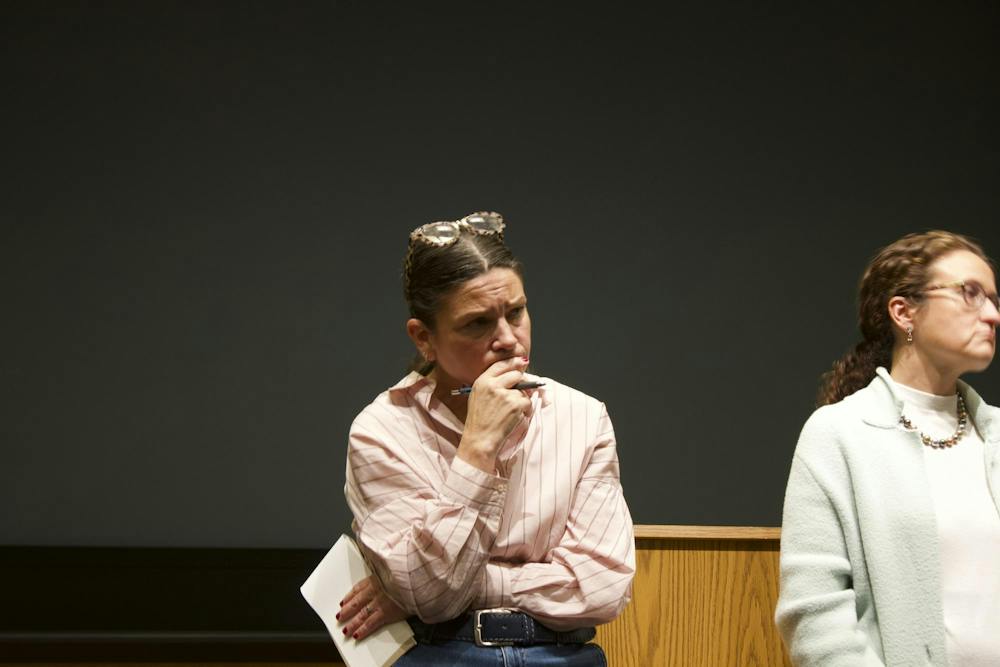
At their Sunday meeting, Undergraduate Student Government members spoke with Executive Vice President Katie Callow-Wright about the search process for the next vice president of campus life, approved a resolution calling for chalking to be permitted on campus, and furthered discussions about election reform.
USG President Quentin Colón Roosevelt ’27 opened the meeting by introducing Callow-Wright, Ruth Shoemaker Wood, a managing director at DSG Global, which is overseeing this executive search for the University, and Bruce Easop ’13, a former USG president and associate director of administrative planning in the Office of the Executive Vice President. As the leader of the search committee, Callow-Wright noted that her goal for the meeting was to “get some feedback … some ideas about both the person who will be the next vice president, as well as what you want these folks to know about Princeton and about Princeton’s student experience here.”
“Calhoun has got some pretty big shoes to fill,” Callow-Wright said. “She is somebody who has proven that she has led and can lead with kindness, with care, [and] with a lot of wisdom and expertise in her area.”
With the search process launching soon, Callow-Wright stated that she wants to find the “most talented student affairs leader who’s out there,” and wants USG members to have input before the highly confidential process begins.
Several students emphasized Calhoun’s visibility around campus and hopes that the next vice president of campus life emulates her approachability.
“I would see [Calhoun] all around campus, and I think you absolutely need that in someone that’s supposed to be a face to the student body,” U-Councilor Ian Mann ’28 said. “Someone that just stays in their office all day probably won’t make those connections.”
USG Treasurer Marvel Jem Roth ’28, who served on a search committee for assistant vice president for campus dining last year, added how crucial student input is to the selection process. Roth emphasized the importance of the next vice president being attuned to Princeton’s distinct student culture, rather than simply possessing a resume that checks off a list of qualifications.
An experienced candidate is different from someone who “embodies what it means to be a part of Princeton,” USG Academics Chair Isaac Bernstein ’28 added. “Someone that kind of lives and breathes Princeton, doesn’t just view it as employment, but rather a place to call home.”

Bernstein is a former staff News writer for The Daily Princetonian.
The selection committee will include two student representatives — one undergraduate and one graduate — whom Callow-Wright will select based on their involvement in campus leadership and good standing in the eyes of the student body. It was not immediately clear if appointments to the committee have been finalized yet.
Mann, however, expressed concern about only choosing students in elected leadership positions, citing that student leaders in areas of campus beyond the USG have valuable feedback and are often underrepresented in spaces like selection committees.
“If our selection procedure relies on administrators choosing people [who] think they would be good… It will look like this room … and there are a lot of aspects of campus life that don’t look like that,” Mann said. “Just because someone isn’t on USG doesn’t mean they’re not qualified [to be on the committee].”
Class of 2027 President D’Schon Simmons also discussed Calhoun’s response to student protestors during the 2024 “Gaza Solidarity Encampment.” “I think regardless of whatever side you stood on in the protests, I think the entire University community had high tension, and I think that’s something we should address … I look forward to the new vice president of campus life being someone that students can still believe they can engage with, even when they strongly disagree with the administration,” Simmons said.
U-Council Chair Isaac Barsoum ’28, when discussing the encampment, also added the importance of having administrators who treat every member of the student body fairly.

Barsoum is an associate Opinion editor for the ‘Prince.’
Though the candidate screening process will begin soon, in-person interviews will not commence for several months. Callow-Wright encouraged students in the room to share their input with her from now until the Spring.
“These are fairly quiet, comprehensive processes, generally speaking. So I will not be coming back throughout the year [to] give you guys a lot of updates, Callow-Wright noted. “That means that we need to get a lot of input on the front end,” she added.
The meeting continued with the unanimous approval of a resolution to advocate for a repeal of the ban on chalking on campus. The 1995 chalking ban — issued after LGBTQ+ positive messages were written on campus property — was, according to Roth, “an overreach into student free expression efforts.” Presented by Barsoum and Roth, the resolution calls on the University to overturn the policy.
“I’m really excited about this move,” Barsoum said. “I think that it’s an important step forward for free expression at Princeton to allow chalking, and I’m looking forward to working with Dean Crotty and other members of the University administration to push it forward,” in reference to Dean of Undergraduate Students Regan Crotty ’00. Recently, Barsoum published an opinion piece in the ‘Prince’ advocating for an overturning of the chalking ban.
Colón Roosevelt and Barsoum then presented the results of a USG elections reform straw poll conducted on Tuesday. Following the contentious debate surrounding slate limitations at last week’s meeting, as well as a special meeting to discuss the topic on Tuesday, the poll asked USG members if they support any changes to the joint campaign system and, if so, what restrictions they believe would be necessary.
Twenty-one of the 26 voting Senate members completed the form; 52.4 percent said that reform is needed, while the other 47.6 percent — split half and half — said they were either unsure or did not support reform. Though the majority of the Senate indicated that it was interested in reform, the poll results showed no consensus on what changes should actually be implemented. Imposing cash “penalties” on larger slates and restricting the number of candidates who can be members of joint campaigns had the most votes, but neither reached a majority, with nine and 10 members expressing support for each approach, respectively.
Given the contentious nature of the proposed reforms and the fact that five Senate members did not respond, it was unclear if any measures would garner majority support before the Winter election cycle, which starts on Nov. 9. Barsoum introduced a plain-language proposal to combine some of the more popular measures, including a limit on the number of people who can join a slate, an introduction of unlimited unilateral-only endorsements, and a ban on spending from endorsers on behalf of endorsees.
“I can’t necessarily speak to a unified strategy on this front, but I would favor a measure to change winter elections, but one that would not take effect until next year,” Barsoum said in an interview with the ‘Prince.’ “A measure to change winter elections that we do now would put an undue burden on our chief elections manager and also deputy elections manager.”
USG meetings are open to the public and held weekly on Sundays at 5 p.m. in Robertson 016.
Claire Ding is a News contributor for the ‘Prince’ from Cherry Hill, N.J.
Please send any corrections to corrections[at]dailyprincetonian.com.
Read More

Amid budget cuts, Princeton Annual Giving campaign raises second-highest amount in history
Benedict HooperPrinceton’s Annual Giving campaign raised $79.6 million in 2025–26, its second-highest total ever, even as alumni participation continued to decline amid broader University budget uncertainty.
Princeton’s Annual Giving campaign raised $79.6 million in 2025–26, its second-highest total ever, even as alumni participation continued to decline amid broader University budget uncertainty.

‘Now Princeton has gone and done it’: The Critical Languages Program and its former students
Lucia ZschocheThe Critical Languages Program, which ran between 1963–1972, gave students — both men and women — from partnering universities the opportunity to attend Princeton. Its students look back on their experiences and the program’s legacy.
The Critical Languages Program, which ran between 1963–1972, gave students — both men and women — from partnering universities the opportunity to attend Princeton. Its students look back on their experiences and the program’s legacy.

A review of “Primetime”: Lance Oppenheim’s daring, bizarre “To Catch a Predator” film
Gavin McLoughlinHead Editor for The Prospect Gavin McLoughlin reviews Lance Oppenheim's "To Catch a Predator."
Head Editor for The Prospect Gavin McLoughlin reviews Lance Oppenheim's "To Catch a Predator."