



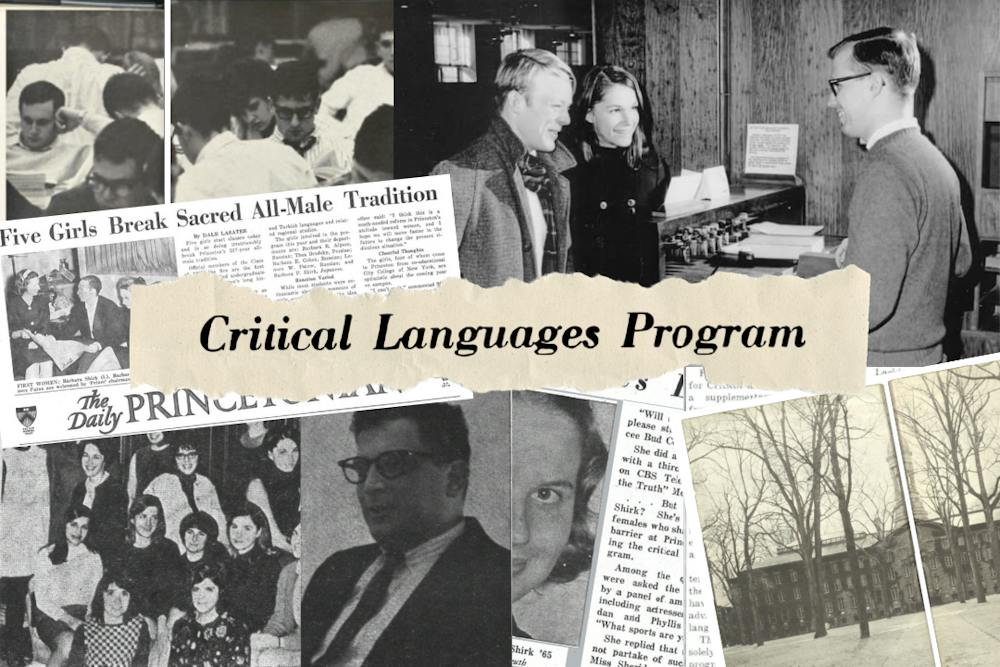
In the fall of 1963, 14 critical language students set foot on Princeton’s campus for the first time. Among them were nine men and, for the first time in Old Nassau’s 217-year history, five women.
The Critical Languages Program was introduced to meet the “growing national need” for training in the “critical languages” — Arabic, Chinese, Japanese, Persian, Russian, and Turkish — during the Cold War. For almost a decade, Princeton hosted a select group of visiting students from other universities for a year at a time for intensive language training and additional classes. But its consequences were clear — Princeton’s “sacred all-male tradition” was broken for the first time.
“It was more like a college exchange or a junior year abroad,” Nelle Brown Williams h’68, a former critical language student and an honorary member of the Class of 1968, explained. “None of us expected to be graduates of Princeton.”
‘No Girls!’
On April 11, 1963, The Daily Princetonian announced that the University had been given a $125,000, three-year grant from the Carnegie Corporation to start a “Cooperative Program for the Critical Languages,” in partnership with 32 other universities, including Colby and Elmira Colleges. Students from these other schools would attend Princeton for one to two years and come out with “a level of knowledge in their area equivalent to a year or two of graduate college.”
In the 1960s, the government pushed the study of “critical languages” in light of Cold War geopolitical tensions. Virginia Harris Aksan h’68 explained, “This was a government initiative to expand the knowledge of our diplomats … I think that would be in Princeton’s ethos, to make for better public servants.”
The next day, more exciting news broke: women could be coming to campus. Across the country, newspapers had noticed the one thing that the ‘Prince’ seemingly hadn’t — some of the universities that Princeton had agreed to take students from were coeducational.
“Now Princeton has gone and done it,” the Buffalo Evening News announced. The New York Herald Tribune was more definitive: “For the first time in its 217-year history, Princeton University will open its doors to undergraduate women.”
David H. Blair ’40, who was appointed to be director of the program until he was replaced by Allen Kassof in 1965, did little to put the suspicions to rest, telling the ‘Prince’ that women were a “theoretical possibility,” and their admission would ultimately “be up to the trustees of the university.”
Some students were not as happy as their peers to potentially welcome women.
“We fail to see why Princeton University cannot discriminate against women participating in this program, since it has ‘discriminated’ against women applicants for admission during the past 217 years,” two members of the Class of 1966 wrote in a Letter to the Editor titled “No Girls!” on April 16.
Despite this, the University said “yes” to girls that summer, enrolling the first five women — called “critters” — to ever study at Princeton: Barbara Alpern, Thea Brodsky, Barbara Cohen, Lenore Patow, and Barbara Shirk. Nine men also enrolled in the Critical Languages Program alongside them.

“I was riding on the train with my father, and he subscribed to the New York Herald Tribune. On the first page, second section, there was a headline that said ‘Girls Being Admitted to Princeton University,’” Alpern, now Barbara Engel explained. “My father read the article, turned to me, and said, ‘You should apply.’”
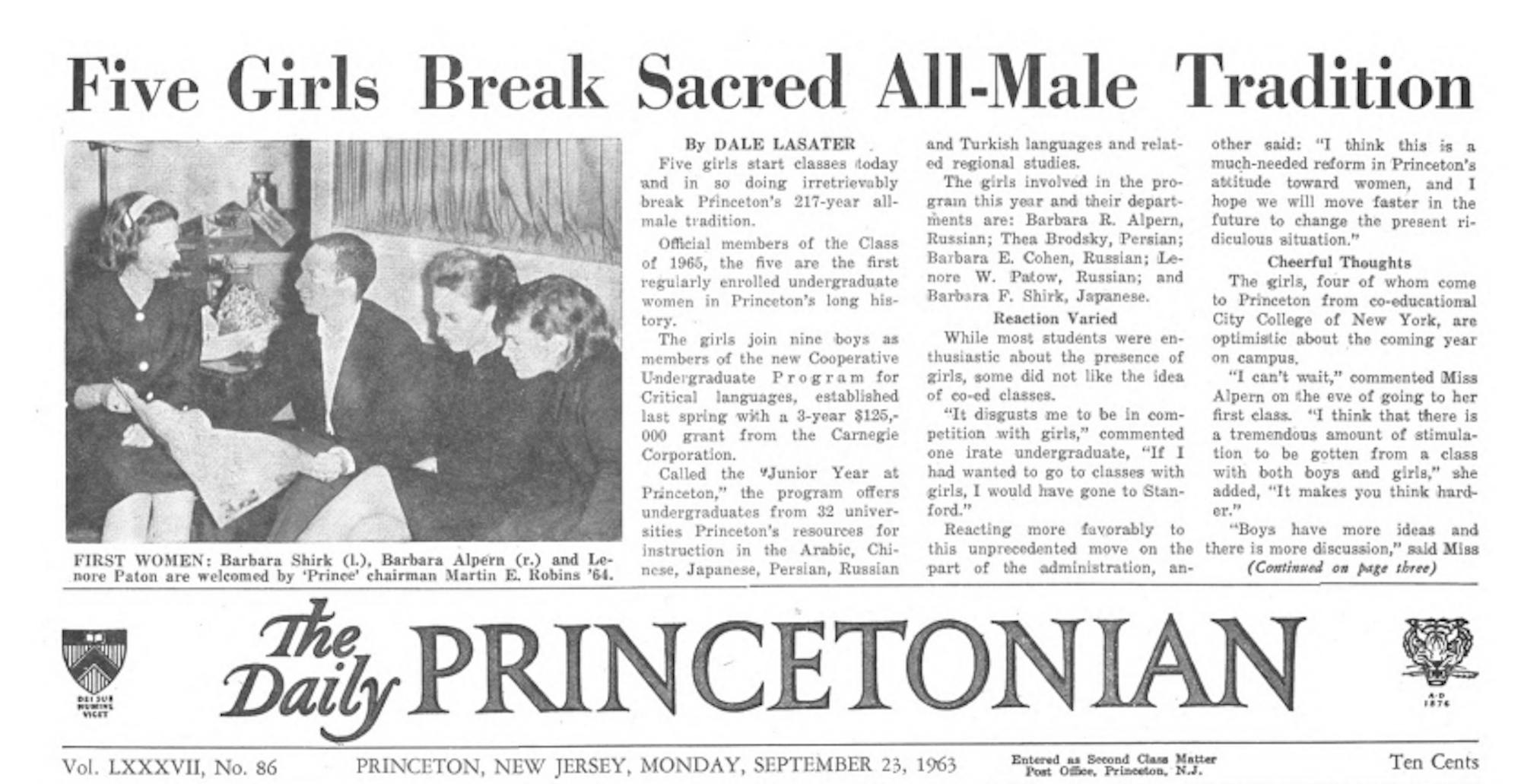
The Daily Princetonian on Sept. 23, 1963, the first day of the Critical Languages Program.
The Daily Princetonian
In a 2014 ‘Prince’ article, members of the CLP’s first cohort of women recalled facing antisemitism and contempt from Princeton men.
“Four of us were Jewish, and at that time there was an unannounced but real quota for Jews at Princeton,” Engel explained. “So, some of the hostility may have been to that, but certainly, in the yearbook, there’s some snide remarks.”
To compound the discrimination, the first five women all hailed from public universities — City College of New York and Rutgers University — which meant male students treated them with less respect than their counterparts at private women’s colleges such as Wellesley or Mount Holyoke.
Aksan noted that, as a student from Allegheny College and not one of the “Ivy League female schools,” it was difficult to be “more engaged on campus.”
“I started picking up with non-[eating] club people,” she explained. “By second term, I had companionship with a small group of those who were not of the elite wealthy sons.”
The men and women of the Critical Languages Program had vastly different living conditions. The male students saw themselves integrated into the main campus, living alongside Princeton students in their dormitories.
Michael Helke h’68, who studied Arabic at Princeton from 1966–67, lived in the since-demolished 1942 Hall in Wilson College. He had to move rooms halfway through the year because a neighbor fell asleep smoking dope, lit his latex mattress on fire, and then dragged the flaming mattress to the bathroom to extinguish it, according to Helke. The ‘Prince’ reported that the student dozed off with a stick of incense next to his bed.
“I plucked up my courage and ran out through the fire out of the building,” Helke said. He added, “By the next day, I was placed in another room… No questions asked — just the matter was settled.”
The women, on the other hand, were carefully chaperoned at the Princeton Theological Seminary, then a house at 31 Library Place, and finally in the Graduate College. They had strict parietal hours and curfews, and were forbidden from staying too long in men’s dormitories. The Seminary and 31 Library Place also had no eating facilities, meaning once they made the half mile trek to campus, they were there until after dinner.
“There was nothing there except our place to sleep,” Nelle Williams Brown h’68, who studied Russian in the program, said. Her Smith College roommate’s brother attended Princeton, so she could “run a tab” at his eating club, Cloister Inn, a few days a week for lunch.
“There were mixed receptions when I showed up with somebody at an eating club, depending on the eating club,” Engel explained. In January 1965, nine months after she had left Princeton, a poll in the ‘Prince’ ranked her as the “most missed personality” on campus. In the same poll, “coeducation” was voted the “Best Joke.”
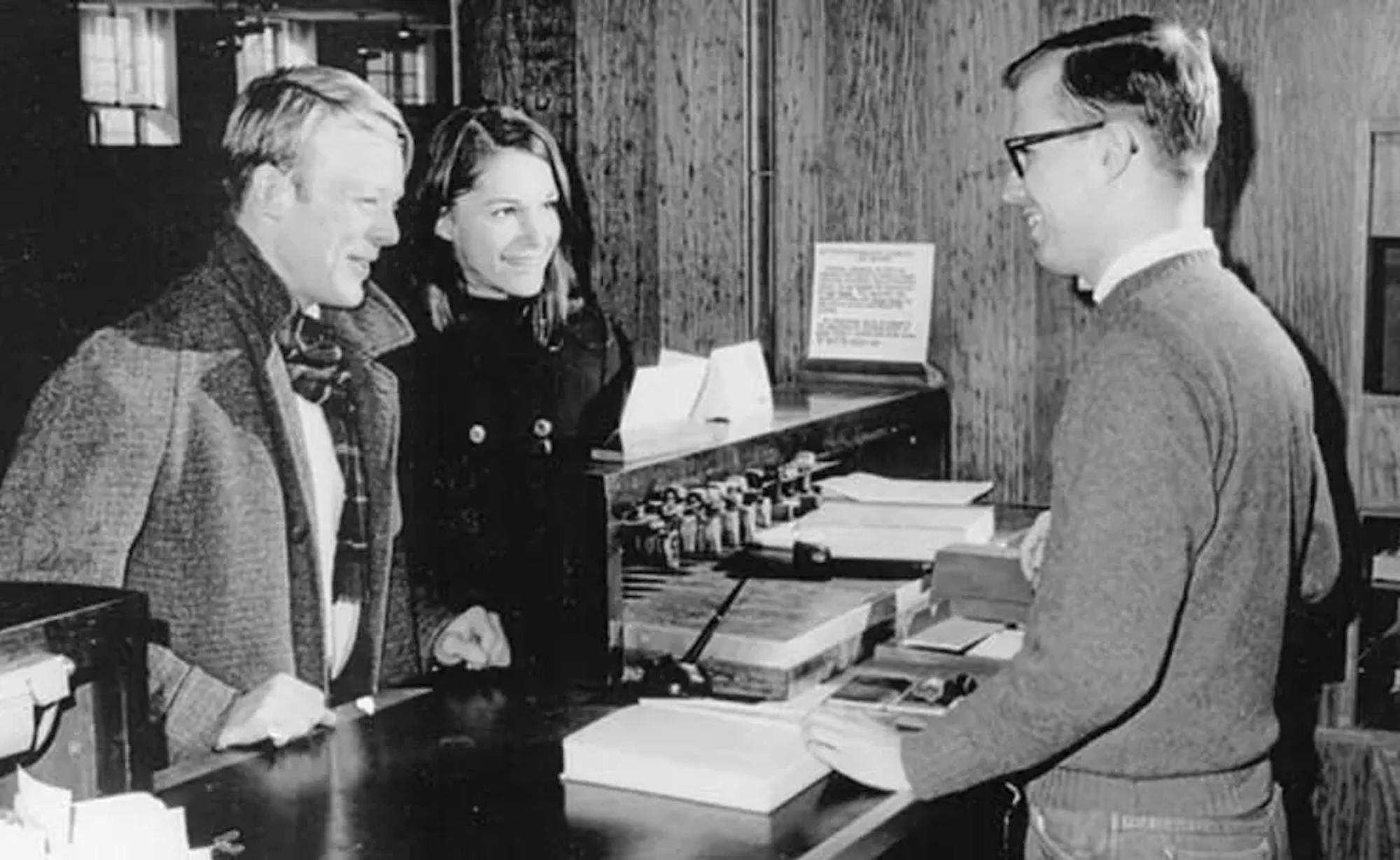
Anne Wallace Kruthoffer next to her late husband, Peter Fitzpatrick ’68 in Firestone Library.
Princeton Alumni Weekly
“I remember being very impressed by the fact that the male Princeton students were much more outspoken and questioning of the professors, even a little combative, than we were at Wellesley,” Anne Wallace, now Anne Kruthoffer h’68, said. She came to Princeton to study Russian during the 1966–67 school year from Wellesley College. “In fact, a lot of them would just carry on without really being prepared.”
Critical language students took courses in their respective language departments, but many branched out. Williams, who studied Russian, took economics courses at Princeton — a Princeton economics professor even acted as her interim senior thesis advisor at Smith College.
For the critical language students, Princeton courses were intellectually stimulating, but not excessively challenging. “I guess that I was afraid that it would be harder than the classes I’d experienced before at Goucher [College], but it wasn’t really. It was comparable,” said Kathryn Goldman Schuyler h’68, who studied Russian at Princeton.
As part of the Critical Languages Program, Princeton made an agreement with collaborating universities that students who came to Princeton during their junior year could not transfer to Princeton permanently. Several male students, however, found a way to work around this.
Ronald Feldstein GS ’73 h’68 came to Princeton to study Russian from 1967–68 and took many linguistics-focused graduate courses alongside older graduate students.
“I got this weird idea that it would be ridiculous for me to go back to Rutgers, because they didn’t have what I wanted, and I ought to just stay [at Princeton] and continue studying Slavic linguistics,” he explained.
So that’s what he did. Without finishing his Bachelor’s degree, Feldstein withdrew from Rutgers and matriculated as a Ph.D. student at Princeton. During his Ph.D. program, he also elected to receive his incidental Masters in Arts.
“Here I was, halfway through the Princeton Ph.D. program, and I only had a high school diploma,” Feldstein explained. “So I said, I better get that Princeton MA, so at least I have something to show that I had an education beyond high school.”
Helke had a similar story, but left Rutgers to pursue a Ph.D. in linguistics at Massachusetts Institute of Technology.
With the end of the 1960s came the possibility of full coeducation for Old Nassau. In 1967, Schuyler became “Princeton’s first female Fulbright scholar,” according to the ‘Prince.’ In 1968, the first brother-sister duo — Edward Craig ’69 and Susan Craig ’70 — attended Princeton together. The same year, the ‘Prince’ elected its first female staff reporter — C. Holly Hoffmeister Davies ’70.
At that point, many of the undergraduate men were “eager to have coeducation,” according to Kruthoffer.
“I really thought that it might happen while I was there. I would have stayed on,” she explained. When Princeton went coeducational, it allowed present critical language students to transfer as full undergraduates. “It was discussed a lot amongst us girls, even fairly late in the year. I was still hopeful, but that was not to be.”
In January 1969, the Board of Trustees voted 24–8 to admit women “in principle.” In April, the coeducation plans were set in stone with the announcement of 130 women being admitted into the Class of 1973. Coeducation came in phases, increasing the number of admitted women to 650 by 1973.
While coeducation was met with jubilant celebration by many, it symbolized a death knell for the Critical Languages Program. Princeton relaxed its rules so that the last years of critical language students, including Davies, could fully transfer to the University and graduate before the first class of women in 1973. The ‘Prince’ announced in November 1971 that the program would end in 1972.
‘Quasi-alumni status’?
The demanding course load that the Critical Languages students took at Princeton has made some wonder whether or not they should be considered proper alumni.
“There was never a provision that would make them alumni. That was not part of the deal. They could just have the opportunity to come to Princeton and profit from that year’s experience, and that was it,” retired Marine Col. Lawrence Kelley ’68 explained, before adding, “But the rationale doesn’t hold. There are people who withdraw from the university within the first term and never come back, and they are treated as alumni.”
After retiring from the United States Marine Corps, where he had been heavily involved in Soviet affairs, Kelley remembered the Critical Languages Program and wanted to know if “any of the people [were] still involved in Russian affairs later.” After reaching out to critical language students from the 1966–67 cohort, Kelley managed to get in contact with about half of them and uploaded their autobiographical profiles onto the class website.
“When I saw that I was not the only one who was interested in what the critical language students had done — the others were as well — I made a pitch to our class officers that we offer these students the opportunity to become honorary classmates,” he said.
At a class meeting in 2021, Kelley and his classmates voted overwhelmingly to offer honorary alumni status to the critical language students in the 1966–67 cohort who wanted it. In total, 11 former critical language students out of the twenty-seven from that year were inducted into the Class of 1968, in addition to Kruthoffer, who had already been made an honorary member after her first husband passed.
“He’s been a real champion of the program, and really the ladies,” Kruthoffer said of Kelley.
Kelley also proposed that critical language students should be given “quasi-alumni status” as a new, separate group. For some former critical language students, this halfway point could be a “middle ground,” Williams said. However, others find themselves indifferent to being alumni of Old Nassau.
“If I suddenly discovered that I was now a Princeton alum, that would also be cool, but it wouldn’t really affect what’s going to happen tomorrow or next week,” Schuyler said.
For some, it’s a cause that doesn’t need to be picked up.
“I think it’s nonsense. I’d love to be a Princeton alumnus, but I didn’t go to Princeton,” Helke said. He continued, “It’s a bit like a junior year abroad. You go someplace, have a good time, and then you go back to where you came from.”
“The understanding was that we were going to go back to our own institutions to graduate,” Engel explained. “It was one year. I don’t feel like a Princeton alum.”
From Bloomington to Moscow
In its eight academic years of existence, the Critical Languages Program hosted some of the world’s now distinguished scholars in the critical languages and other fields.
Of the seven men and women interviewed for this article, four became professors: Engel, Feldstein, Aksan, and Schuyler.
Engel received her Ph.D. in Russian history from Columbia University, worked as a professor at the University of Colorado Boulder for more than thirty years, and has authored nine books. Out of the five women in her original cohort, Engel said that she is the only one who went on to have a career in the language and culture she studied.
“I’ve been retired for a while now, but none of that would have happened had I not gone to Princeton,” she said. “It was absolutely life-changing.”
Feldstein taught at Indiana University, Bloomington, for 40 years, and eventually became the chair of the Slavic department.
After getting a library degree from the University of California, Berkeley and working at Princeton University Library with the University’s Middle Eastern collections, Aksan enrolled for a Ph.D. at the University of Toronto. She then became a Professor of History at McMaster University for the rest of her career.
Schuyler used her Fulbright scholarship to go to Paris in 1968. She then worked for Dean Kassof in New York City before receiving her doctorate from Columbia, and became a professor at Alliant International University in San Francisco and the President of Coherent Change, an organization that assists with personal growth and movement education.
Kruthoffer received a Fulbright scholarship as well, after she had graduated with a Ph.D. from the University of Virginia. She studied at Moscow State University, where she traveled at night in train cars with blacked-out windows in order to access the archives in Saint Petersburg. Censors at the archives read the same sources that she did, “and then it would be determined whether [she] could Xerox the materials,” she said.
While Williams “made pretty minimal use of Russian in [her] later life,” she spent the last 14 years of her career working for “one of the major UN organizations,” allowing her to listen to others in “several other languages, including Russian.” She received her Ph.D. from MIT, and she worked in policy issues across various countries.
Helke wound up as a linguistics professor at New York University after graduating from MIT, but transitioned to working for the United Nations at an administrative level. However, after experiencing a relief mission in Cambodia, Helke shifted his focus to humanitarian and relief missions, and now lives in Geneva.
“For me, it was a complicated experience, but a very, very good experience. It changed my life. And it’s not often one can say a thing like that,” Engel said.
Lucia Zschoche is an assistant editor for Features and an associate editor for Archives for the ‘Prince.’
Please send any corrections to corrections[at]dailyprincetonian.com.