



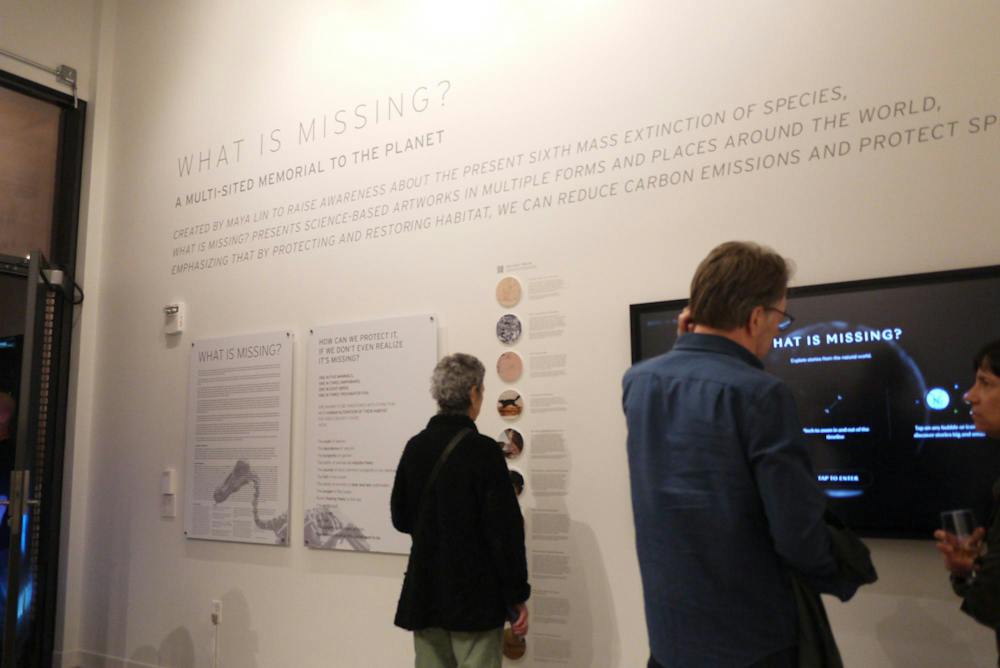
A whale appears to swim up the wall of Briger Hall. Its enormous body fills the two-story screen, accompanied by the sound of its song. Afterwards, a tiger moves through a forest and a giraffe walks across the display, representing species whose futures are increasingly uncertain due to the climate crisis.
The scenes are part of Princeton’s own installation of architect and artist Maya Lin’s “What Is Missing?” multi-site memorial project. The new installation was also the inaugural exhibition of the High Meadows Environmental Institute’s new Environmental Gallery at Briger Hall.
The exhibition opened Tuesday following an artist talk by Lin and a conversation with Princeton ecology and evolutionary biology and public affairs professor David Wilcove, moderated by Rachael DeLue, director of the Princeton Humanities Initiative.
In an interview with The Daily Princetonian, DeLue emphasized her hope for visitors to leave the exhibit with “a sense of hope rather than helplessness,” as solving the climate change and biodiversity crisis can feel insurmountable. “I want people to take away a real empathy and love for the natural world, because only that kind of empathy with the planet is going to lead to substantial change,” DeLue said.
Lin is best known for her “memory works,” a series of memorial projects exploring historical and environmental themes. Among these include the Vietnam Veterans Memorial in Washington, D.C.; the Civil Rights Memorial in Montgomery, Alabama; and the Women’s Table at Yale University, where Lin earned her Bachelor of Arts in 1981 as well as her Master of Architecture in 1986.
At Princeton, her architecture can be seen in the earthwork installations near the Lewis Arts Complex, where sculpted hills reshape the landscape around the building.
According to Lin, the “What is Missing?” series, which began in 2009, is her fifth and final memory work. Rather than constructing traditional monuments, she builds the project across websites, videos, sound work and public exhibitions. Her website describes the project as both a memorial and advocacy project, documenting what has disappeared while highlighting ongoing conservation efforts.
“I’ve always seen my memorials as teaching tools,” Lin said at her Tuesday talk. “Can it teach us and guide us to a different future?”

One challenge in bringing the exhibit to Briger Hall was finding technology that could display the project’s high-resolution films while using energy efficiently. The large digital screen had to be both visually immersive and efficient enough to operate within the exhibition space without generating significant heat.
The project also presented a technical challenge because of the amount of footage involved. “The hardest effort was taking, let’s say, we have about 90 films that we produce for this, and they’re all single screen,” Lin said. “We’ve remastered 70, and they also have to be extremely high resolution.”
Much of the footage used throughout the “What is Missing? What If?” exhibits was donated by organizations including the BBC, National Geographic, and Cornell’s Lab of Ornithology. The contributions have allowed Lin’s memory work to include footage and sounds of species from around the world.
Gabriel A. Vecchi, geosciences professor and director of the High Meadows Environmental Institute, commented that the exhibit reflects HMEI’s broader goal of using art and the humanities to connect people with environmental issues, in an interview with the ‘Prince.’
“The planning process for this particular exhibit was about two years before the building was completed, when we were still in Guyot Hall,” Vecchi said. “Visual culture, art, and the humanities have a unique way of allowing us to connect with the concrete issues that arise in environmental concerns, everything from climate change to biodiversity loss to water challenges.”
“What we want is a Princeton community — the students, our colleagues, the larger community in the Princeton area to come and really be a part of this generative art week,” Vecchi added. “As Maya said, this is going to be an artwork that is going to thrive with input from you. This is supposed to be a welcoming environment for creativity.”

Jakub Koguciuk, the gallery specialist and curator, noted, “The gallery is open to the public, and we’re waiting for visitors — everyone should come.” Koguciuk is coordinating the teaching events and future plans for exhibitions in the space.
“We’re hoping to bring more shows like this one, work with artists and museums and other institutions on environmental projects, and we’re hoping to use this space to highlight the research that’s happening here,” Koguciuk said.
“This is the biggest screen that we could have possibly installed here on campus, and gathering all the information and making sure all the research is footnoted and well-presented, that has been a challenge,” Koguciuk explained. “There are also challenges in presenting an online project — especially one that's been going on for more than 10 years — in a physical space.”
Looking ahead, Lin hopes to collaborate with Princeton faculty on future projects. “For instance, some faculty will be interviewing high school students to get memories from their parents to add to the map of memory,” said Lin in an interview with the ‘Prince.’
Multiple Princeton professors have already used the new exhibit as part of the classroom curriculum. These include Jeff Whetstone, a visual arts professor, Cassie Stoddard, a professor in Ecology and Evolutionary Biology, and Anna Mueser, a postdoctoral fellow at HMEI.
“I think Maya Lin’s installation makes people see and hear about the twin crises of climate change and biodiversity loss in a very original and emotionally resonant way,” Wilcove told the ‘Prince.’
Wilcove continued, “It’s a new way of bringing these issues to the attention of people, making them understand the gravity of the problems, and at the same time feeling some degree of optimism that, with the right actions, both climate change and the loss of biodiversity can be reversed.”
“We want everyone to begin to engage, so by the end of the school year, Greenprint really grows and is shaped by the classes here,” Lin said. “My hope is we’re going to get different groups to get students to go out in the field and volunteer to help, whether it’s plastic pollution or wetland remediation or dune restoration.”
Mia Chen is a News contributor for the ‘Prince’ and a member of the Class of 2030.
Riley Price is a News contributor for the ‘Prince’ and a member of the Class of 2030.
Please send any corrections to corrections[at]dailyprincetonian.com.
Read More

Sherrill calls for Lt. Gov. Caldwell ’82 to resign after investigation found policy violations
Luke GrippoN.J. Governor Mikie Sherrill is calling for the resignation of Princeton alumnus Dale Caldwell ’82, following the release of a report finding that he engaged in workplace misconduct. A lawyer for Caldwell denied the allegations and contested the process behind the investigation.
N.J. Governor Mikie Sherrill is calling for the resignation of Princeton alumnus Dale Caldwell ’82, following the release of a report finding that he engaged in workplace misconduct. A lawyer for Caldwell denied the allegations and contested the process behind the investigation.

Music and love: Alec Baldwin at Richardson Auditorium
Annika PlunkettStaff writer for The Prospect Annika Plunkett covers Alec Baldwin’s conversation on music at Richardson Auditorium.
Staff writer for The Prospect Annika Plunkett covers Alec Baldwin’s conversation on music at Richardson Auditorium.

‘The Art of Japanese Publishing’ exhibit illuminates the history of Japanese illustrated literature
Hifza KaleemCurated by Nicole Fabricand-Person and Holly Hatheway, the exhibit will be on display through Dec. 6.
Curated by Nicole Fabricand-Person and Holly Hatheway, the exhibit will be on display through Dec. 6.