



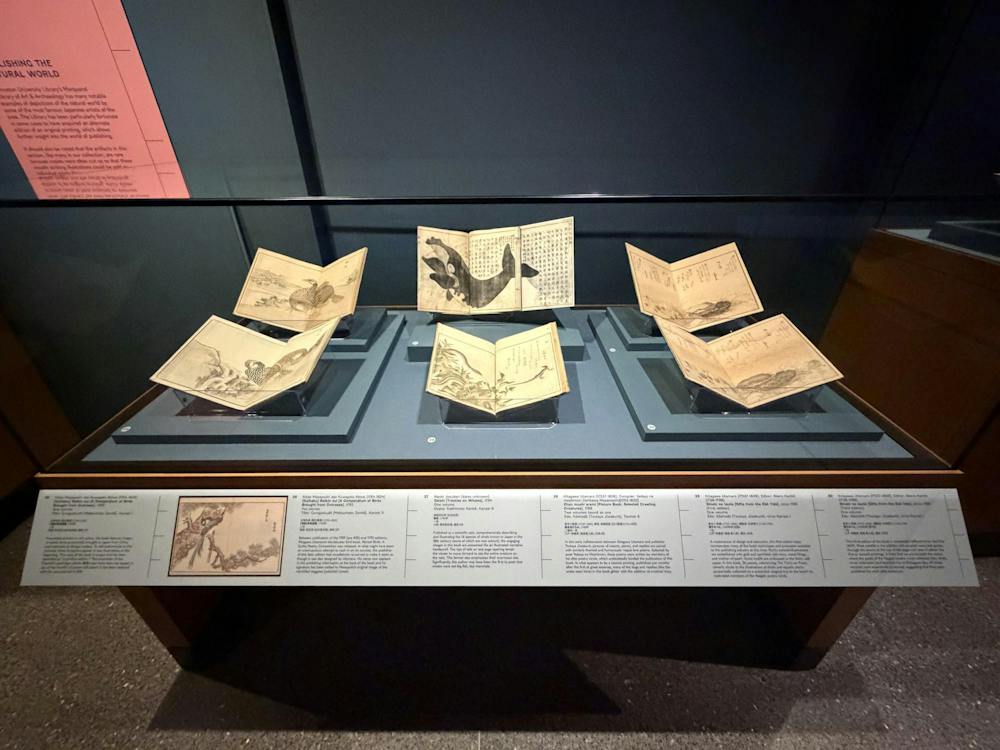
The Ellen and Leonard Milberg Gallery in Firestone Library will display “The Art of Japanese Publishing: A Selection of Japanese Illustrated Books from the Marquand Library Collection, 1660–1960” until Dec. 6. The exhibit, which features rare illustrated Japanese books from Marquand Library of Art and Archaeology’s collection, tells the history and evolution of Japanese publishing from the 17th century through the 20th century.
The exhibition was curated by Nicole Fabricand-Person ’76 GS ’01, the Japanese art specialist for Marquand Library, and Holly Hatheway, director of Marquand Library. Marquand Library has established a collection of illustrated Japanese books over the last 17 years. Fabricand-Person initially proposed a list of 100 items from this collection to library leadership four years ago when planning began.
“These books are works of art and are collected based on their artistic merit, not on their literary content — although some are classics of Japanese literature as well,” said Fabricand-Person of the Marquand Library’s Japanese book collection in a statement to The Daily Princetonian. “Because illustrated books are so important to the history of art — East and West — yet so often ignored, we decided to do an exhibition that would celebrate their history.”
The exhibition proceeds chronologically through Japanese publishing. “I approached this as I would a course in the history of Japanese art, told through books,” Fabricand-Person explained.
The first section, titled “The Commercial Publishing of Illustrated Books in the Mid-17th to Mid-18th Centuries,” features three particularly famous pieces: “Scenes of Lovemaking,” “Mirror of the Yoshiwara” [Yoshiwara kagami], and “Yoshiwara Pillow Pictures” [Yoshiwara makura-e]. These works all depict themes of sexual pleasure, which are observable throughout the first half of the exhibit. These featured pieces also serve as some of the earliest examples of “ukiyo-e,” meaning pictures of the floating world — a genre of Japanese woodblock printed art often centering the urban entertainment districts of Edo-era Japan. Various pieces from Hishikawa Moronobu, the “father of ukiyo-e,” are on display in this section.
The exhibit dives further into the 18th century, depicting the rise of color printing as woodblock printing methods advanced, before proceeding into the 19th century. Here, the exhibit showcases the “golden age” of woodblock print designs. Many books were exported to Europe, influencing Western art practices and movements such as Impressionism, Japonisme, and Art Nouveau.
Fabricand-Person noted the historical significance of select books in the exhibit, including “Picture Book of Modern Forms and Figures” [Ehon imayō sugata] and “Actors on Two Sides of the Leaf” [Yakusha konotegashiwa]. These pieces “are the actual books owned by famous connoisseurs and promoters of Japanese art, like Edmond de Goncourt,” she said.
The exhibit features numerous rare artifacts. In displays dedicated to the 18th and 19th centuries, visitors can view books whose copies were often cut up in order to maximize profits, as well as alternate versions of some books’ original printings. Visitors can also view “book wrappers,” or protective paper wrappers from the 18th century. Wrappers were often thrown out by book owners, so few survive.

The collection also has a section dedicated to banned books from 1660 to 1868. During this period, the Japanese government censored publications, banning books that were considered unflattering to the government, books that disrespected the government’s mandated social hierarchy, and books deemed too luxurious or colorful. “Books and their woodblocks were burned, making many of the books in our collection quite rare,” Fabricand-Person stated.
The penultimate section of the collection, “The Coming of the Americans and the End of Isolationism in Books,” explores the influence of America’s arrival to Japan in the mid-19th century — which brought forth the end of Japanese isolationism — on Japanese illustrated literature. These pieces reflect the polarized Japanese response to modernization, or Westernization.
The exhibit closes with the “Early to Mid-20th Century,” which features contemporary Japanese art and modern media. The evolution of Japanese photography, for example, is visible through rare copies of Hakuyō, a historic Japanese photography magazine. Various books and serials, some containing propaganda and others banned surrealist material, also reflect Japanese sentiments during and in response to World War II.
“This exhibition afforded us the opportunity to introduce the Princeton community to the Japanese illustrated rare books at Marquand Library and, through the concurrent digitization of each item, allowed us to offer these resources to scholars worldwide,” Fabricand-Person concluded.
Hifza Kaleem is a News contributor for the ‘Prince’ and a member of the Class of 2030.
Please send any corrections to corrections[at]dailyprincetonian.com.
Read More

Kwanza Jones ’93 and José Feliciano ’94 purchase the San Diego Padres for record $3.9 billion
Kai Kim and Ari AhdiehPrinceton alumni and billionaire couple Kwanza Jones '93 and José Feliciano '94 acquire the San Diego Padres at record price.
Princeton alumni and billionaire couple Kwanza Jones and José Feliciano acquire the San Diego Padres at record price.

Roundup: Joyce Carol Oates and Katherine Nouri Hughes’ book talk, U.S. News rankings, and meal swaps
Coralene Ellis, Riley Price, Devon Rudolph, and Wesley BartlettAuthors Joyce Carol Oates and Katherine Nouri Hughes read excepts of their latest works, student reactions to U.S. News ranking, and the new meal swap program.
Authors Joyce Carol Oates and Katherine Nouri Hughes read excepts of their latest works, student reactions to U.S. News ranking, and the new meal swap program.

Late efforts not enough as No. 18 men’s soccer draws Seton Hall 0–0
Matthew YiNo. 18 Princeton men’s soccer battle out a draw against Seton Hall before conference play.
No. 18 Princeton men’s soccer battle out a draw against Seton Hall before conference play.