



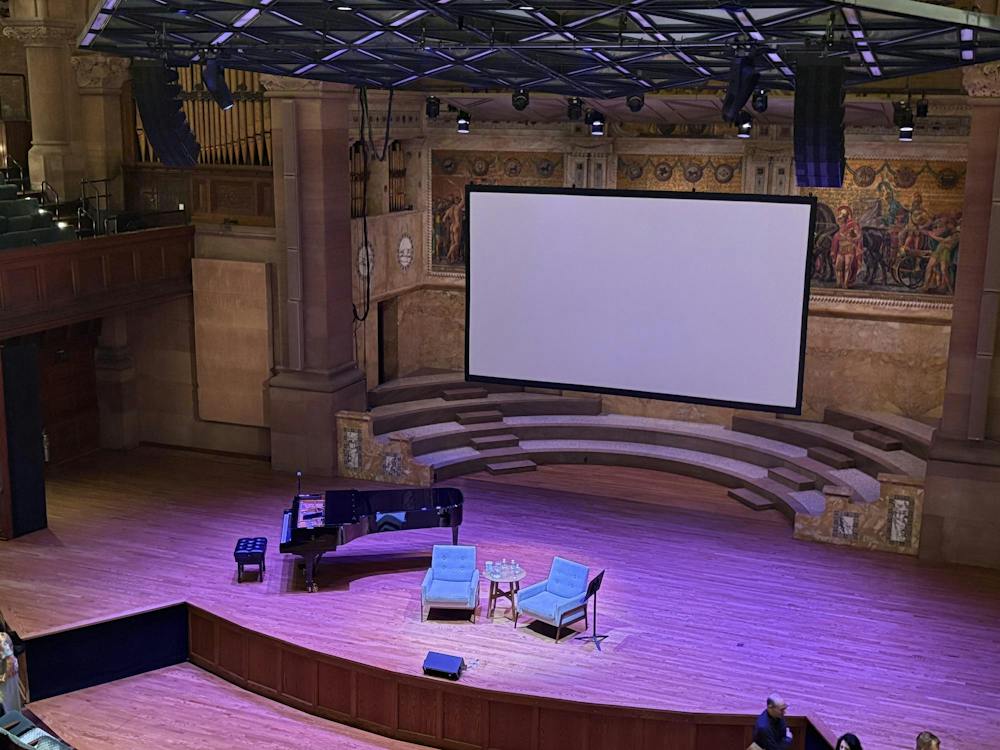
Even those familiar with Alec Baldwin may be surprised to learn that the actor who voiced “The Boss Baby” also loves classical music. On a drizzly Sunday afternoon, I headed to Richardson Auditorium to hear the well-known actor and filmmaker speak with evening host of WQXR Terrance McKnight about the impact of music in his life and the importance of love and connection. Punctuated by interludes of live and recorded music performances, their conversation formed the first episode of Princeton University Concerts’ 2026–27 “Healing with Music” series. Mostly serious and occasionally comical, the conversation was consistently heartfelt, and I left with a new appreciation for classical music –– and for Baldwin himself.
Known for his successful work as an actor, Baldwin has acted in and voiced films as varied as “Beetlejuice,” “It’s Complicated,” and “30 Rock.” However, he is also the radio host of “The New York Philharmonic This Week," a weekly show featuring NYPhilharmonic performances and interviews with musicians. After the tragic death of one of his castmates while on set for the movie “Rust” in 2021, Baldwin withdrew from his acting career. This edition of Princeton University Concerts’ “Healing with Music” series explored how classical music has helped Baldwin on his healing journey, and its broader impact on his life.
Before the conversation began, Princeton University Concerts played a short video they had produced to provide background for the discussion, featuring an interview with Baldwin and clips of some of his favorite classical music performances.
“The movie often disappoints me, the theater sometimes disappoints me, the symphony never disappoints me,” Baldwin said in the video, setting the tone for the afternoon.
After the video ended, McKnight and Baldwin walked onstage to applause. Wearing a grey suit that befit the emotional gravity of the discussion to come, Baldwin acknowledged the audience with a hand before settling into his chair. As McKnight said some opening words, Baldwin contemplated his shoes and the audience, shading his eyes in evident curiosity to see into the auditorium balcony, seemingly in no particular rush to speak.
It quickly became clear that this conversation had a star-studded cast. Though, of course, Baldwin was the big draw as the guest of the show, I was equally transfixed by the moderator, McKnight. As evening host on WQXR and creator and host of the new WQXR podcast "Every Voice with Terrance McKnight,” McKnight was enthusiastic about sharing music with the audience and a good catch for Princeton University Concerts.
It was set to be a great conversation. But first, we had to have music.
McKnight invited pianist Tony Siqi Yun, a 2024 graduate of Juilliard and professional pianist, to join them on stage for a live performance of Bach.

Pausing to exchange greetings with Baldwin and McKnight as if they were old friends, Yun went to sit at the piano. He lowered his hands and began to play, tenderly coaxing a slow melody from the keys that gained strength in waves. The performance was breathtaking.
It seemed only natural that music should precede the conversation, as if only after Yun’s performance would Baldwin be ready to talk. And, indeed, then the conversation began.
McKnight opened by asking Baldwin about his path to appreciating classical music. Growing up in Los Angeles, Baldwin said that he was tired of pop music by the time he was 20 years old. He craved something richer and found it in classical music, which was smart and mathematically clever.
“It was the complexity –– I needed something that was more interesting,” he said.
Then in 1983, when he was only 25 years old, Baldwin’s father died of cancer, and he fell into two years of drugs and drinking. His salvation came in the form of a symphony on the radio: Mahler’s Ninth Symphony, or, as Baldwin and McKnight referred to it, “Mahler 9.”
“It was like someone just hit me with a dart,” Baldwin remembered.

He called the radio and asked for the details of the exact record that they were playing so that he could purchase a copy for himself. And so he began a tradition of tracking down his favorite pieces at Tower Records on Sunset Boulevard in Los Angeles, where he started and grew his collection.
Baldwin expressed a deep appreciation nearing reverence for classical music.
“Once you understand the effect that music has on you, and you allow it to get into you, everything changes,” he said in the opening video.
It was clear that McKnight shared Baldwin’s sentiments. As McKnight and Baldwin exchanged music recommendations and Baldwin began asking McKnight questions in return –– “watch this,” he said cheekily –– the conversation truly felt like a conversation between two music-lovers, and not simply an interview with a guest artist.
After Mahler 9, Baldwin discovered Mahler 4. As with many of his favorite pieces, he grew attached to a particular performance of the piece: the performance by the Cleveland Orchestra with Judith Raskin as the soloist.
“Only J.R. will do,” he said.
Naturally, the audience had to hear Baldwin's preferred version of Mahler 4. The lights dimmed, and a recording of a clip of the first movement of Mahler 4 played. As Raskin sang in German about a child’s view of heaven –– as McKnight had explained it –– many members of the audience around me closed their eyes, as if to absorb the music better. On stage, Baldwin’s eyes were closed as well.
After Mahler 4, McKnight moved the conversation to Baldwin’s other encounters with music. Beyond listening to records on the radio, Baldwin also found community among fellow classical music appreciators.
As he soaked up the music, he explained, “I took my cues from other people,” and went to the concerts which his fellow music-lovers asked him if he planned on attending.
Baldwin said his love for classical music reflects his greater appreciation for culture and the arts. He shared that he loves being in a space with other people who also love the arts, and that in the days, weeks, and months following the accident on set for “Rust,” Baldwin said he found himself missing interactions with these communities. He said he felt shut out from the arts community and missed participation in “all the worlds I’m in.”
Perhaps as a result, Baldwin shared that he is more open about telling people about his love for them.
“The people who I love –– I tell them,” he said. “It’s so important to me. How you take it is your business.”
I was struck by Baldwin’s candor about his experience and touched by his desire to share his love with others.
Coming full circle, the program closed with a recording of Mahler 9. To introduce the piece, McKnight explained that Mahler had written it for his daughter Maria who passed away, “turning his anguish into art.” Wherever Baldwin was in his own healing journey, McKnight said, he hoped that Mahler’s piece would still resonate with him in some way.
For just a minute, the high, mournful sound of strings filled the auditorium. Then the music ended and the lights returned. “Thank you,” Baldwin nodded to the crowd. Amidst applause, he and McKnight walked off stage.
I walked away touched by the authenticity and bravery of the conversation –– and inspired to listen to more classical music.
Annika Plunkett is a staff writer for The Prospect, associate Newsletter editor, and a Spanish Translator. She can be reached at aplunkett[at]dailyprincetonian.com.
Please send any corrections to corrections[at]dailyprincetonian.com.
Read More

“The Art of Japanese Publishing” exhibit illuminates the history of Japanese illustrated literature
Hifza KaleemThe Milberg Gallery at Firestone Library is presenting "The Art of Japanese Publishing," an exhibition of rare illustrated books from the Marquand Library's collection that traces Japanese publishing from 1660 to 1960. Curated by Nicole Fabricand-Person and Holly Hatheway, it will be on display through December 6.
The Milberg Gallery at Firestone Library is presenting "The Art of Japanese Publishing," an exhibition of rare illustrated books from the Marquand Library's collection that traces Japanese publishing from 1660 to 1960. Curated by Nicole Fabricand-Person and Holly Hatheway, it will be on display through December 6.

Kwanza Jones ’93 and José Feliciano ’94 purchase the San Diego Padres for record $3.9 billion
Kai Kim and Ari AhdiehPrinceton alumni and billionaire couple Kwanza Jones '93 and José Feliciano '94 acquire the San Diego Padres at record price.
Princeton alumni and billionaire couple Kwanza Jones and José Feliciano acquire the San Diego Padres at record price.

Roundup: Joyce Carol Oates and Katherine Nouri Hughes’ book talk, U.S. News rankings, and meal swaps
Coralene Ellis, Riley Price, Devon Rudolph, and Wesley BartlettAuthors Joyce Carol Oates and Katherine Nouri Hughes read excepts of their latest works, student reactions to U.S. News ranking, and the new meal swap program.
Authors Joyce Carol Oates and Katherine Nouri Hughes read excepts of their latest works, student reactions to U.S. News ranking, and the new meal swap program.