



The following is a guest contribution and reflects the author’s views alone. For information on how to submit a piece to the Opinion section, click here.
On my way home to El Paso, Texas, I sit in seat 29F of American Airlines flight 1303. Looking out at the plains and suburbs below, I realize I’ve made the journey to and from Princeton and El Paso 26 times before. Across these journeys, I have had no shortage of time to stare out an airplane window and think. To ponder the triumphs of the past semester: the final that went well, the leadership position I recently attained, or the personal best I set in Dillon Gym. I’ve also found myself thinking about where I fell short: the paper that never realized its full potential, the first date that never became a second, and the planned meal exchange that remained unfulfilled.
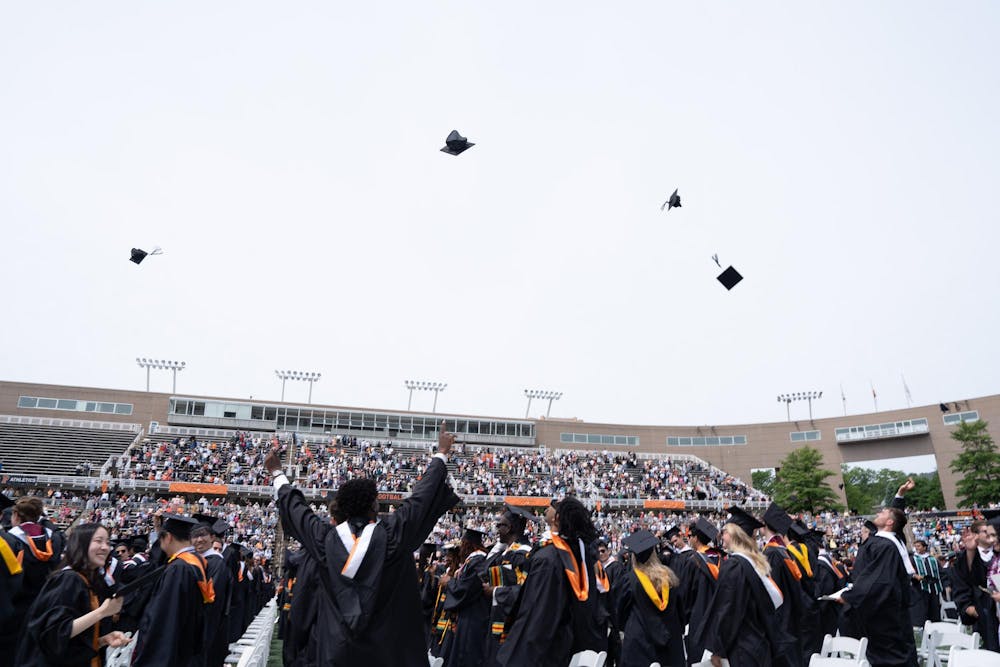
But now, on my 27th and last journey between home and college, I cannot help but feel overwhelmed with gratitude for my time at Princeton University.
To be overwhelmed with gratitude is not an entirely positive emotion. While it is a blessing to be grateful for those who have made an impact in our lives, to be “overwhelmed” is to not know where to begin expressing this feeling. I’m sure many of us students feel that there are innumerable friends, family, professors, coaches, religious leaders, and other individuals who have shaped our time at Princeton. I’m also sure that we intended to thank these mentors at some point — in my case, once the stupefying haze of the senior thesis gave way to the calm and seemingly endless hum of post-thesis life.
However, I quickly realized that the time between the end of the thesis and Commencement was, indeed, finite; there was simply not enough time to thank all those I had hoped to thank, not to mention those to whom I forgot to express my gratitude: the dining hall worker who greeted me with a smile every day, the sophomore year roommate who inspired me to work harder, or the professor who gave me a second chance.
With an abundance of people to whom we owe thanks, can we ever satisfactorily express our gratitude? Probably not — but we should at least try.
Being overwhelmed with gratitude, we might be tempted to keep our thanksgivings to ourselves. We might think that by expressing our gratitude to some people, we commit some injustice toward others who impacted us but whom we’ve forgotten to thank. We might also think that our window of opportunity has passed if we do not thank a friend in person, or while still on campus.
But we should not let these fears, among others, define the metes and boundaries of our outward manifestations of gratitude. We should instead realize that it is far better to thank someone “imperfectly” than to not thank them at all. In my view, we do little good drafting emails without sending them, leaving messages on read out of fear of responding too late, and letting a friendship slip away because we ran out of time.

I recognize that not every expression of gratitude — articulated in-person, via email, or through some other means — may be met with a commensurate degree of enthusiasm. Indeed, there will be professors to whom we will send paragraphs of praise only to receive a two-sentence reply along the lines of “Thanks Sam. Best of luck going forward.” Sometimes, we may not even receive a response. This might very well hurt us — letting our emotions sit in an inbox, forever unreciprocated.
However, for every tepid response we do receive, the important part is that we have conveyed those messages of gratitude in the first place, which might mean everything to the recipient. We might even inspire others to express their gratitude to someone who impacted their lives as well.
I recognize what I am asking here is easier said than done, and I know that I leave many questions unanswered. For instance, how can we adequately express the love we feel toward a friend in a single letter, email, or even conversation? What if our gratitude comes off too strong or too weak? And what if we feel there may be a disconnect between how we feel about a person and how that person feels about us? I do not profess to know the answer to these questions — they are deeply personal, inviting reflection. But we should not reflect too long! If there is anything I’ve learned in my now 27 journeys between El Paso and Princeton, it is that the journey is never as long as it first seems.
While our post-Princeton lives might seem boundless, they are, like our time at Princeton, finite. And in this finite time, we should undertake an imperfect yet affirmative effort to thank those who have changed our lives. Even if we don’t know where to start, and even if we don’t know where we are going, our future selves will thank us for undertaking the overwhelming journey of imperfect gratitude.
Samuel Kligman ’26 is a recent graduate from the Princeton School of Public and International Affairs. He is from El Paso, Texas and can be reached at samuelkligman[at]gmail.com.
Please send any corrections to corrections[at]dailyprincetonian.com.
Read More

The real crisis on campus isn’t cheating, it’s thinking
Jack GoodmanFurther, a growing body of research confirms that use of generative AI undermines the cognitive effort that is essential to the development of the human brain. As AI use increases, learning, recalling, and critical thinking skills decline.
Further, a growing body of research confirms that use of generative AI undermines the cognitive effort that is essential to the development of the human brain. As AI use increases, learning, recalling, and critical thinking skills decline.

Trust in academia is at a low. Can Writing Seminar help?
Ian RosenzweigAcademia has a PR problem, and no amount of insular critical inquiry is going to solve it. Writing Seminars should live up to their name and teach us not just to solve thorny research problems but also to effectively communicate our solutions through clear and — perhaps more importantly — stylistically compelling prose.
Academia has a PR problem, and no amount of insular critical inquiry is going to solve it. Writing Seminars should live up to their name and teach us not just to solve thorny research problems but also to effectively communicate our solutions through clear and — perhaps more importantly — stylistically compelling prose.
Why is the recording policy being kept secret?
Isaac BarsoumIn denying new students — and faculty and staff, for that matter — the right to know what regulations they are subject to, Princeton makes violations likely and will end up unfairly investigating or disciplining community members who were unaware of the policy’s existence in the first place.
In denying new students — and faculty and staff, for that matter — the right to know what regulations they are subject to, Princeton makes violations likely and will end up unfairly investigating or disciplining community members who were unaware of the policy’s existence in the first place.