



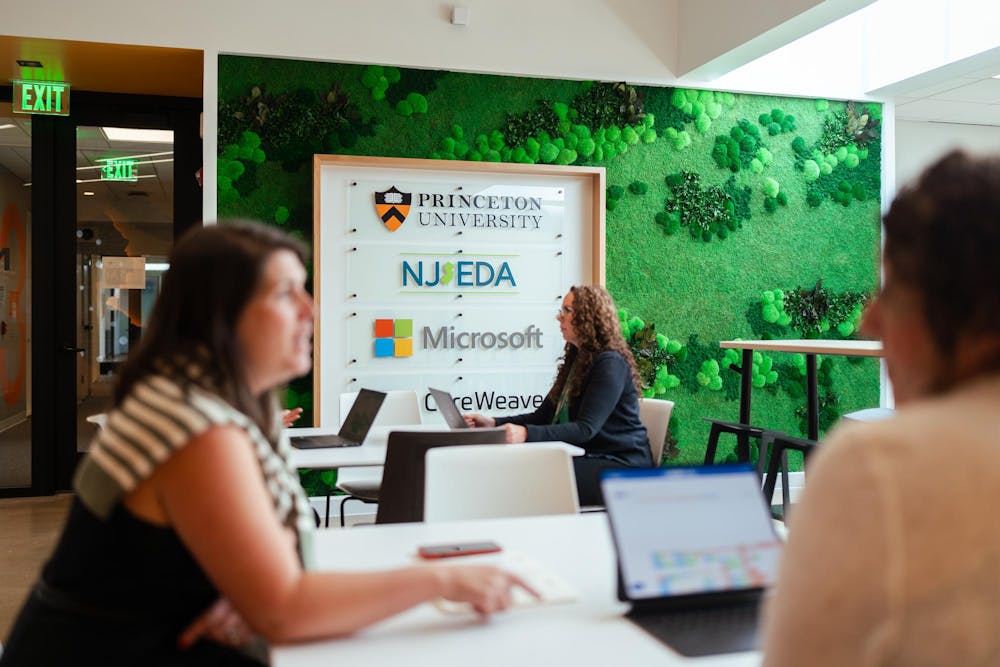
A year after the New Jersey Artificial Intelligence Hub’s launch, the first cohort of startups has begun its AI Accelerator program. The AI Hub is a collaborative initiative between Princeton University, the State of New Jersey, Microsoft, and CoreWeave, aimed to “accelerate innovation in artificial intelligence and position New Jersey as a global leader in the field.”
The AI Accelerator program is designed to shorten the sales cycles for each member of the cohort and connect their founders to new customers, according to New Jersey director of Plug and Play Tyler Lange. The cohort of startups receives support from Plug and Play, a venture capital firm that aims to connect large companies with startups, including weekly workshops, corporate introductions, and direct product feedback.
Justin Murray, who leads much of Plug and Play’s U.S. venture work, told The Daily Princetonian that the AI Hub team evaluates what companies to back using what he calls the three Ts: “technology, traction, and team.” Hundreds of candidates were considered by Plug and Play to be part of the program, and 20 finalists pitched their startups in March at the AI Hub. Fourteen were chosen to be in the inaugural cohort.
Founders and leaders of these startups shared that simply being selected for the AI Accelerator program changed how customers and partners viewed them.
Mohnish Mohanty, CEO of healthcare finance startup Intelizen, said the accelerator gave his company legitimacy in a crowded and skeptical market.
“There’s a positive association with [Plug and Play] and [the AI Hub],” he said. Mohanty added that credibility is especially important in healthcare, where hospitals and providers are inundated with vendors. “It takes a village to build a great company,” he said. “And I think having these events and having these people that are kind of vetted and being part of the ecosystem now — that matters a lot.”
For Chorah Labs, a platform which uses AI to design workflows that help companies satisfy federal regulations in the pharmaceutical sector, the New Jersey connection was equally important. Co-founder Sepehr Rahimi said applying “was a no-brainer,” explaining, “Not only are we an AI company, we are an AI company for the pharma industry, which is kind of one of the most dear industries in New Jersey.”
The program, according to Rahimi, helped Chorah Labs “build that authority as we are building … and bootstrapping our platform.”

Chorah Labs’ other co-founder Jason Chou added that the state’s biotech momentum made the AI Hub a natural fit. “We’ve really seen a surge in biotech activity in New Jersey,” he said. “Graduates shouldn’t have to go to Boston or the West Coast to build biotech companies.”
Founders also described Plug and Play’s programming as useful to understanding what platforms companies may be interested in.
Rahimi said the program “refined us and helped us rethink about what we are doing.” Chorah Labs made several pivots based on traction and distribution insights from Plug and Play, Chou and Rahimi explained.
Hydronos Labs founder Colby Fisher GS ’18 said the workshops offered the opportunity to showcase his work to a group of people before actually pitching it out.
“When I was a grad student, this is exactly the kind of program I would have wanted,” he said. “Plug and Play’s ecosystem lets you show your work to hundreds of people. It’s a vetting process that’s incredibly useful.”
Nodes Inc. founder Saad Bin Shafiq said the corporate-first structure was what convinced him to apply to the cohort. “This is one of the first times I saw someone like, ‘Okay, why don’t we first introduce you to customers?’” he said. “‘Then if you think we bring you enough value, then you let us invest with you.’”

Shafiq said the reverse pitches, where companies present what they need, and corporate sessions led directly to new business. “I made some really great connections afterward to some biopharma company,” he said.
Alex Ge, co-founder of Rena Labs, echoed that the introductions were the most valuable part. “Plug and Play and the AI Hub introduced us to corporations we never knew before,” he said.
Throughout the program, Plug and Play offers introductions to Microsoft, NVIDIA, and other hyperscalers as well as access to its own 3,000-person Silicon Valley Summit.
Lange said the AI Hub’s location is central to the accelerator’s strategy. The program is “stage‑agnostic,” he said, meaning it accepts companies at any stage but does not rely solely on local clientele. He added that New Jersey’s density of talent and corporate customers makes it unusually fertile ground for the program. Founders similarly pointed to the state’s industrial landscape as a reason to stay.
Mohanty pointed to the state’s dense healthcare infrastructure as a natural fit for his company. Ge added that many of the state’s traditional industries are now seeking modernization, creating strong demand for privacy-preserving data tools.
Though the AI Accelerator lasts 12 weeks, Plug and Play maintains ongoing relationships through its internal “Playbook” platform, which tracks startup progress and connects alumni to new corporate requests.
“It’s not a relationship that’s severed after the three months,” Lange said. “It’s really just the beginning.”
Several founders said they plan to continue working with Princeton researchers and New Jersey institutions as they grow.
Rahimi said Chorah Labs hopes to deepen its ties with Princeton researchers. “We would love to kind of start those relationships and kind of cultivate that,” he said. “Princeton University being one of the leading research institutes in the nation, there will be some PIs and some research groups that are working on pharmaceutical drugs or therapies that would find our systems interesting or to the least of it enabling for the earlier stages… so yeah, we would love to actually increase that.”
Fisher said Hydronos Labs is open to future collaboration with Princeton researchers. “I go to all the Princeton events and talk to people,” he said. If there’s a “logical connection, we’re more than happy to pursue it.” Mohanty said Intelizen is “definitely early in that game” but eager to build research and talent connections.
While the accelerator does not guarantee pilots or funding, it offers access to opportunities that many early-stage founders struggle to reach. “Nothing’s a guarantee in the startup world,” Lange said. “We’re trying to push as many of these opportunities to the forefront as possible.”
Lange said the AI Hub’s long-term goal is to help build the next generation of New Jersey-born AI companies.
“This foundation we’re laying in [New Jersey],” said Lange, “is hopefully a very good means to help startups onboard to all the state has to offer.”
Zihan (Frank) Xu is a contributing Data, News, and Features writer for the ‘Prince.’
Please send any corrections to corrections[at]dailyprincetonian.com.
Read More

Three Princeton alumni awarded 2026 Fields Medal
Clara DochertyThe three alumni who received the medal are Yu Deng GS ’15, John Pardon ’11, and Jacob Tsimerman GS ’11.
The three alumni who received the medal are Yu Deng GS ’15, John Pardon ’11, and Jacob Tsimerman GS ’11.

How Charles Plohn ’66 brought his classmates together on the shelves
Nikki HanFor decades, Charles J. Plohn, Jr. ’66 has been collecting books published by members of his class. With nearly 700 titles in this collection, Plohn is attempting to find his library a permanent home.
For decades, Charles J. Plohn, Jr. ’66 has been collecting books published by members of his class. With nearly 700 titles in this collection, Plohn is attempting to find his library a permanent home.

Major gift from Leinweber Foundation to strengthen theoretical physics research
Daphne Lewis and Haeon LeeThe University is joining a national network of institutions advancing theoretical physics research, following the major gift. The foundation has committed over $165 million to top fundamental science research institutions during a period of uncertainty for research funding.