



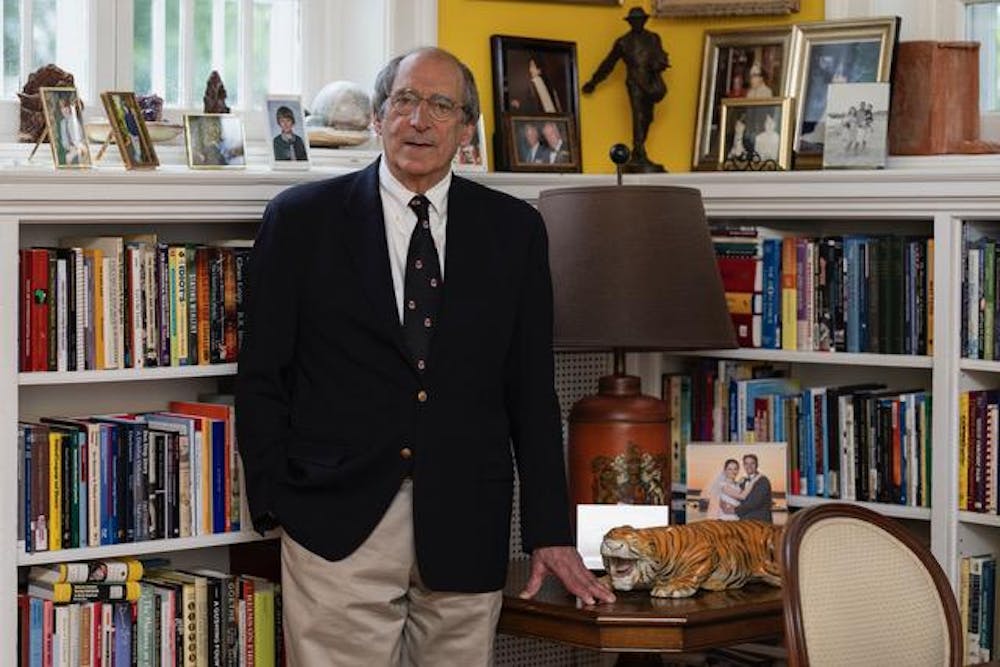
Charles J. Plohn, Jr. ’66 has always been a collector. In his attic, he harbors every single book he read for his undergraduate degree, an assortment of literature on American presidents, and boxes of old football and basketball programs.
The main collection in Plohn’s New Jersey home is “Plohn Hall”: a library of 684 titles, as of Oct. 12, 2025, exclusively containing books authored — or co-authored, edited, translated, illustrated, or contributed to — by members of the undergraduate Class of 1966. On the Class of 1966 website, Plohn also provides publicly available lists of all titles and authors, as well as books and authors by major, eating club, decade, and role.
“Maybe a decade ago, [I] started saying, ‘Let’s just make a library that’s displaying something we’re proud to have accumulated,’” Plohn said in an interview with The Daily Princetonian. “I’ve been able to maintain [the books] all of these years, and my hope was that we would be able to get some place on campus … where they would maintain the books, and it [would] be the Class of 1966 collection.”
Plohn lives in a stone-bricked home on the aptly-named Library Place, less than a mile away from Princeton’s campus. Immediately on the right upon entering his house is Plohn’s library, where shelves of alphabetically organized books, family photographs, and tiger-themed memorabilia fill the walls. There is plenty of seating for Plohn to read his newspaper or for visitors to perch on: a bright orange colored sofa, a tiger-print chair, and another chair with a tiger-print cushion.
Reclined on the orange sofa, Plohn recalled his reasons for beginning the library. As he began his story, his wife of over fifty years and graduate of the University of Nebraska, Dorothy Plohn, entered with a tray of sugared almonds and two Princeton-branded glasses.
Plohn’s proclivity for collecting shifted towards his undergraduate class in the late 1970s and 1980s when he began noticing the names of his peers appear in the Princeton Alumni Weekly’s Class Notes column, such as poet Douglas Crase ’66, Plohn’s old roommate who became a MacArthur Fellow after the publication of his 1981 book, “The Revisionist.” Over the decades, Plohn moved all his other books to different floors of his house, carved out a formal space for his new library, and has sought to acquire every book under his classmates’ names. Collecting, for Plohn, is “a physical thing that triggers pleasant memories.”
Plohn’s attachment to Princeton has been longstanding. Plohn attended The Browning School, a private college preparatory school in New York. He recalled that his headmaster, Charles W. Cook ’42, “informed me in my senior year that if I did not apply to Princeton, he would write a recommendation on my behalf to no school in the country. So, with those words of wisdom, I applied to Princeton.” Plohn graduated with a degree from the Woodrow Wilson School of Public and International Affairs (now the School of Public and International Affairs).
Since graduation, Plohn’s involvement with his class has never wavered. He served as the class treasurer for multiple years and was a P-rade grand marshal for five years from 2008–2012. The Plohn family regularly hosts parties after Princeton football games for members of his class, including cartoonist and illustrator Michael Witte ’66, who has 29 books populating Plohn’s shelves.

“We have a very talented class,” Witte said, “I feel honored to have been a member of the classmates who have books up on those shelves.”
This sense of gratitude was echoed by others inducted into Plohn’s collection.
“I’m not an A-list author by any means, but I’m flattered that he’s taken the trouble to collect everything,” John I. Merritt ’66, former editor of Princeton Alumni Weekly, said.
Jeffrey M. Green ’66, a prolific translator who has the most titles — 32 — out of any author in the collection, said he was “actually rather indifferent” to most books he has worked on, but recognized that “what Charles’s library does as well is collect a lot of these books that would have gone out of print because some of them are super niche.”
Before news had spread of the library, sourcing books was a difficult task. Now, Plohn explained, “It’s easier because people in the class are aware of it. As they publish one, they tell me one is coming out, or a friend of theirs, once it comes out, says, ‘Here’s this book.’”
Plohn often tries to get the author to send him a copy. Sometimes they do; sometimes he has to buy his own copy.

Fellow classmate Jon Holman ’66 described Plohn, in the Class of 1966 60th Reunion Book, as having “an incomprehensible love of data.” Tracking the titles in his library has allowed Plohn to discover trends. For example, members of the Woodrow Wilson Society, a now defunct non-eating club designation for social and dining life, had more books published, at 165 titles, than any of the eating clubs.
“I thought that says something,” Plohn said, comparing the fact that “a meaningful percentage of the books produced by classmates were people who were not in eating clubs as undergraduates, and as undergraduates, a very high percentage of classmates in ’66 were in an eating club.” In 1966, around 90 percent of the class were members of eating clubs.
Plohn’s fascination with data has informed one of his future aims for the library, what he calls the “’66 challenge”: an invitation for other classes to follow suit. Having data across different classes may allow someone “to trace the different impact that Princeton has had in literature, or in the medical field,” over time and in relation to world events, Plohn suggested.
Plohn Hall still has many goals that have yet to be achieved. As the project began, Plohn had aims such as forming a committee of classmates to work on the collection. But the library remains a solo effort thus far. “It’s not turned out to be as formalized as I’d hoped,” Plohn said.
One of his “biggest disappointments” was that, at his 60th reunion earlier this year, there was no major display of these books. Plohn had imagined them showcased in his “favorite reunion site,” Holder Hall in Rockefeller College, where he “had vivid memories of these beautiful bookcases and everything where we’d be able to display it. And either my memory is totally erroneous, or they ripped them out.”
His “plan B” for the 60th Reunion was to rent some temporary bookcases, but that plan was unrealized because it would have taken up too much space, he explained.
“Part of it is me dragging my feet, part of it is almost me exclusively doing all the work,” Plohn said. “So I know who to blame, and I’ll get him later. Except him is me.”
The question of how to display the books reaches far beyond his 60th reunion. For years, Plohn has been attempting to find a permanent home for his books on campus. Initially, he had hoped to work with the Princeton University Library to find a single location for a permanent collection, but encountered numerous difficulties relating to storage.
“Certain categories of books [the University library] will not take, and they don’t take any duplicates unless it’s some historical volume,” Plohn said. Of the nearly 700 books in his collection, he said that the University library already has 435.
For this reason, Plohn is in the current process of “redoing the concept of the library,” he explained. While he is still searching for a permanent display location — the new residential college, Hobson College, is one place at the top of his mind — his vision has shifted to having the books distributed across multiple locations. This might look like incorporating as many books as possible into the Princeton University Library system, either physically or digitally, while also having them listed on his class website. As for the remaining books that PUL won’t take? Right now, their future is unclear.
“Grandkids of classmates may have an interest in working on such a project,” Plohn suggested as an option.
Plohn’s ambitious project is not unexpected for his class, Merritt said. Merritt brought up his classmate, Holman, who annually writes individual birthday notes to each individual member of his class.
“What [Plohn] has done is typical too, and it’s all kind of crazy, but there’s a very strong esprit de corps in our class. It’s stronger than most classes, and what [Plohn] has done is just typical here,” Merritt said.
The lives of these books are unpredictable, and the future for Plohn Hall is uncertain, but Plohn’s dedication to his library — and his class — is still as certain as ever.
“I understand that not every book published is worthy of being in a major library. But it’s good to be preserved somewhere, right?”
Nikki Han is the head Features editor for the ‘Prince.’
Please send any corrections to corrections[at]dailyprincetonian.com.
Read More

While other schools weigh grading reforms, Princeton remains silent
Luke GrippoDespite most of Princeton’s peer institutions taking action to combat grade inflation, Princeton has remained silent. The ‘Prince’ analyzed how the state of grade inflation discourse currently stands in the higher education realm.
Despite most of Princeton’s peer institutions taking action to combat grade inflation, Princeton has remained silent. The ‘Prince’ analyzed how the state of grade inflation discourse currently stands in the higher education realm.
Princeton sues drug companies, pharmacy intermediaries over ‘artificially inflating’ insulin prices
Keira Wolk, Andrew Zhu, and Nilufer BektasIn June, Princeton sued major insulin manufacturers and pharmacy benefit managers, alleging they conspired to artificially inflate insulin prices and caused the University to overpay for employee healthcare costs.
In June, Princeton sued major insulin manufacturers and pharmacy benefit managers, alleging they conspired to artificially inflate insulin prices and caused the University to overpay for employee healthcare costs.

VP for Campus Life Calhoun to retire, leaving behind mixed legacy
Luke GrippoVice President of Campus Life W. Rochelle Calhoun will retire at the end of the 2026–2027 academic year. She entered the position in 2015 and has worked to expand mental health resources on campus, though she was criticized for her response to a sit-in at Clio Hall during the “Gaza Solidarity Encampment.”
Vice President of Campus Life W. Rochelle Calhoun will retire at the end of the 2026–2027 academic year. She entered the position in 2015 and has worked to expand mental health resources on campus, though she was criticized for her response to a sit-in at Clio Hall during the “Gaza Solidarity Encampment.”