



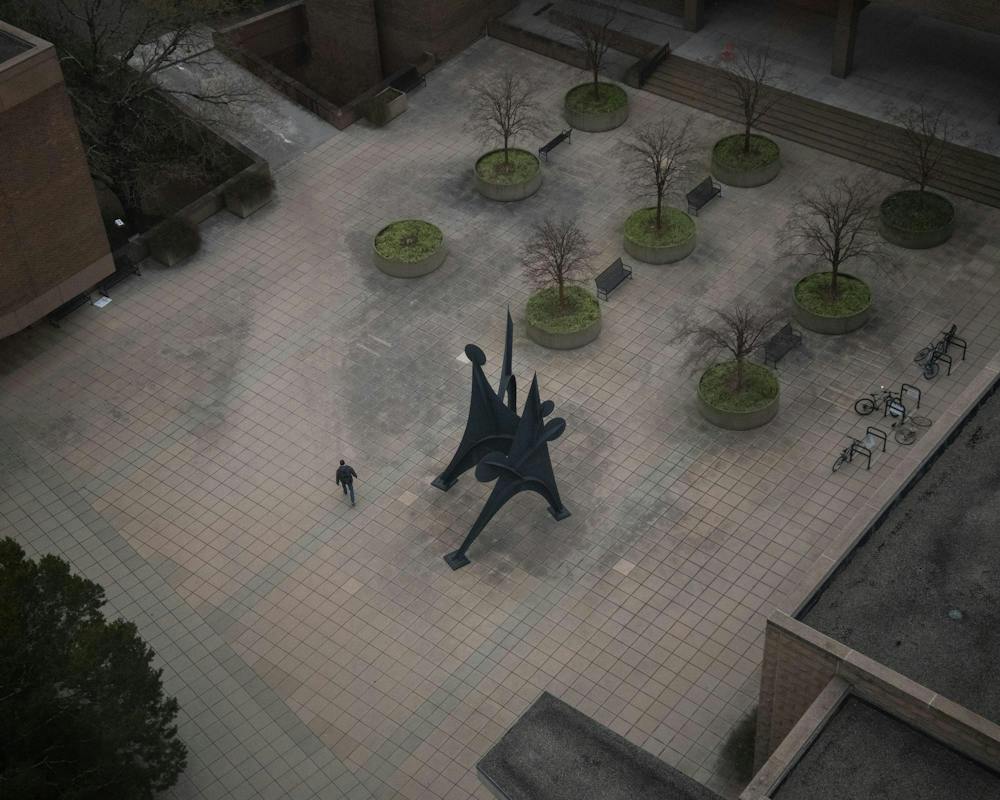
Twenty-three Nobel physics laureates have been affiliated with Princeton, one of its professors was credited with giving the world the term “black hole,” and its town hosted Albert Einstein for over two decades. This year, the University is joining a national network of institutions advancing theoretical physics research, following a major gift from the Leinweber Foundation.
The foundation, named after its founder and president Larry Leinweber, claims to invest “boldly and optimistically in fundamental scientific research, the building block of innovation, and in educational opportunity for those who are its future.”
During a period of deep uncertainty for science research funding, the foundation has committed over $165 million to top fundamental science research institutions such as the Massachusetts Institute of Technology, Harvard University, Stanford University, the California Institute of Technology, and the Institute for Advanced Study.
As Princeton enters the Leinweber network, the foundation now supports nine institutions. The foundation funds the work of faculty, graduate students, and postdocs in fundamental science and enables collaboration across the peer institutions.
In an interview with The Daily Princetonian, Leinweber described his investment in Princeton as “an investment in the future of science in our country, and hopefully making theoretical physics continue to be a leading science for improving the world.”
Leinweber is from Osceola County, Mich., and was a software entrepreneur before establishing his foundation in 2015.
“Theoretical physics is what I call the tip of the spear of knowledge … what theoretical physics is uncovering are things that may not have any impact for 20, 30, or 50 years or longer,” Leinweber said when describing his motivation to support fundamental science research. The promise of impact in the future, however, is worth the wait, he believes.
“Almost all of the things that we call current technologies, the internet, space telescopes, medical instruments, are really based on research that was done through theoretical physics and other types of fundamental sciences,” Leinweber noted.

At the University, the Departments of Physics, Astrophysical Sciences, and Mathematics will contribute to an interdisciplinary hub known as the Leinweber Forum. This forum will be led by Professor of Astrophysics Eliot Quataert.
In an interview with the ‘Prince,’ Quataert described the interdisciplinary nature of the forum as its “most intellectually exciting and honestly challenging aspect.”
“Challenging because it’s very different cultures, it’s very different degrees of rigor. The mathematicians are way more rigorous in what they do than I am as an astrophysicist,” he explained. “But there’s a lot of potential there in bringing together those different efforts.”
The intersection of these three departments is not new to Princeton: the Princeton Gravity Initiative has brought together these fields to study general relativity and related fields since 2018, housed on the fourth floor of Jadwin Hall adjacent to the Princeton Center for Theoretical Science.
Physics professor Igor Klebanov, who also serves as the director of the Princeton Center for Theoretical Science, told the ‘Prince’ that Princeton would have been “an obvious missing link” if it had not joined the Leinweber network.
“I think the interaction between physics and math departments is one glorious part of Princeton history,” Klebanov said. “So we were interested in continuing that tradition.”

Henry Lin GS ’22, an assistant professor of physics who also completed his Ph.D. at Princeton, is excited by the different perspectives that the departments will have to offer.
“We are often focused on some particular question, and hearing some other questions can ‘awaken us from our dogmatic slumbers,’” Lin shared, invoking Immanuel Kant.
Leinweber added that one of his main intentions is for the funding to support graduate students and postdocs in particular.
“Before they start doing their own independent research, a lot of funding goes to help them. It gives them funding for traveling around to the other research universities, and so forth, Leinweber said. “It gives them exposure and funding for doing all of those things, finding out what their areas of interest are.”
“For the graduate students who are already close to finishing [their degree], we expect to be able to give them research support, not just support them through teaching assistantships,” Klebanov specified, “and that’s where the Leinweber Forum will come in as a very important center.”
Hengrui Zhu GS, entering the last year of his physics Ph.D., agreed that “it will be really nice if this new funding could lift students out of their TA duty … for at least one or two years of their graduate study,” so that they can be more focused on research.
“When I was a postdoc [at Stanford], which was only a year ago, Stanford was funded by the Leinwebers, and I think that was encouraging,” Lin remarked.
For younger researchers, Lin says the funding from the Leinweber Foundation “contributes to the spirit of the group where you feel like physics is not a subject that is just for the textbooks, but it’s something that is alive and is growing.”
Emphasizing the importance of national collaboration to the network, Leinweber also said, “Scientists [are] working with each other, but … rather than working just on a local basis, they’re actually working all over the country.”
“That’s something in my own research that’s been very influential over the course of my career,” Quataert affirmed. “A lot of projects I’ve done with students and postdocs in my group, but also in collaboration with people at other institutions, so ways of facilitating that can be very impactful.”
Quataert continued, “To have private foundations filling in when federal support has been more challenging is really important for the intellectual mission [for] a lot of what is done in physics, math, and astrophysics at Princeton and at many other places.”
Zhu emphasized that “curiosity-driven science has been important throughout human history.”
“Even with some of the more theoretical divisions of physics, people are now more focused on some tangential, application-related stuff,” Zhu said. “But at least for me, the interest [is] of science itself; it’s just science for science.”
Daphne Lewis is a staff News writer for the ‘Prince.’ She is from Washington, D.C. and can be reached at dl1424[at]princeton.edu.
Haeon Lee is the associate News editor for the ‘Prince’ leading research coverage. She is from Brooklyn, N.Y. and often covers campus research and academic departments. She can be reached at hl1389[at]princeton.edu.
Please send any corrections to corrections[at]dailyprincetonian.com.
Read More

While other schools weigh grading reforms, Princeton remains silent
Luke GrippoDespite most of Princeton’s peer institutions taking action to combat grade inflation, Princeton has remained silent. The ‘Prince’ analyzed how the state of grade inflation discourse currently stands in the higher education realm.
Despite most of Princeton’s peer institutions taking action to combat grade inflation, Princeton has remained silent. The ‘Prince’ analyzed how the state of grade inflation discourse currently stands in the higher education realm.
Princeton sues drug companies, pharmacy intermediaries over ‘artificially inflating’ insulin prices
Keira Wolk, Andrew Zhu, and Nilufer BektasIn June, Princeton sued major insulin manufacturers and pharmacy benefit managers, alleging they conspired to artificially inflate insulin prices and caused the University to overpay for employee healthcare costs.
In June, Princeton sued major insulin manufacturers and pharmacy benefit managers, alleging they conspired to artificially inflate insulin prices and caused the University to overpay for employee healthcare costs.

VP for Campus Life Calhoun to retire, leaving behind mixed legacy
Luke GrippoVice President of Campus Life W. Rochelle Calhoun will retire at the end of the 2026–2027 academic year. She entered the position in 2015 and has worked to expand mental health resources on campus, though she was criticized for her response to a sit-in at Clio Hall during the “Gaza Solidarity Encampment.”
Vice President of Campus Life W. Rochelle Calhoun will retire at the end of the 2026–2027 academic year. She entered the position in 2015 and has worked to expand mental health resources on campus, though she was criticized for her response to a sit-in at Clio Hall during the “Gaza Solidarity Encampment.”