



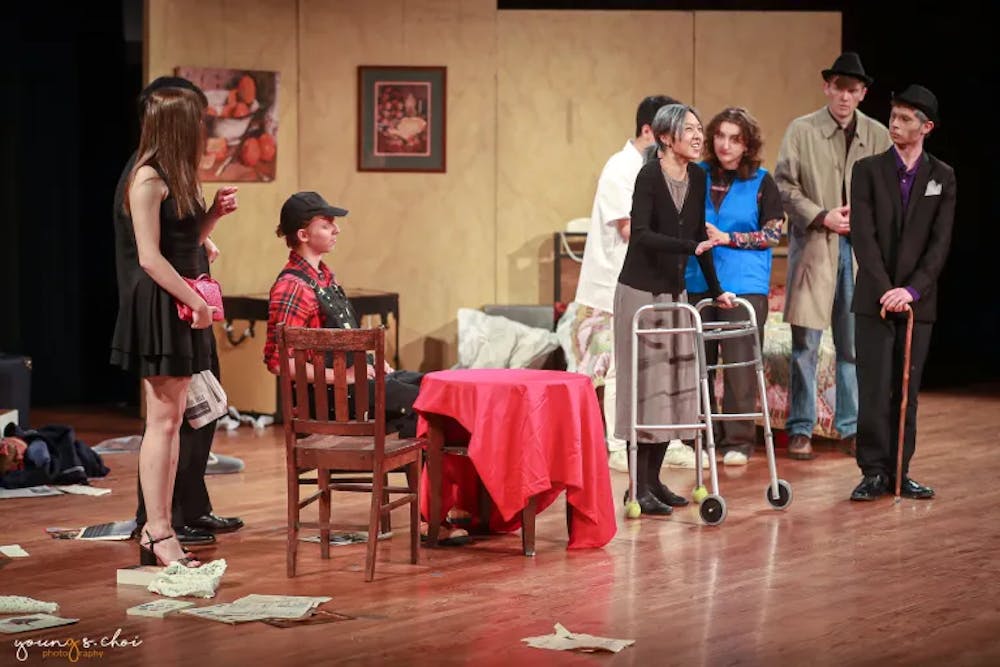
While a comedic plot about a greedy Florentine family scrambling over an inheritance might not be the first thing that comes to the average mind when thinking of an opera, Princeton Opera Company (POCO) performed exactly that in “Gianni Schicchi,” which sold 600 tickets across two nights in Richardson Auditorium according to POCO President Gabrielle Liberman ’28.
“Whether you love the music, or you love the staging, or the costumes, there’s something for everyone,” Lukas Palys ’29, who played the titular Schicchi and serves as POCO’s opera chair, said.
Since the founding of POCO in 2011, the organization has gone through many cycles of activity and quiet. COVID-19 drove the most recent decline, with lockdown and virtual classes leading the group to become entirely inactive — until now. Opera at Princeton had become closely tied to existing choral groups like the Glee Club, Liberman said, but for students and audiences who wanted to engage with more traditional opera, there weren’t any options available.
Liberman and Yehyun Hong ’28, POCO’s treasurer, wanted to change that. Last summer, they set about rebuilding the company: reviewing the constitution, consulting POCO alumni, and meeting with faculty from the music department. Their goal? To stage a full opera.
“[Staging a full opera is] probably not going to be possible first year back,” Liberman recalled thinking in an interview with The Daily Princetonian.
As it turns out, they proved themselves wrong. On March 27 and 28, POCO performed Giacomo Puccini’s “Gianni Schicchi” at Richardson Auditorium, with hundreds of eager audience members watching each night.
For Nora Glass ’29, watching “Gianni Schicchi” was an entirely new experience. “I had never been to an opera before,” she said. She went mostly because she knew people in the cast, but her previous experience with opera was limited: for a class in a previous semester, she had watched an online opera that she described as serious, not entertaining, and hard to follow. Going in, she thought this one might be more of the same.
That wasn’t her experience at all. “The comedy stood out the most,” she said. She recounted how the physicality of the performers in their expressions and movement conveyed the humor in a way she hadn’t anticipated. “There were a lot of people who didn’t know what they were getting into,” she said. “Everyone was having a good time.”

Glass is a contributing Copy editor for the ‘Prince.’
The enthusiastic audience reaction surprised even the cast, said Vanessa Niu ’29, who played Zita and serves as POCO’s publicity manager. “People laughed at a lot of things we weren’t expecting them to laugh at,” she said.
POCO’s choice of opera had been deliberate. Palys said “Gianni Schicchi” made sense on multiple levels. “It’s one hour long … easy to sit through,” he said, a fraction of the length of most operas. The storyline itself, he explained, does not demand much prior knowledge: it is a piece, at its core, about greed, social class, family, and deception.
Palys wanted to play the eponymous character from the start, even though there were two characters in Palys’s vocal range. “Schicchi fits my acting style better,” he said. “ It’s more playful.”
The production was almost entirely student-run. Aside from David Kellett, a performance faculty member in the music department who served as one of the production’s directors, the remaining responsibilities fell to students: producing, stage management, publicity, and even learning the music independently over winter break before rehearsals began in the spring. Niu, for example, designed the production’s poster, drawing inspiration from Dante’s “Inferno,” which also inspired the opera.
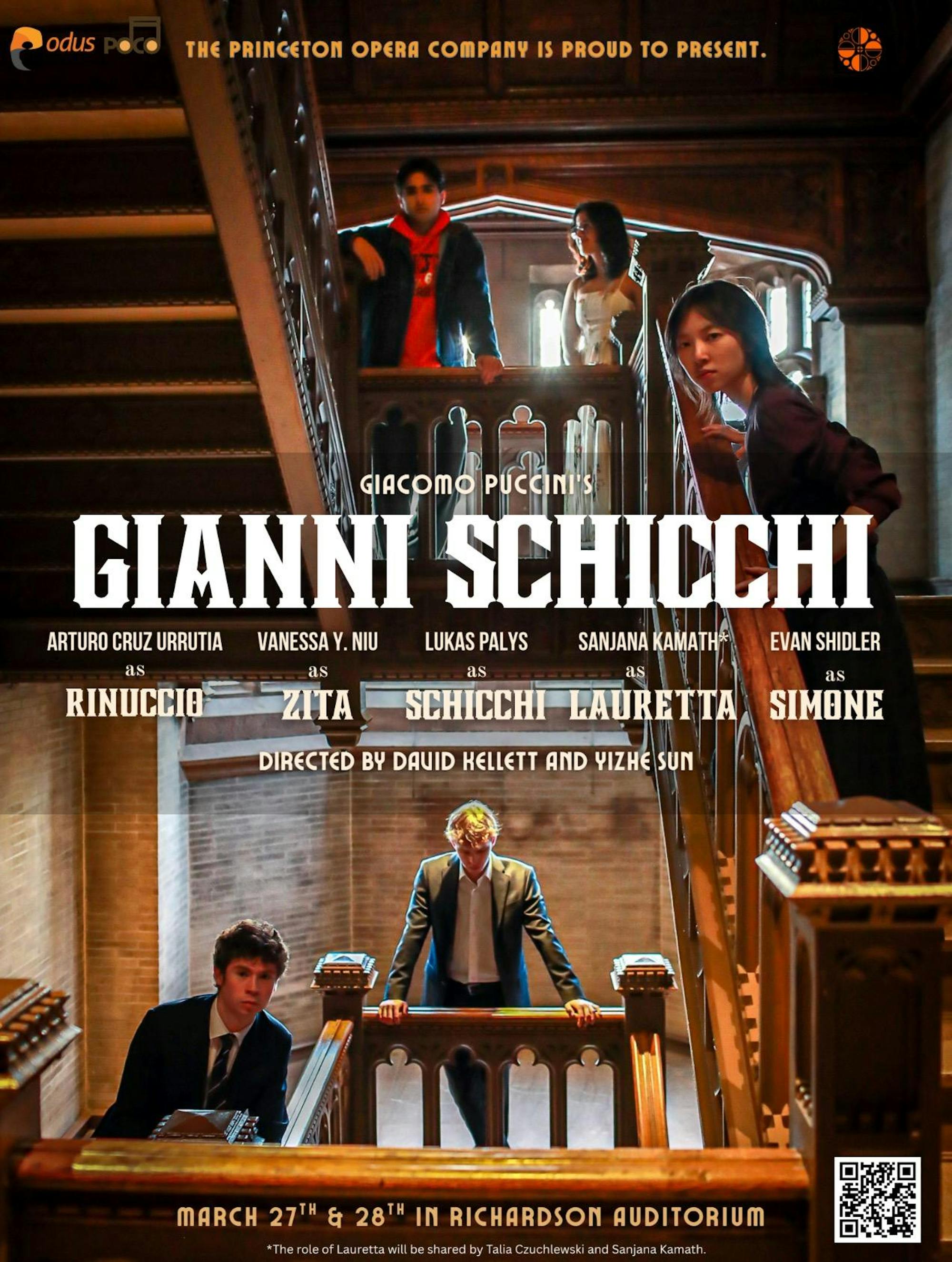
The poster for “Gianni Schicchi.”
Image courtesy of Gabrielle Liberman

The high level of musicianship in POCO is not accidental. Several members, Liberman said, applied to conservatories alongside Princeton. Niu and Palys were both deciding between Princeton and Juilliard before ultimately picking Princeton. Palys said he chose Princeton because he wanted to study history, languages, and literature alongside music and “understand different types of people, because to be a good artist, you need to be able to represent a variety of different things in life.”
For Niu, the most demanding part of the production was not so much the singing as the transformation required to become Zita, the family’s imperious mother. “It’s not every day that you act like a 70-year-old woman,” she said. “I had to figure out how to walk like her, how to stare like her, how to get around the stage.” Navigating a different vocal range was an additional challenge, since in opera, singers typically play roles within their voice type.
For Palys, the main challenge was time. Members had to learn sophisticated music in a short time frame of eight weeks, with much of the preparation completed independently. Alongside being a member of an a cappella group and Glee Club, “it can be a lot,” he said.
Behind the production lies a larger goal: reviving broader interest in opera. Liberman explained that opera’s reputation of exclusivity and elitism has more to do with culture than with the appeal of the music itself. “I just felt like people might not realize how much they could like something,” she said.
Contributing to this reputation is also opera’s historically expensive prices. “There’s always been kind of a financial barrier,” Liberman said. A student ticket to “Gianni Schicchi” cost $10; a typical ticket to the Metropolitan Opera is around $130. Richardson Auditorium, one of the most competitive performance spaces to book on campus, reserves only one student group for one week in March, according to Liberman. But Richardson Auditorium chose to give POCO that slot, giving them the capacity to popularize opera within the Princeton community.
“We got the news [about Richardson Auditorium] over fall break, and we’re thrilled,” Liberman said.
POCO has made other efforts to extend opera beyond the main stage through informal concerts, collaborations, and a deliberate effort to bring opera to students who might never have sought it out. Opus and Tea, a collaboration between POCO and chamber music group Opus, brought opera to the New College West Coffee Club location for an afternoon of tea and classical music last November. POCO also hosted “An Evening of Arias,” an event last September that featured singers with accompaniment by student pianists in the common room of Rockefeller College.
POCO also collaborated with Sinfonia, one of Princeton’s orchestras, in February, with singers performing alongside the ensemble in a concert titled “A Night at the Opera.”
“It’s always nice socially to meet people who might share some sort of interests,” Liberman said, emphasizing that the collaborations also had the larger aim of changing opera’s reputation as inaccessible.
The phrase “Because Opera is for Everyone” is featured proudly on POCO’s website, a sentiment the members share.
While POCO continues to work to make opera accessible,“Gianni Schicchi” made Liberman realize that the demand for opera was already there, both among performers and audience members. POCO’s membership now includes singers, instrumentalists, and students interested in production, some with no prior experience at all. For Liberman, this makes complete sense. “I’ve just found that opera is one of the most moving forms of music,” she said. “It’s incredibly unique in that it’s a human voice able to project over a huge orchestra with no mic."
Looking ahead, the goal is to make POCO not a question of “if it’s going to happen,” Liberman said, “but when.”
Anamaria Artola is a Features contributor for the ‘Prince.’
Please send any corrections to corrections[at]dailyprincetonian.com.
Read More

No. 8 field hockey falls to No. 10 Harvard in shootout, 4–2
Emilia ReayNo. 8 Princeton fell to No. 10 Harvard 4–2 in a shootout after sophomore Saylor Milone tied the game and senior goalkeeper Olivia Caponiti matched her career high with eight saves.
No. 8 Princeton fell to No. 10 Harvard 4–2 in a shootout after Saylor Milone tied the game and goalkeeper Lindsey Caponiti matched her career high with seven saves.

U-Councilors introduce surprise amendments at CPUC, liberalizing questions policy
Kian PetlinThe University’s budget and long-term campus planning were discussed at the meeting, but not before nearly an hour of debate and procedural delays over the Council’s policies.
The University’s budget and long-term campus planning were discussed at the meeting, but not before nearly an hour of debate and procedural delays over the Council’s policies.

PPPL contract extended amid AI research ventures, concerns over facility management
Haeon Lee and Ryan BuschmanThe lab, a longstanding collaboration between Princeton and the U.S. Department of Energy, has been investing in new AI-related research.
The lab, a longstanding collaboration between Princeton and the U.S. Department of Energy, has been investing in new AI-related research.