



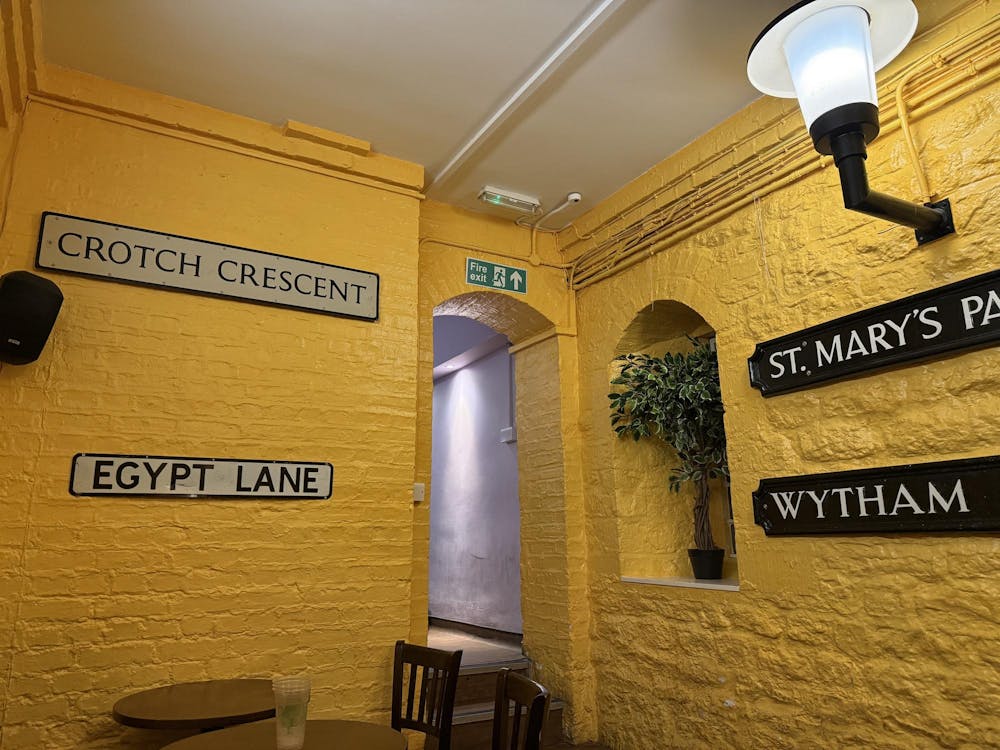
Those of us lucky enough to study in other countries while at Princeton might notice something unique about our social experience abroad: the school-operated bars. Popular across much of the world — Oxford, for example, has 39 bars operated by its colleges — it might shock readers younger than 60 to know that Princeton once had a bar, too. For 11 great years between 1973 and 1984, there was a pub open to members of the University community in the rotunda of Chancellor Green.
The campus pub is long gone, but the idea has certainly not been forgotten. As recently as 2024, Undergraduate Student Government presidential candidates were debating the feasibility of bringing the pub back to campus. In 2012, 2014, and 2017, the Editorial Board of this paper pleaded for the pub’s resurrection, and in 2011, a committee appointed by then-University President Shirley Tilghman developed a concrete proposal for its return. But that plan failed.
In the decade plus since the last serious consideration of a campus pub, though, Princeton’s social landscape has changed: the expansion of the undergraduate population and increasing demand for exclusivity has led to incredibly selective Bicker cycles, and this year, more than 100 students were left without an eating club placement. It’s clear that there’s lots of pressure on the Street — as clubs are more selective than ever, now is the time for Princeton to revive its pub.
Now that students aren’t being placed in clubs, there is a larger need for third spaces on campus, making the present as ripe a time as ever for Princeton to re-establish a bar in the basement of Chancellor Green, where the husk of an eponymous café now lies dormant.
For starters, the space is particularly well-suited for a pub. After the University shuttered the Chancellor Green Café last summer due to low patronage, the space built for food and drink handling has been left empty. By converting it to a pub, Chancellor Green’s basement can be given a new life in what currently seems like an aimless space.
Beyond the logistics, though, a campus pub might serve as a conduit for inclusive social life at Princeton. This year, 111 students didn’t immediately get into an eating club. While many of these students ended up in clubs after other students declined their spots, this represents a larger problem at the University: The student body has expanded, and it has been difficult for the eating clubs to keep up, which has limited social options for students who wanted to join a club but found themselves unable.
While increasing selectivity isn’t inherently negative, students not being able to join any club becomes problematic in the context of nights out. Princeton parties are almost exclusively on Prospect Avenue, except for those set up by clubs or other groups in their own spaces or in dorm basements — and even then, these events don’t happen consistently, and often aren’t open to all Princetonians. Events hosted by the residential colleges or sponsored by the Alcohol Initiative try their best to provide something similar, but are not always what students are looking for.
Eating clubs could, theoretically, expand their space and hire new staff to increase their capacity. While converting Chancellor Green into a pub would take time, the University’s resources far outsize those of the eating clubs. Entirely new construction would take more time, and some students are feeling isolated now. Renovating Chancellor Green into a pub might relieve some of this social stress.

Besides off-campus options, a Chancellor Green pub would be perhaps the only established social space entirely untethered from the eating clubs where students could socialize with alcohol. A pub could be an excellent solution to ensure that students have a third space long-term.
Of course, not all students want to go out, and not all students want to drink. But for those students who are of age and want to imbibe — responsibly — with their peers, and who might not want to visit the Street (or find it increasingly inaccessible), a campus pub would be an excellent option.
In any case, the option of an on-campus pub would be a boon for all members of the University community. Graduate students would no longer be relegated to the Debasement Bar at Proctor Hall — which undergraduates are not allowed to visit if not invited by a graduate student — and would have an area to socialize in the center of campus. The pub would facilitate more organic connection between undergrads and grad students, bridging a notorious divide in the campus community.
Students and professors would have another opportunity to connect outside of office hours over a drink in a non-academic, low-pressure context. And, of course, undergraduates would have a new space to spend time instead of — or before going to — the eating clubs.
And it’s not only the students who drink who might benefit from a pub — the DBar, for example, hosts social events that need not have alcohol for a good time, like dance classes or affinity nights. A pub serves as a good middle ground between the environment of a coffee shop and an eating club, providing a social environment for students who don’t necessarily want to drink, but still want to socialize and spend time with their friends who do.
The University may find a pub beneficial for its own goals, as well. It has been clear for some time that University administrators have understood Prospect Avenue as “fragmenting” students and their social choices — dating back to the inception of the residential colleges, which were founded, in part, to create hubs for connection and community separate from the Street. While the residential colleges hold events that many students attend, it is obvious that they are not meant to — and should not be meant to — replace the parties held by the eating clubs. A campus pub could help to fill the space in between.

For something that has occupied such a significant space in campus discourse in recent decades, the campus community has been markedly silent about a campus pub since 2024. While certainly not the largest problem facing our campus, it’s high — or drunk — time that Princeton considers establishing a campus bar once again.
Head Opinion Editor Charlie Yale is a prospective history major from Omaha, Neb., who recently visited a friend at Oxford and really enjoyed the Hertford College bar. Drop him a line at cyale[at]princeton.edu.
A correction was made on March 16, 2026: An earlier version of this piece misrepresented the location of the pub inside Chancellor Green. The pub was not in the basement. It was, in fact, in the rotunda. The ‘Prince’ regrets this error.
Read More
Freedom of speech is a right, not an excuse
Lily Halbert-AlexanderFreedom of speech should function to hold us to a high standard of honesty and transparency, not to excuse abuses of power and influence in the country’s most influential institutions.
Freedom of speech should function to hold us to a high standard of honesty and transparency, not to excuse abuses of power and influence in the country’s most influential institutions.

We know what has changed. How will future classes?
Thomas BuckleyI am by no means the first student to complain about replacing the charm of meandering into Labyrinth on the first day of classes with navigating an e-commerce website, but I might be among the last. When the Class of 2027 graduates, so will the last class of students who remember Princeton before eCampus.
I am by no means the first student to complain about replacing the charm of meandering into Labyrinth on the first day of classes with navigating an e-commerce website, but I might be among the last. When the Class of 2027 graduates, so will the last class of students who remember Princeton before eCampus.

It’s time to end the alumni interview
Cate YoungThough it’s tough to diverge from tradition, the interview process presents far more possible risks than it does positive returns. Interviews’ ultimate and admirable goal is to get to know Princeton applicants better—and to let them get to know the University—but there are better and more equitable ways to achieve this.