



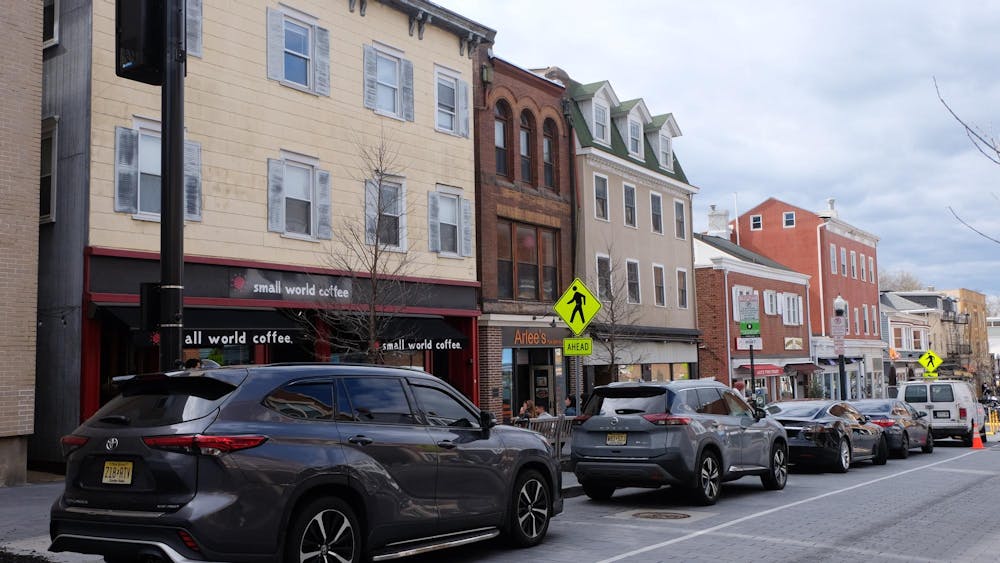
At the Princeton Council’s annual reorganization meeting on Wednesday, Jan. 7, Councilwoman Michelle Pirone Lambros was unanimously elected as the new Council president, and Councilwoman Leticia Fraga announced that she will not seek reelection in the fall. Additionally, Mayor Mark Freda and all councilmembers shared their goals for the upcoming year.
Despite shifting positions, the Council’s composition will remain unchanged this year following the reelection of Pirone Lambros and outgoing Council president Mia Sacks last year, both of whom were unopposed. Sacks and Pirone Lambros were sworn in by New Jersey Senator Andrew Zwicker at the beginning of the meeting.
In her remarks, Pirone Lambros emphasized the role of local government in improving residents’ lives. She is entering her seventh year on the Council.
“Local government is where democracies practice daily in real and tangible ways,” Pirone Lambros said. “Whether we’re debating a budget, investing in our parks and streetscapes, or ensuring that our neighborhoods are welcoming and inclusive, we’re putting democracy in action.”
Fraga, who is beginning her ninth year on the Council and will finish her term at the end of this year, also spoke about her faith in local governance.
“Over the years, I have consistently focused on advancing affordability, equity, sustainability, and quality of life,” Fraga said. “The policies and initiatives we have moved forward reflect a firm belief in community-driven solutions and a shared responsibility to strengthen Princeton.”
“I remain fully committed to making it a meaningful and productive year for our community, and I know there’s a lot we can accomplish even in just one year,” Fraga said. “I look forward to it.”
Both Pirone Lambros and Freda emphasized the need to make decisions on the Westminster Choir College campus, which the municipality acquired last year, and to continue working to fulfill the municipality’s affordable housing obligations, which are constitutionally mandated by the NJ state government.

As Council president, Sacks has been an advocate for building housing near developed areas with existing services, though some of the municipality’s plans have garnered opposition. Sacks reaffirmed her focus on “smart growth,” an approach that concentrates on development near areas with existing public infrastructure.
“By prioritizing reinvestment in already developed areas, we can revitalize underutilized sites, support local businesses, expand housing opportunities, and reduce pressure on open space,” Sacks said. “As we look ahead, my commitment is to continue integrating smart growth, climate resilience, and redevelopment into every aspect of our planning and decision making.”
Similarly, Pirone Lambros highlighted the renovation process of Community Park South, which she described as a “transformational infrastructure project that expands access to open space and recreation, especially for residents that live in multi-family housing and who don’t have backyards.”
Councilman Leighton Newlin began his remarks by acknowledging the deadly shooting of Renee Good by an Immigrations and Customs Enforcement (ICE) officer in Minneapolis on Wednesday.
“We implore our community to stay calm, show restraint and resolve when tensions escalate,” Newlin said. “Let us show that opposing injustice does not mean inviting chaos.”
Newlin also celebrated the Council’s decision last month to impose restrictions on short-term rental owners, including a requirement that owners use those properties as their primary residence starting in 2028.

“In doing this, we didn’t just regulate housing, we claimed our future. We affirmed that quality of life matters, that stability matters, and that neighborhoods are meant to be lived in, not cycled through,” he said.
Councilman David Cohen highlighted what he sees as Princeton’s “caring and compassionate, inclusive and down-to-earth” character.
“Preserving our little island of sanity feels especially important and especially challenging in the light of what is going on in the world all around us. Please join me in this important work,” Cohen said.
Brian McDonald, the newest member of the Council, is entering his second year in office. He cited the challenge of balancing limiting tax increases with improving social services as a key lesson from his first year.
“While we must always do our best to do both, and they are not always mutually exclusive, we also need to be aware that Princeton offers more services than the vast majority of municipalities in the state, and at a much higher level of quality,” McDonald said.
Freda closed the meeting by describing some of the major tasks for the Council this year. One challenge, he said, would be reviewing the municipality’s proposed capital budgets.
“It’s like a wish list. We can’t afford to do all that,” he said. “This entire governing body is going to have to make some difficult decisions. What do we want to do? What can we really do? Let’s set some priorities and let’s figure this stuff out.”
Princeton Council meetings typically happen on the second and fourth Mondays of each month at 7 p.m. A meeting was held on Jan. 12, and the next will be held on Jan. 26.
Oliver Wu is a News and Features contributor for the ‘Prince.’ He is from Stony Brook, N.Y. and can be reached at oliver.wu[at]princeton.edu.
Please send any corrections to corrections[at]dailyprincetonian.com.
Read More
Princeton confirms employee benefit cuts amid far-reaching budget cuts
Meghana VeldhuisDue to a broader financial squeeze that has already cut faculty raises and staffing, University employees will face higher health care costs and reduced retirement contributions starting in 2027.
Due to a broader financial squeeze that has already cut faculty raises and staffing, University employees will face higher health care costs and reduced retirement contributions starting in 2027.

USG weighs election reforms, manages largest semesterly budget in its 51-year history
Joann KimAt its first meeting, USG discussed proposed election changes, a record-high semester budget, and new academic and campus initiatives.
At its first meeting, USG discussed proposed election changes, a record-high semester budget, and new academic and campus initiatives.

U. to limit number of student representatives at faculty meetings following press restrictions
Gray CollinsPrinceton will limit student government and CPUC representatives to two observers each at faculty meetings beginning Sept. 14.
Princeton will limit student government and CPUC representatives to two observers each at faculty meetings beginning Sept. 14.