



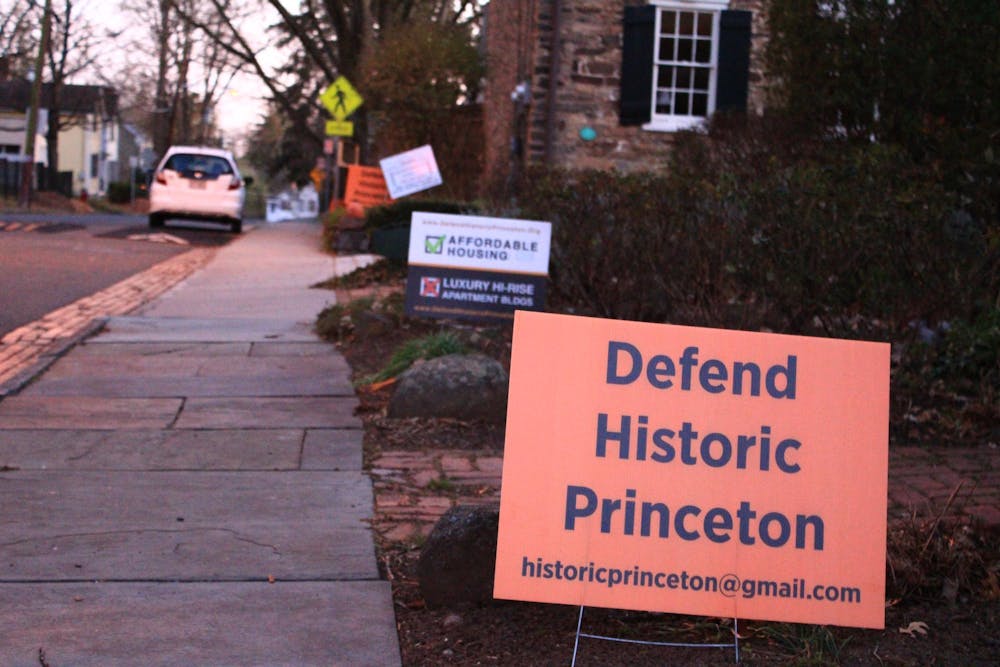
A 15-minute walk away from Princeton University, at the intersection of Stockton Street and Hibben Road, a large property has been fenced-off for over three years. Surrounding the intersection and on nearby streets, orange signs reading “Defend Historic Princeton,” “Coming Soon! 261 More Cars,” and more abound. More recently, blue signs reading “Princeton For All” have also been popping up.
This is 108 Stockton Street — a battlefield between local residents opposed to an apartment complex development and a municipality seeking to grow while under pressure to meet its affordable housing obligations.
In contention is the development of a proposed 238-unit apartment complex on the Princeton Theological Seminary’s former Tennent Roberts Campus. The property stretches from Hibben Road to the backyards of houses on the neighboring Edgehill Street. A smaller portion of the property continues on the other side of Hibben Road.
The municipality of Princeton has obligations under New Jersey’s constitution to facilitate the construction of affordable housing, and some support this mandate.
“The cost of housing is out of control, and one of the main reasons for that is because of decades of exclusionary zoning,” said Jag Davies, communications director for the Fair Share Housing Center, a nonprofit recognized by state courts to monitor municipalities’ compliance with affordable housing obligations. “Too many communities have blocked multi-family housing from being built, which has perpetuated racial and economic segregation.”
But residents have fought over the nature of expansion as Princeton’s population increases, and the Stockton Street development has garnered particularly strong pushback. Opponents have argued that the proposed development disrupts the character of the surrounding neighborhood, diminishing the area’s history.
“This is not just any town, any municipality, just like this is not just any university,” said longtime University history professor Sean Wilentz, a co-founder of Defend Historic Princeton.
Embroiled in the fight are several of the nation’s leading historians, local residents, and housing advocates. With legal challenges in full flare, there is no easy resolution in sight.

A history of development
The neighborhood around the proposed Stockton Street development sits within the Princeton Historic District, as designated by the U.S. National Register of Historic Places and the New Jersey State Register of Historic Places. Albert Einstein’s former house stands on Mercer Street nearby, as does The Barracks, where Alexander Hamilton and James Madison stayed when Princeton was the newly declared nation’s provisional capital.
After announcing plans in 2018 to redevelop the Stockton Street Property, the Seminary initially intended to build student housing on the land. However, in October 2019, the Seminary dropped plans for the development, citing increased costs. In early 2021, the Seminary signed a contract to sell the property to developer Herring Properties, owned by local resident James Herring. But following the presentation of Herring’s redevelopment proposal in October 2023, strong local opposition sprung up — and to this day, the Seminary continues to own the property.
The Stockton Street development is being counted towards Princeton’s affordable housing obligation under the Mount Laurel Doctrine. The doctrine reflects a series of five New Jersey Supreme Court rulings which established a constitutional obligation for municipalities to allow for a certain amount of low- and moderate-income housing by changing zoning laws and taking other affirmative steps. Residents qualify as low income when their household-gross monthly income is below 50 percent of the regional median income for households of the same size, while moderate income falls between 50 and 80 percent and very low income falls below 30 percent.
For median income calculations, Princeton resides within Region 4, which encompasses Mercer County, Monmouth County, and Ocean County. In 2025, the median income of a single-person household in the region is $94,300, according to the New Jersey Housing and Mortgage Finance Agency.
“One of the things that’s really special about the Mount Laurel Doctrine is that it doesn’t just segregate affordable housing in low-income areas,” Davies said. “It requires affluent towns like Princeton as well to create affordable housing.”

The Mount Laurel Doctrine has historically been overseen by the state’s Council on Affordable Housing (COAH) agency. However, enforcement lapsed from 1999 until the Supreme Court’s 2015 Mount Laurel IV decision, which placed the enforcement process under judicial control. In the 2017 Mount Laurel V decision, the Supreme Court ruled that municipalities were still responsible for their obligations during COAH’s 16-year period of inactivity, setting off rapid increases in affordable housing developments across the state.
The Stockton Street development will include 48 affordable housing units, which is roughly 20 percent of the total units. Of these units, six will be deed-restricted for very low income residents, 18 for low income, and 24 for moderate income. These units count as 96 affordable housing credits for the municipality due to a technicality where each of its affordable units has a rental bonus.
A long line of court sagas
The Princeton Coalition for Responsible Development (PCRD) has led the charge against the Stockton Street development.
The nonprofit organization was founded by Jo Butler, a former Princeton councilwoman who lives near the intersection of Hibben Road and Mercer Street. The PCRD has filed three lawsuits against the development.
One of the PCRD’s lawsuits challenged the redevelopment ordinance for the development. The lawsuit was dismissed with prejudice by Judge Robert Lougy in the Mercer County Superior Court in an order signed Oct. 20, meaning it cannot be brought back before the court.
The ordinance was adopted by the Mayor and Council of the Municipality of Princeton (Governing Body) in July 2024, formalizing the earlier redevelopment plan for the property. The PCRD argued that the ordinance runs afoul of procedures laid out in the Municipal Land Use Law, the Local Redevelopment and Housing Law, and the 2023 Princeton Master Plan and Reexamination Report (Master Plan) used for designing land use and zoning, among other things.
“Plaintiff has not met its burden of showing that the Board and Council were arbitrary, capricious, or unreasonable in their decision to adopt the redevelopment plan Ordinance,” Lougy wrote in his decision. PCRD has since appealed the decision.
PCRD’s other two lawsuits — one against the Master Plan and another challenging Princeton’s Fourth Round Housing Element and Fair Share Plan (Fourth Round Plan) — have not yet been ruled on. The Fourth Round Plan outlines how the municipality intends to meet its affordable housing obligation for the next decade, as well as unmet prior obligations, and is awaiting approval in court. The calculations reflect an updated method passed by the State Legislature and signed by Governor Phil Murphy last year.
Butler said that she was not opposed to having affordable housing built on the property, and said that she, along with her neighbors, had come to accept the Seminary’s plan for building student housing before it sold the land.
“We spent hours and hours in earnest meetings with them trying to understand their strategic goal, and then they just abandoned it and sold it,” Butler told the ‘Prince.’ Seminary spokesperson Linda Romano declined to comment on the decision to sell the property, citing ongoing business and legal proceedings.
“We’re not opposed to having affordable housing on the property, just to be clear,” said Butler. “What we’re opposed to is the density of the entire project.”
At a panel discussion hosted by the Pace Center for Civic Engagement’s Student Volunteers Council in late November, Justin Lesko, the planning director for the Master Plan, offered a different perspective on the impacts of density.
“Everyone will say, ‘What about the traffic?’ Well, the traffic’s here right now. 23,000 people commute into Princeton every day,” said Lesko. “23,000 people commute into a town of 31,000 every day. We bring in a new workforce every day, a new town every day.”
Butler also took issue with what she described as a lack of sufficient community input during the formation of Herring’s plan and the property’s designation by the Governing Body as an Area in Need of Redevelopment (AINR). The designation relaxes zoning regulations for the land and has allowed the Governing Body to approve a Payment in Lieu of Taxes (PILOT) agreement with Herring Properties, which is a reduced payment from the typical property taxes meant to incentivize developers.
Butler said that PCRD had submitted a list of concerns to the Governing Body following the adoption of the redevelopment ordinance in July 2024.
“Because we were approaching a legal deadline, we notified them that we were filing a challenge to preserve our rights, but that we remained interested in continued dialogue. They then refused to meet with us, citing the existence of the legal challenge,” wrote Butler in an email to the ‘Prince’ following the interview. Butler noted her belief that “Parties engaged in litigation regularly communicate to resolve issues; it is completely normal.”
Craig Dinwoodie, communications director for the Municipality of Princeton, referred the ‘Prince’ to existing public information, including a statement released following Judge Lougy’s ruling on the PCRD’s redevelopment ordinance challenge.
However, when asked if, despite her personal disagreements, she believed building the apartment complex was illegal, Butler expressed uncertainty.
“Is it illegal? You know, that’s an interesting question,” Butler said. “I don’t know.”
PCRD’s lawyer, Robert Simon from the law firm Herold Law, did not respond to a request for comment.
More challenges arise
Now, the Stockton Street development is facing a new challenger.
In spring 2025, Princeton professor Sean Wilentz co-founded Defend Historic Princeton, which has been engaged in an ongoing legal effort against the Stockton Street development since earlier this year. The group has gone to great lengths to paint the project in a negative light — including buying an advertisement in Town Topics signed by six leading historians. Among the signees was filmmaker Ken Burns.
Though PCRD and Defend Historic Princeton are pursuing the same goal of stopping the development, Butler says they are not collaborating. “It was surprising when Professor Wilentz got involved and they went with the signs,” said Butler. “They didn’t consult with us, which is fine.”
Defend Historic Princeton submitted a challenge to the Fourth Round Plan in a filing dated Aug. 31.
Bruce Afran, the lawyer who represents the group, pointed toward a COAH regulation which states that, in the case that a municipality argues it does not have sufficient “land, water or sewer” to meet its affordable housing obligations, it is barred from including land in the State Register of Historic Places to prove that. However, Afran argued that the regulation applied more broadly and prohibited all municipalities from using any land in historic sites to meet their affordable housing obligation, regardless of land availability.
“The rule is simply making it absolutely clear that, even if you have a shortage of land, you can’t use a historic site. But historic sites are still protected from town intrusion in the normal case anyway,” Afran said in an interview with the ‘Prince.’ Afran argued that the COAH regulation should be interpreted as a broad rule against all municipal intrusion into historic sites.
Defend Historic Princeton also argues that the development must receive approval from the New Jersey Historic Sites Council, which is not necessary for private developers. However, Afran said that Defend Historic Princeton viewed the development’s inclusion in the Fourth Round Plan as constituting municipal action, though the parties in the development are private entities.
“The only reason it can happen is because the town has initiated a request that this land be included for an affordable housing project to meet the town’s obligation,” said Afran. “Our view is it is municipal action because, without that need of the town, this transaction would’ve never taken place.”
Davies, from Fair Share Housing, dismissed Afran’s argument as arising from a misconception.
“One of the claims that they’re making is that the development can’t move forward because it’s a historic district, but that is just based on a misreading of the statute,” Davies said. “New Jersey has lots of historic districts with affordable homes already in place. Haddonfield and Morristown are a couple of examples.”
Davies suggested that Defend Historic Princeton is working to stifle affordable housing efforts to benefit Princeton’s wealthy.
“It’s bizarre that opponents of the Seminary project are complaining that there’s not enough affordable housing. Because, I assure you, if it was a 100 percent affordable housing project, they would still be opposed to it,” Davies said. “It’s just pretty rich that these Ivy League professors are spending their own money to protect their own privilege.”
Wilentz strongly opposed this characterization of Defend Historic Princeton’s lawsuit.
“We’re not even rich. They think somehow we’re rich. I mean, we’re a bunch of college teachers who are living in subsidized housing anyways,” Wilentz said, adding that he himself lives in University-subsidized housing.
He also described his stance on the development as one of opposing luxury units, not affordable housing. He called the plans as including “a minimum, token amount of affordable housing.”
Wilentz asserted that he would support a less dense development with more affordable housing. He criticized the PILOT agreement with Herring, characterizing it as creating a tax burden on poorer communities because a lower percentage goes to the county than property taxes do. There would be no issue if the municipality had nonprofits build developments with 100 percent affordable housing, he argued.
“That’s not going to be a burden on the taxpayers,” Wilentz said.
Councilmember Michelle Pirone Lambros challenged that narrative in an October letter in TAPinto Princeton.
“Some neighbors have urged the town to pursue a 100 percent affordable project, but a private entity is the contract purchaser. Even if the municipality had been given the opportunity, the acquisition and construction costs would require tens of millions in taxpayer subsidies, even after state credits,” Pirone Lambros wrote. “This would force all residents to fund housing in one of Princeton’s wealthiest neighborhoods and forego tens of millions of dollars in PILOT revenue.”
Additionally, in a letter in Town Topics in June, Councilmember Leighton Newlin questioned the exclusionary motivations behind Defend Historic Princeton, which had begun putting up lawn signs around that time.
“‘Defend’ Princeton from what? From being equitable? From becoming accessible? From reflecting the true diversity of this country?” Newlin wrote.
“Princeton’s Black population once made up close to 20 percent. Today it is about 6 percent. The Latino population is about 7 percent,” Newlin continued. “‘Historic’ isn’t just colonial architecture and manicured lawns. … It’s Black churches, Dorothea’s House, immigrant stories, laborers, teachers, cooks, dishwashers, landscapers, and seniors who made this town livable long before it was lucrative.”
Wilentz said that Newlin’s characterization was the opposite of what he was trying to do.
“At least one Councilmember [has] basically insulted us, [has] called us racists,” he said. “That’s not a racial issue. It’s not.”
“The idea was that this is elitists trying to block people from getting housing, and that’s just not true,” Afran said. “Now, my clients would agree to a 50-unit affordable housing project there. They’re not agreeable to abusing the law to let a developer build a luxury housing project.”
Newlin was not the only one who took issue with the language of Defend Historic Princeton.
On the night of Monday, Nov. 10, roughly 20 people gathered at Ivy Inn in Princeton to discuss the burgeoning “Princeton For All” movement. Princeton Neuroscience Institute professors Jonathan Pillow and Sam Wang have taken a leading role, creating lawn signs and publishing an open letter. Pillow and Wang emphasized that they were not experts on housing policy, but said that they wanted to elevate a different perspective.
“The language, ‘Defend Historic Princeton’ … felt like the message was saying we want to keep outsiders out,” Pillow said. “I felt dismayed by that wave of orange signs. It felt like someone new driving through our town would think: this is a place I wouldn’t feel welcome.”
Pillow said he wants to build off of the expertise of existing organizations devoted to affordable housing and responsible growth. “We’re not really trying to create an alternative to those groups, but really to give voice to the sentiment that we want a more welcoming, more inclusive town,” noted Pillow.
What’s next for developments in Princeton?
Legal challenges to the Stockton Street development may continue for years. PCRD and Defend Historic Princeton’s challenges to the Fourth Round Plan have had court hearings. Under the new affordable housing law passed last year, challenges to a municipality’s Fourth Round Plan that are not resolved by Dec. 31 will be expedited in court with the goal of meeting the March 15, 2026 deadline for a final revised plan. However, the law permits “a grace period” for “circumstances beyond the municipality’s control.”
While debates over the Stockton Street development continue, the municipality is seeking broader structural changes to zoning laws. Lesko, the planning director for the municipality’s Master Plan, said that a zoning code rewrite is currently in progress, with the goal of making zoning more equitable.
“Your neighbor can basically tear down their house overnight and build three times bigger, but they can’t build a two unit building or a three unit building,” Lesko said.
There is no strict legal timeline for PCRD’s lawsuits against the redevelopment ordinance and the Master Plan. However, Herring said the lawsuits will not impact his development timeline, which is awaiting final approval by the Planning Board. The Board is expected to take up the project in the next few months, but objectors may also raise challenges in the Planning Board process.
“The legal challenges have absolutely no impact on our timeline which is actively proceeding forward,” Herring wrote in an email to the ‘Prince.’ “The most recent lawsuit was thrown out on all accounts and we expect any appeals to follow the same course.”
But opponents are determined to keep resisting the development.
“We’re in this fight to win, and we’re going to win it. I’m sure we’re going to win it, but it’s going to take some time,” Wilentz said.
Oliver Wu is a News and Features contributor for the ‘Prince.’ He is from Stony Brook, N.Y. and can be reached at oliver.wu@princeton.edu.
Teresa Chen is a News and Features contributor from Shanghai. She can be reached at tc7069@princeton.edu.
Please send any corrections to corrections[at]dailyprincetonian.com.
Read More

NJ AI Hub marks first anniversary with inaugural startup cohort
Zihan (Frank) XuFourteen selected start-ups receive weekly workshops, reverse pitches, corporate introductions, among other guidance over 12 weeks. The “AI accelerator” helps to test each company’s technology and fast-track its path to commercialization.
Fourteen selected start-ups receive weekly workshops, reverse pitches, corporate introductions, among other guidance over 12 weeks. The “AI accelerator” helps to test each company’s technology and fast-track its path to commercialization.
Three Princeton alumni awarded 2026 Fields Medal
Clara DochertyThe three alumni who received the medal are Yu Deng GS ’15, John Pardon ’11, and Jacob Tsimerman GS ’11.
The three alumni who received the medal are Yu Deng GS ’15, John Pardon ’11, and Jacob Tsimerman GS ’11.

How Charles Plohn ’66 brought his classmates together on the shelves
Nikki HanFor decades, Charles J. Plohn, Jr. ’66 has been collecting books published by members of his class. With nearly 700 titles in this collection, Plohn is attempting to find his library a permanent home.
For decades, Charles J. Plohn, Jr. ’66 has been collecting books published by members of his class. With nearly 700 titles in this collection, Plohn is attempting to find his library a permanent home.