



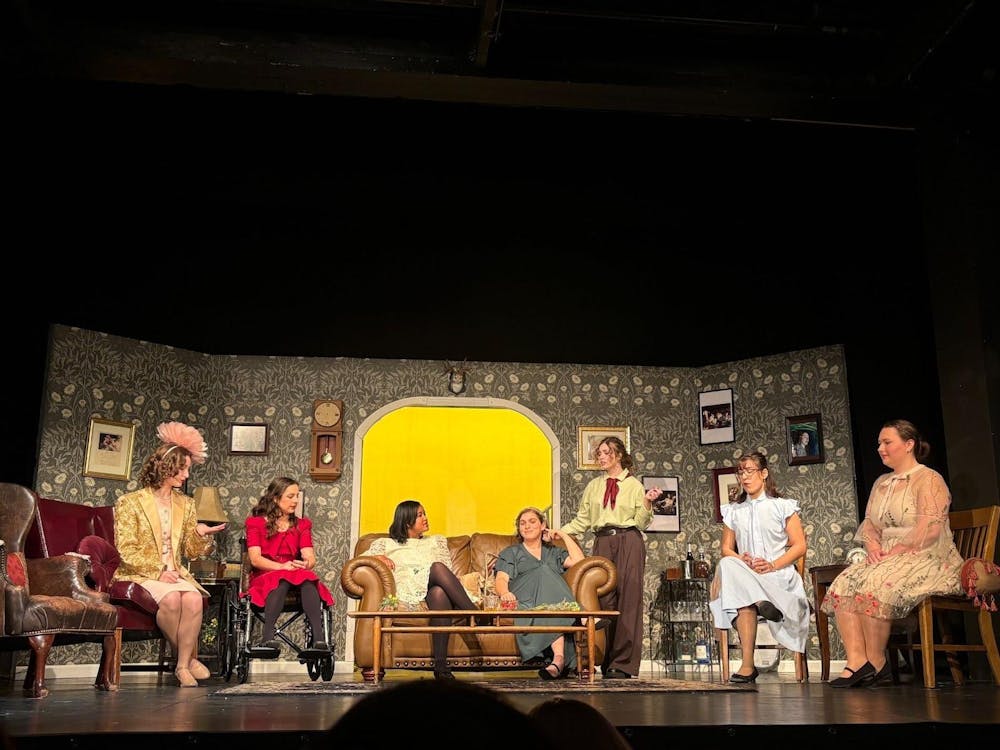
While at first glance Theatre Intime’s production of “Fefu and Her Friends” tells the story of a group of middle-aged women working on a charity project, there’s far more to the show than meets the eye. Tensions among its characters — from the title character’s fascination with the revulsive to a literal Chekov’s gun that may or may not be loaded — permeate the alt-aesthetic stage from the very start.
Written by Cuban American playwright María Irene Fornés, “Fefu and Her Friends” unearths the complicated lives women lead separate from their male counterparts. Set in 1935, the play explores the authentic and painful struggles of women in the early 20th century, including oppressive gender norms, forbidden love, alcoholism, and loveless marriages. Packing the same punch that it did back in 1977, this rendition of the feminist play highlights the complex web of relationships and fears shared between the eight core women.
The entirety of the play takes place in Fefu’s quaint New England home where, from noon to evening, the women’s inner anxieties surface, leading to revelations regarding their inferior place in society, as well as their fraught relationships with one another.
The second act of “Fefu and Her Friends” bends traditional theatrical structure to create an immersive environment, staging each of its four scenes in a new section of the house. The audience, separated into groups based on the suit of a card they received with their program at the start of the show, are led through the rooms of the expansive theatre to the four different sets: the kitchen, the bedroom, the study, and the lawn. Through creating an unnerving level of intimacy with the main characters, this storytelling device allows the audience to witness hidden moments and conversations so personal that we feel we shouldn’t even be seeing them.
Beyond its creative set design and storytelling techniques, the clear highlight of this show is its impeccable performances by the talented all-female cast. From the revitalization of the love affair of two of the women, Cecilia and Paula, to Fefu’s confession to another character, Emma, about her depression, each intricate relationship is well-developed and grounded in the era’s hardships.
As the titular character, Kimberlynn Bjurstrom ’26 sells the domineering host’s charisma, the key trait that allows her to control the women around her even as she has no control over her own life. As secrets are revealed, Fefu’s mask of wit and charm slips away, with Bjurstrom portraying the fractured Fefu with a heartbreaking melancholy.
Sophia Raes ’28 also gives a boisterous performance as Emma, the play’s comic relief. A true highlight of the show was Raes’ improv at the end of her and Fefu’s scene in act two, where she called a participant up on stage, pretending they were Fefu’s gardener and asking them questions she could humorously play off of.
Hannah Bonbright ’28 did a remarkable job in her role as Julia, a woman mysteriously bound to a wheelchair after a peculiar hunting accident. In a particularly haunting scene, her character, suffering from mild hallucinations, gives a poignant monologue addressed to an imagined group of men known as the “judges.” “Woman is not a human being. She is: one, a mystery; two, another species; three, as yet undefined; four, unpredictable,” she exclaims, repenting for her supposed inferiority. With her pained movements and hysterical shouting, Bonbright excellently captured Julia’s frustration, representing the submissive position the patriarchy puts all women in, the root of the underlying tension festering in each of the play’s characters.

While the actors all delivered incredibly engaging characters, the enveloping play would not have been possible without its director, Kailani Melvin ’28. Whether it was directing characters to storm off the stage into the aisles or peer through the theatre windows, Melvin made full use of the space given to her. These choices immersed the audience in the chaotic reality of the house and the characters’ experience.
In embracing the uneasy interactions between its characters, “Fefu and Her Friends” created a growing tension between the three acts that did not let up until the final shot was fired.
Mia Mazzeo is a contributing writer for The Prospect and is a member of the Class of 2029. She can be reached at mm4755[at]princeton.edu.
Please send any corrections to corrections[at]dailyprincetonian.com.
Read More

Princeton Council discusses community resources, e-bikes during summer meetings
Hifza Kaleem, Kevin Jin, and Michelle HarrisOver the summer, the Princeton Council surveyed residents’ needs, discussed new state legislation around e-bikes, and chose to hold off on updating the municipality’s public parking fees and regulations following community pushback.
Over the summer, the Princeton Council surveyed residents’ needs, discussed new state legislation around e-bikes, and chose to hold off on updating the municipality’s public parking fees and regulations following community pushback.

Princeton considers AI and data science-focused ‘evolution’ for ORFE department, specifics unclear
Sena Chang and Luke GrippoThe ORFE major could undergo changes in the coming years as a new ad hoc faculty committee considers how the University can strengthen its research and scholarship in AI and data science.
The ORFE major could undergo changes in the coming years as a new ad hoc faculty committee considers how the University can strengthen its research and scholarship in AI and data science.
Upperclassmen receiving financial aid see no increase to food budget for first time in 18 years
Joann Kim, Rajbir Toor, and Grace MeyerleThis year marks the first year without an increase to the budget since Princeton began to cover the average cost of eating club dues in 2007, sparking concerns among low-income students.
This year marks the first year without an increase to the budget since Princeton began to cover the average cost of eating club dues in 2007, sparking concerns among low-income students.