



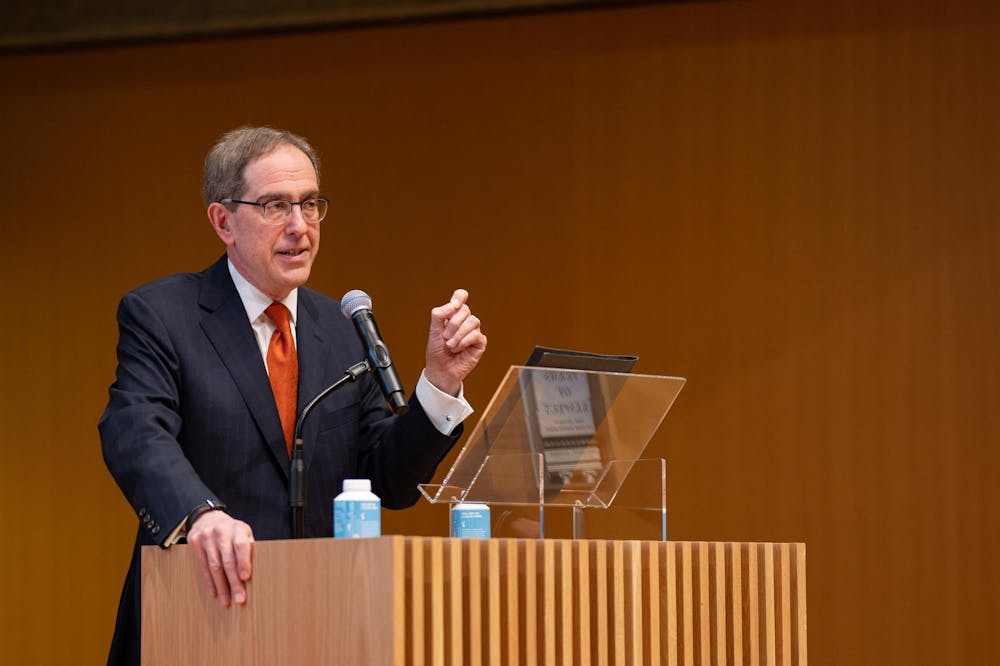
In his recently released book “Terms of Respect,” Princeton University President Christopher Eisgruber ’83 presents a strong defense of free speech on college campuses. He locates the roots of contemporary free speech doctrine in the Civil Rights Era and ultimately concludes that “students are getting free speech right.” This is a commendable analysis consistent with Eisgruber’s public defenses of student speech. But his framework is often unfairly paternalistic.
Eisgruber’s approach to discussing free speech makes it clear that he views students on college campuses like kids in a sandbox. Their speech and protests, he suggests, are akin to playing around and being creative, but ultimately lack substance and are inconsequential for the wider world. Eisgruber characterizes student speech as practice, not real engagement. His one-dimensional view of students fails to account for our simultaneous existence within and outside of the Orange Bubble. But our speech, like us, is not confined to the Princeton community, and attempting to shield or protect students from the real world can underrate our participation in it.
Eisgruber’s misunderstanding of how student speech can and should resonate in the world beyond Princeton is evident in his analysis of the 2015 Black Justice League protest. He laments that, unlike past protests that could be confined within FitzRandolph Gate, “two blocks away, lots of people soon knew exactly what was happening” due to social media. While Eisgruber rightfully identifies that the digital era has increased the visibility of college protests, his perspective is far too one-dimensional. Online discourse and the ability to project beyond our campus are not unilaterally dangerous for students.
This protective instinct towards student speech, while admirable, is ultimately belittling. For instance, Eisgruber demonizes the internet for exposing students and their speech to critics. In reflecting on how he handled the “Urban Congo” club scandal, where members of the men’s varsity swim team performed racially insensitive skits and mimicked religious rituals by hanging towels from their speedos, he laments the massive online backlash directed at the team, which compelled him to send a campus-wide message urging the Princeton community to “live up to our ideals.” He writes that “it is hard to believe that the clueless swimmers in Urban Congo could have provoked the same kind of crisis 10 or 15 years earlier. This was the internet at work.”
I agree with his assessment that the internet is a brutally unforgiving place, and that these students should not be “canceled” or punished for their mistakes. Something you write in The Daily Princetonian at age 19 shouldn’t tank your Supreme Court nomination hearing when you’re 50. But that does not mean that students’ actions are untouchable or deserve to be shielded from the world. The students’ speech had real effects on real people. To suggest it was merely practice or play would be to diminish the concrete impacts of racist speech. Students, whether they are holding a sit-in at their University President’s office or performing racist comedy, are adult members of society who have the agency to choose how to use their voices and the responsibility of reaping the consequences of those decisions. They aren’t just preparing to contribute to conversations once they graduate. They’re participating in those conversations right now.
Eisgruber’s fear of student speech having ramifications beyond the Orange Bubble ignores the real weight of the things students say. Campus speech is the product of young people figuring out what they think, but it also genuinely impacts our social and political landscape, and it always has. As Eisgruber acknowledges, this was true before the internet — for instance, when student protestors significantly impacted policy during the Civil Rights movement or the Vietnam War — but it’s especially true now, when students have the power to amplify their own voices instantaneously via social media, instead of waiting for national media to do it on their behalf. If Princeton students understand our speech as ultimately unimportant the way Eisgruber does, that does a grave disservice to our campus’s civic discourse.
Our youth does not undermine the importance of our speech. We are not throwing toys around the sandbox between Nassau Street and Route 1, carefully shielded from the outside world. Princeton students should be empowered to use their voices in on-campus forums like this paper or public protests, and whatever they do in the many weeks we don’t even spend here. We are not just practicing speech for the future — we can and should use our voices now.
Eisgruber rightly observes that colleges are important training grounds for free speech because they equip students to participate in thoughtful, truth-seeking deliberation. But these discussions do not begin the second Princeton students get their diplomas. He acknowledges that “strong academic institutions address pervasive partisanship and online disinformation by insisting on scholarly norms that promote careful, nonpartisan truth-seeking in every field of teaching and research.” But, he still seems to feel the need to shield us from taking what we’ve learned in the classroom into the wider world. Princeton’s environment so effectively nourishes robust thought and discussion that our speech is just as valuable while we’re still students.
It is true that students are young adults still working out our beliefs and frequently making mistakes. But the latter two of those characteristics are not unique to us. Student speech should be assessed fairly and argued on merit, just like speech from any other group in society. Eisgruber’s analysis and defense of student speech is valuable, but it also feels paternalistic when it should be proud.
Ava Johnson is a junior from Washington, D.C. in the Department of Politics. She credits Professor Stephen Macedo and her classmates in POL 477 for contributing to her thoughts on “Terms of Respect” with their robust in-class discussion. She can be reached at aj9432[at]princeton.edu.