



After a semester of budget cuts and contentious University policy changes, the new leadership of the Undergraduate Student Government (USG) hopes to transform student concerns into concrete policy, working alongside administrators to focus on dining, transparency, and financial accountability.
This year’s USG elections had the lowest student turnout since 2015. All positions on the executive board were contested by the time voting began on Nov. 24.
Dining reform is one of the key priorities for the incoming USG administration. Referendum No. 2, which called for the University to restore the independent dining option, passed with an overwhelming majority of 95 percent of the student vote. This follows weeks of pushback and debate after the University effectively eliminated independent dining status earlier this semester.
Anuj Krishnan ’27, the vice president-elect of USG, said he hopes to lower the proposed Block 128 plan to Block 105.
“This is a wholesale decision of the University that is overwhelmingly unpopular,” Krishnan said in an interview with The Daily Princetonian. “But that doesn’t mean that we should stop advocating for anything.”
Details about the Spelman draw have yet to be announced; administrators have previously said they aimed to make a decision by Thanksgiving.
Oscar Barrios ’27, the incoming undergraduate chair of the University Student Life Committee (USLC), is focused on reducing overcrowding in co-ops and eating clubs.
“I am very interested in trying to bring together the [Interclub Council] and the co-op leadership for the first time,” he told the ‘Prince.’

Barrios’ goal is to rally his committee members to have conversations with leaders from each of these groups.
“We need a regular working group inside USLC to track student concerns and make sure they’re elevated,” said Barrios.
President-elect Quentin Colón Roosevelt ’27 and incoming Academics Committee chair Isaac Bernstein ’28 spoke to a tendency of referenda passed by undergraduates not being implemented by the University. Bernstein said that referenda currently serve more to initiate conversations about policy with the University, rather than guaranteeing reform. He hopes to change this.
Bernstein is a staff News writer for the ‘Prince.’
“My major strategy is to have the referendum reflect the conversation throughout the term,” said Bernstein. “When the referendum is developed at the end of my term, which will be in essentially my 11th month of my term, it will be a reflection of those conversations.”
Colón Roosevelt noted that the turnover between USG terms can cause actions on referendums to be less impactful and that long-term student advocacy was necessary.

“When it [change] happens, it’s not just the victory of that administration, it’s many people working under these things,” he said.
Budget allocation is also a priority for incoming USG officers. Incoming treasurer Marvel Jem Roth ’28 wants to ensure that “every single dollar that students give USG is making a real impact.” Roth noted that USG often has a surplus, with an $80,000 rollover from last semester.
“Decreasing the amount of initial allocations and having more of the budget dispersed through individual project and policy-based budget requests would be a healthier approach to the budget,” Roth told the ‘Prince.’
She hopes to allocate the money to locations where it will be properly used, such as Projects Board, which serves as the main funding source for student organizations across campus. Roth is aiming for a budget increase for Projects Board from $160,000 to $175,000. In September, the budget was increased from $140,000 to $160,000 with the aim of offsetting budget cuts.
“We can help offset those groups that are being affected due to departmental budget cuts,” Roth said.
The successful candidates noted transparency as a key factor that needs improvement on campus. In an attempt to address this this year, Roth created an itemized policy tracker to better understand steps towards USG funding policy. The tracker details the status of any projects and their points of contact. USG launched it last year, but stopped updating it midway through the spring semester. The policy tracker has since resumed operation.
“I made the tracker with the intention of it being a place for working groups and policy work,” said Roth. “There’s a transparent aspect of it, so that students can actually see the work that’s being done as it’s happening.”
Outside of the budget, transparency for the whole of USG has been a driving factor this election year. During his campaign, Colón Roosevelt argued for ending executive sessions following USG meetings and making concerted efforts to keep students informed about the internal workings of USG.
“If we don’t understand how students are feeling, we can’t be an advocacy organization,” Colón Roosevelt said.
The president-elect also stressed the importance of the Mental Health Committee in playing a role to assist students under investigation for infractions on the Honor Committee or Committee on Discipline, a process he described as “emotionally taxing and socially isolating.”
He proposed standardizing suspension (not served) policy as the standard sanction for students found guilty of violating the Honor Code, especially for international students, which he said would protect students from losing their visas. The suspension (not served) sanction was introduced to the Honor Code in October last year and has the same weight as a suspension without requiring time away from Princeton.
Bernstein expressed a desire to reform the Committee on Discipline and increase the visibility of Peer Representatives, undergraduate students who provide support for students facing University investigations.
“Many don’t know that the Committee on Discipline can also have peer representation,” Bernstein said. “That will be changed right away … getting that word out and having events so that people are aware of peer representation.”
Incoming mental health chair Aakansh Yerpude ’27 discussed in an interview how mental health issues can often be dismissed due to the University’s academically rigorous culture.
“Students often don’t know how to reach out, and some courses or departments make it feel risky or unproductive,” Yerpude said. “That’s why I want to focus on helping students learn to ask for help early and training professors to structure courses in ways that make support accessible and effective.”
Newly elected sustainability chair Gianna Maltbie ’29 plans to continue working with administrators on sustainability during her term. The undergraduate vote passing Referendum No. 1, which calls for divestment from the University’s private limited partnership to PetroTiger I, has been an “important step” in sustainability at Princeton.
“I think just being persistent and kind of pushing back against administration, and showing them that there are solutions [is the way to take action]” Maltbie said.
In her term, she also hopes to bring a one-day climate symposium to Princeton, as well as a campus closet for students to donate clothing to (the Office of Sustainability holds occasional clothing swaps). Increasing student engagement is a major priority for Maltbie.
“[The goal is to] show students … what reducing their waste, by, say 50 percent would do to campus, and what that would do to emissions,” Maltbie said.
The new executive board will assume their new positions on Jan. 26, 2026, the first day of spring semester classes.
Clara Docherty is a staff News writer for the ‘Prince.’ She is from Lafayette, N.J. and typically covers campus clubs and institutional legacy. She can be reached at clara.docherty[at]princeton.edu.
Please send any corrections to corrections[at]dailyprincetonian.com.
Corrections: A previous version of this piece said that the U. planned to make a decision about Spelman room draw by Thanksgiving. In fact, the U. was aiming to make the decision by Thanksgiving. A previous version of this piece also said that Roth supervised the continuation of the policy tracker. Roth actually founded it. The ‘Prince’ regrets these error.
Read More
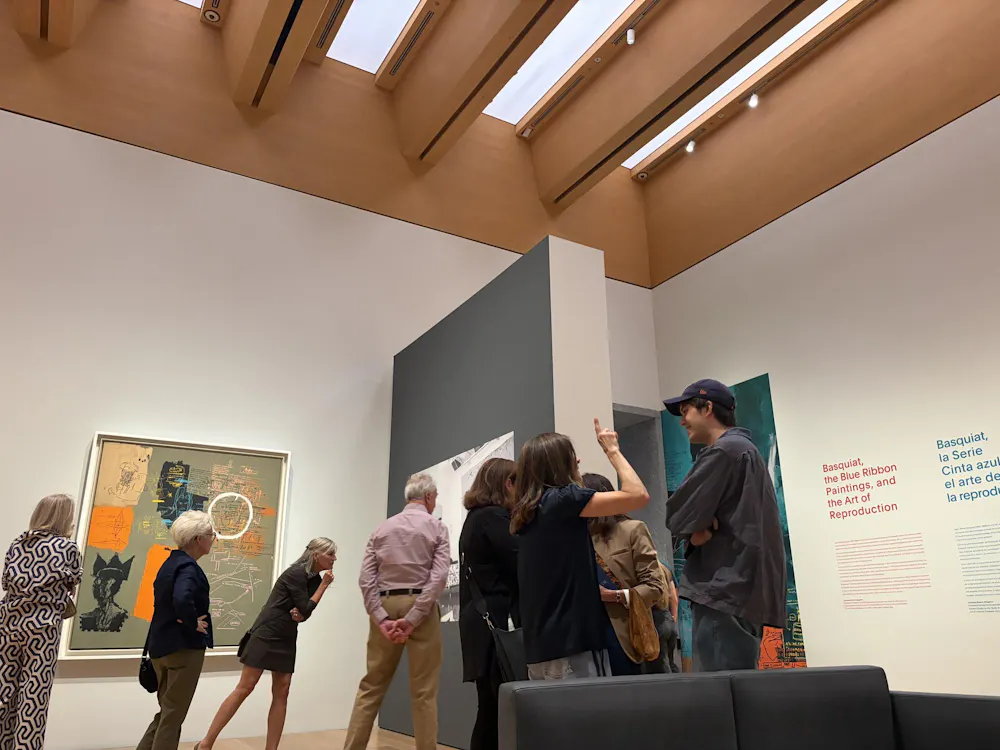
A Blue Ribbon exhibition: ‘Basquiat, the Blue Ribbon Paintings, and the Art of Reproduction’
Persephone Lee and Bella WuContributing writers for The Prospect Bella Wu and Persephone Lee review the Princeton University Art Museum's newest exhibition “Basquiat, the Blue Ribbon Paintings, and the Art of Reproduction.”

Municipality of Princeton prepares to write new zoning code
Joshua KimThe new zoning code will replace its two separate zoning codes with a unified code. Public comments on the simplification of existing zoning codes were generally positive.
The new zoning code will replace its two separate zoning codes with a unified code. Public comments on the simplification of existing zoning codes were generally positive.

Roundup: USG statement on sexual assault allegations, proctoring during midterms, and a varsity sports update
Riley Price and Devon RudolphAn Undergraduate Student Government statement addressing a former Cornell student’s sexual assault allegations, proctoring during midterms, and a mid-season check-in with head Sports editor Lily Pampolina on Princeton’s varsity athletic programs.
An Undergraduate Student Government statement addressing a former Cornell student’s sexual assault allegations, proctoring during midterms, and a mid-season check-in with head Sports editor Lily Pampolina on Princeton’s varsity athletic programs.