



The Princeton Community Democratic Organization held a public meeting on Sunday night, advertised as a forum on “Commun-Adversity,” to discuss the recent difficulty of negotiations between the University and the Borough and Township.
At the meeting PCDO members expressed skepticism about the University’s representation of the Arts and Transit Neighborhood proposal and concern over renewing the University’s payment in lieu of taxes contribution.
PCDO treasurer David Cohen made a presentation at the meeting, first citing an analysis done by Alain Kornhauser GS ’71, University professor of operations research and financial engineering and director of the Program in Transportation, predicting that the proposed displacement of the Dinky by 460 feet would result in a 25 percent loss in ridership due to the change in accessibility.
Cohen voiced skepticism that the sales agreement the University signed in 1984 to purchase the Dinky station gives the University legal grounds to claim the right to move the station. He said that portions of the sales agreement required the University to make certain improvements to the station which the University did not make, thus not upholding its side of the contract.
“How are we supposed to trust that the University is going to do what they say this time around?” Cohen asked.
Cohen also expressed doubt that the Arts and Transit Neighborhood would attract high-profile performers to Princeton, as claimed, if it were created by the University.
“We know there are going to be a couple of small performance venues, but this is not Lincoln Center,” he said. “This is not a major performing arts center that’s going to be bringing people from New York and Philadelphia ... [Arts and Transit Neighborhood supporters] who think that those of us who oppose this particular plan are hurting them by denying them all this new income stream are really being deceived by some misrepresentations that are coming from the other side of the issue.”
Cohen said that the University’s annual contribution, which last year was $1.2 million, amounted to “a rounding error” for the University, citing it as a 10th of a percent of the University’s operating budget.

“Princeton University’s internal policy is to grant aid to students based on need. By this logic should the University still be subsidized by the taxpayers of Princeton Borough and Township?”
“We’re paying so that they can be tax-exempt,” he added, referring to the results of last year’s property tax revaluation, in which he said the University’s properties were “atrociously undervalued.” According to statistics cited in his presentation, while the average Princeton property owner’s holdings increased 100 percent in assessed value, the University’s holdings increased by only 34 percent.
Borough Councilman Kevin Wilkes ’83, who gave a presentation on the history of the University’s expansion, proposed that the community cooperate with the University on development plans supporting mixed University and residential uses.
“Buildings have been obliterated and neighborhoods have been removed for campus expansion,” Wilkes said. “I believe a way for us to work better together in the future would be to exchange, surround and absorb, or ‘combine and share.’ ”
Wilkes also spoke of the Dinky as the most recent “in the line of things that have been shuffled out of the way because they were inconvenient.”
No action was taken as a result of this meeting, though several speakers advocated using the Arts and Transit Neighborhood and the University’s request for zoning as leverage in negotiations.

“The University is not a person,” said Anne Neumann, who has served on several Democratic and municipal community organizations. “We don’t have to be civil to it. I think we need to find whatever leverage we can to negotiate with this behemoth. They haven’t been civil to us.”
“If they’re going to insist on a token, rounding-error contribution to the town’s taxes, then the town has no recourse but to refuse a more permissive zoning to go the other way to down-zone,” said Peter Marks, a Borough resident who spoke during the public comment portion of the event. “Municipalities, together or alone, would have some leverage and be able to make persuasive arguments that the University would have to listen to.”
Read More
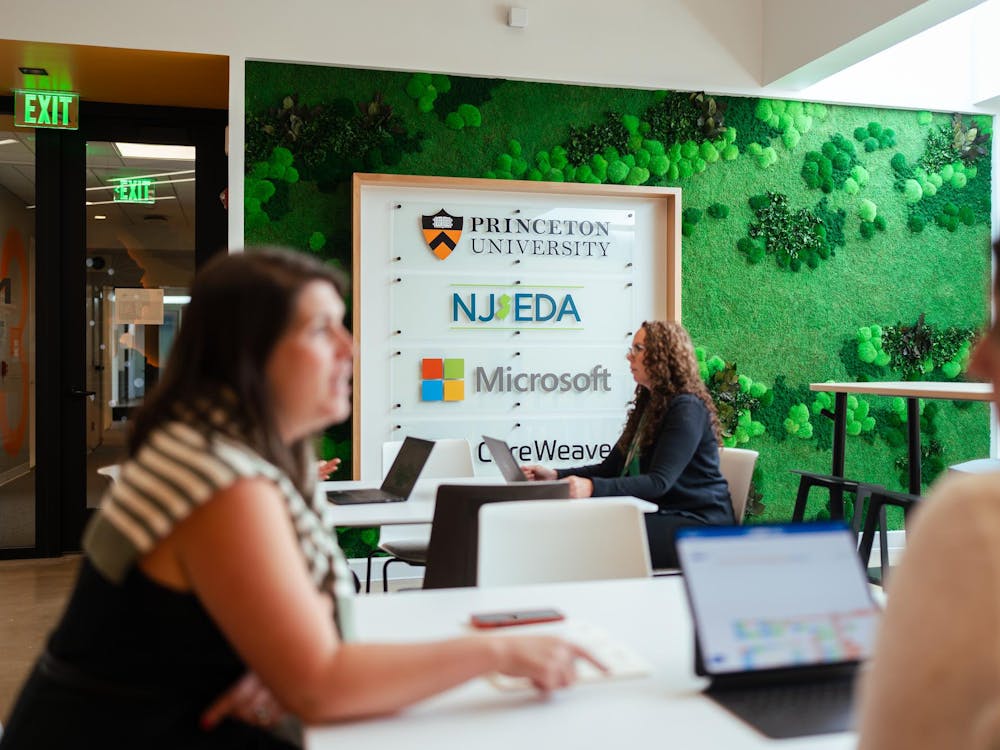
NJ AI Hub marks first anniversary with inaugural startup cohort
Zihan (Frank) XuFourteen selected start-ups receive weekly workshops, reverse pitches, corporate introductions, among other guidance over 12 weeks. The “AI accelerator” helps to test each company’s technology and fast-track its path to commercialization.
Fourteen selected start-ups receive weekly workshops, reverse pitches, corporate introductions, among other guidance over 12 weeks. The “AI accelerator” helps to test each company’s technology and fast-track its path to commercialization.
Three Princeton alumni awarded 2026 Fields Medal
Clara DochertyThe three alumni who received the medal are Yu Deng GS ’15, John Pardon ’11, and Jacob Tsimerman GS ’11.
The three alumni who received the medal are Yu Deng GS ’15, John Pardon ’11, and Jacob Tsimerman GS ’11.

Major gift from Leinweber Foundation to strengthen theoretical physics research
Daphne Lewis and Haeon LeeThe University is joining a national network of institutions advancing theoretical physics research, following the major gift. The foundation has committed over $165 million to top fundamental science research institutions during a period of uncertainty for research funding.