



Since the site is a wiki, it is open to contributions from public users and is continually evolving.
According to Kate Huddleston ’11, who was involved in creating the website and currently edits and contributes to its content, the site was born because the average student spends a significant amount of time searching the Internet and University websites for important information.
“One website collating that information would be helpful,” Huddleston explained. “Also, I think we’d run out of ways to procrastinate on our independent work.”
Information that can currently be found on the site includes hours of operation for dining locations, Dillon Gymnasium and libraries; academic calendars with breaks and key deadlines; the exact wording of the Honor Code; and contact information for movie theaters, grocery stores and campus offices. Additionally, the site features original content such as a tip of the day and instructions for individualizing the Princeton Panda’s logo.
The website’s creators said they hoped to make students’ lives easier through the project.
“If I can feel like it saved people a couple of minutes of frustration, I’ll be happy,” Uri Bram ’11, one of Princeton Panda’s principal collaborators, said in an e-mail.
“The great thing about a wiki is that people can add to it whatever they like,” he explained. “So I’m not really planning how it’ll develop in [the] future. People will add whatever they find useful, and members can respond to any popular requests, so it’ll organically develop in whatever directions are most useful for students. It’s a very open project and a lot of people have contributed.”
The website currently receives 30-50 visitors per day and over 600 visitors per month, though the numbers are rising quickly, its creators said. Currently in beta, so far it has only been promoted informally through friends.

“In the future, we’d like to come to grips with the various aspects of Princeton student life that may not be apparent to some of us or might not be found online, but would undoubtedly be important to many students here,” Raphael Murillo ’12, another contributor and organizer of the website, said in an e-mail.
Murillo compared the website to a similar one at Columbia University, WikiCU, which has accumulated a vast collection of information since its start in 2007.
While the University does a good job of making information accessible, Bram said, he hopes Princeton Panda will be able to compile the knowledge into a more user-friendly location.
“The University already does a great job of providing information for students, and there’s a wide variety of official websites that provide a lot of really useful advice, information and services,” Bram noted. “I also think Yaro’s USG has done an amazing job with its new applications and websites, which I often use myself. The hope for Panda was just to coordinate between these different services as well as non-University sites, such as local restaurants, shops and transport options, and bring together the best of what’s already out there.”
Read More
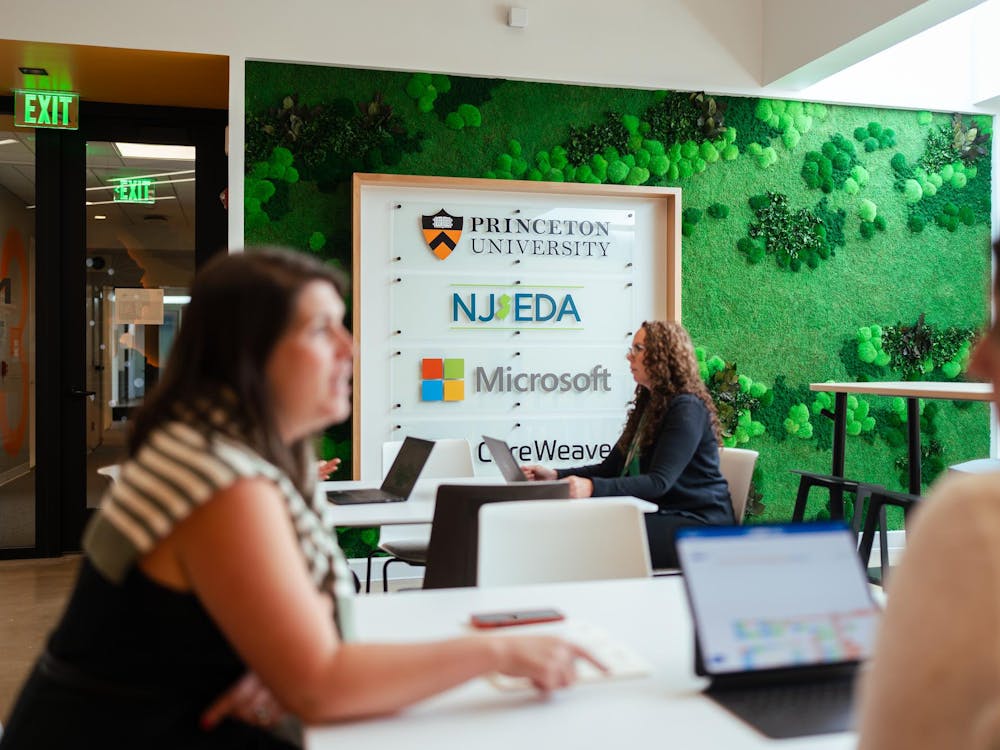
NJ AI Hub marks first anniversary with inaugural startup cohort
Zihan (Frank) XuFourteen selected start-ups receive weekly workshops, reverse pitches, corporate introductions, among other guidance over 12 weeks. The “AI accelerator” helps to test each company’s technology and fast-track its path to commercialization.
Fourteen selected start-ups receive weekly workshops, reverse pitches, corporate introductions, among other guidance over 12 weeks. The “AI accelerator” helps to test each company’s technology and fast-track its path to commercialization.
Three Princeton alumni awarded 2026 Fields Medal
Clara DochertyThe three alumni who received the medal are Yu Deng GS ’15, John Pardon ’11, and Jacob Tsimerman GS ’11.
The three alumni who received the medal are Yu Deng GS ’15, John Pardon ’11, and Jacob Tsimerman GS ’11.

Major gift from Leinweber Foundation to strengthen theoretical physics research
Daphne Lewis and Haeon LeeThe University is joining a national network of institutions advancing theoretical physics research, following the major gift. The foundation has committed over $165 million to top fundamental science research institutions during a period of uncertainty for research funding.