



U.S. Rep. Donald Payne of New Jersey and actress and humanitarian Mia Farrow opened the International Relations Council's Distinguished Speaker's Series last Saturday with their talk titled "What Lies Ahead: Prospects for Peace in Sudan."
Payne is the first African-American representative elected in the state of New Jersey. He has held his position since 1988. He serves as a senior member of the House Committee on Foreign Affairs and as a ranking member of the House Foreign Affairs Subcommittee on Africa, Global Health and Human Rights.During the lecture, Payne discussed solving the current conflict in Sudan from a policy perspective. Sudan has been embroiled in conflict since Omar al-Bashir took power in a military coup in 1989 and the primarily Islamic government has caused massive damage to the tribes of the South and the Darfur region.Between 200,000 and 400,000 people have been killed in the conflict, with almost 3 million people displaced from their homes, Payne explained. In 2004, then-Secretary of State Colin Powell declared the situation a genocide in a speech before the U.S. Senate’s Committee on Foreign Relations, a classification Payne said he endorsed.Payne spoke on recent political developments in Sudan, particularly a recent referendum in which the South voted to declare a sovereign government that would be separate from the ruling al-Bashir regime.Though the new government is set to become independent in July, Payne noted that there are still difficulties in dividing up the region.“The South controls most of the oil, but the North controls the actual pipelines and centers for refinement,” he explained.Payne also cautioned against allowing the apparent underdevelopment of the country to overshadow the significance of the referendum.“Some people may write off the referendum decision because most of the people in the region are illiterate so therefore they must be unintelligent,” he said. “That is not true. An overwhelming majority of eligible voters turned out for the referendum. The children can tell when the attack helicopters are coming when the chickens start running around, then the parents notice. These are not dumb people.”Farrow spoke next. A Golden Globe-winning actress famous for her roles in films such as "Rosemary’s Baby," "See No Evil" and "The Great Gatsby," she is also a noted humanitarian who has made several trips to Sudan’s Darfur region and is an ardent supporter of aid to the area. In 2008, Time named her one of the most influential people in the world.Farrow focused on her personal encounters in the region, calling in particular for the world to pay more attention to the plight of refugees. Accompanied by a series of pictures from her time in Sudan, Farrow told several stories about her personal experiences with the tribal people, including accounts from women and children who had witnessed attacks on forced removal camps.She explained that malnutrition, mutilation, rape and disease are just a few of the issues that young people are subjected to on an everyday basis.“The government in Khartoum is arming Islamic nomadic peoples and giving them license to attack the camps,” she explained. “These partisans are called Janjaweed, which means ‘demons on horses’ ... I wish that some of the attention that has been directed at Libya would carry over to the Sudan.”Among the images, Farrow included young childrens' drawings of the deadly attacks and, more positively, the smiling face of a young girl whom Farrow described as the “face of hope.” Farrow explained that she kept the image as a screensaver and was inspired by the young girl’s ability to find happiness in the midst of such tragic conditions.Despite some recent progress in Sudan, both Payne and Farrow noted that much more work needs to be done. Though the South is moving toward independence, they said, the state of the Abyei region is under dispute as the government has put an indefinite hold on its residents’ ability to vote on the referendum, leading to the death of at least 30 people so far.Read More

NJ AI Hub marks first anniversary with inaugural startup cohort
Zihan (Frank) XuFourteen selected start-ups receive weekly workshops, reverse pitches, corporate introductions, among other guidance over 12 weeks. The “AI accelerator” helps to test each company’s technology and fast-track its path to commercialization.
Fourteen selected start-ups receive weekly workshops, reverse pitches, corporate introductions, among other guidance over 12 weeks. The “AI accelerator” helps to test each company’s technology and fast-track its path to commercialization.
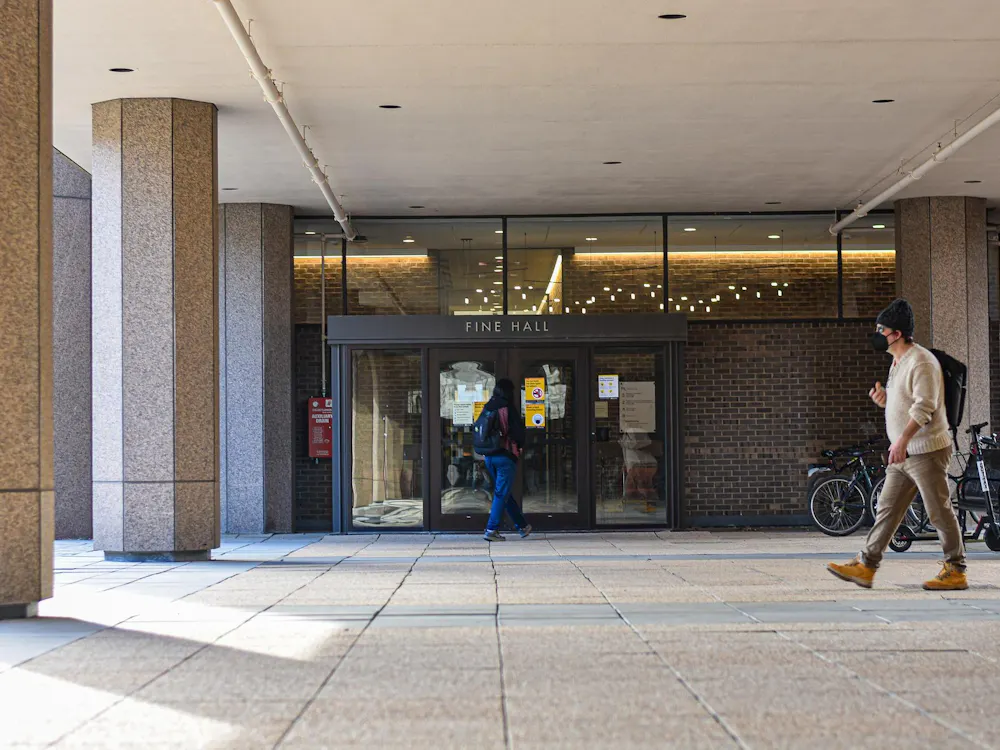
Three Princeton alumni awarded 2026 Fields Medal
Clara DochertyThe three alumni who received the medal are Yu Deng GS ’15, John Pardon ’11, and Jacob Tsimerman GS ’11.
The three alumni who received the medal are Yu Deng GS ’15, John Pardon ’11, and Jacob Tsimerman GS ’11.

Major gift from Leinweber Foundation to strengthen theoretical physics research
Daphne Lewis and Haeon LeeThe University is joining a national network of institutions advancing theoretical physics research, following the major gift. The foundation has committed over $165 million to top fundamental science research institutions during a period of uncertainty for research funding.