



This year, the University and nearly all other peer institutions received record numbers of applicants, continuing a years-long trend of increasing competitiveness.
At a recent higher-education conference at the University of Southern California, Skidmore College professor emeritus Sandy Baum and Spencer Foundation president Michael McPherson presented a radical solution to this issue: The “top 20” undergraduate educational institutions could alleviate the problem by increasing their class sizes by 50 percent.In response to the backlash resulting from their proposal, Baum and McPherson clarified their position in a post on the Chronicle of Higher Education’s website. Though they acknowledged that the endowments of the nation’s leading universities are still in recovery from the recent financial crisis, they asked the following question: “Should [universities] devote added resources to further improving the educational services and the amenities provided to the limited number of students they currently enroll, or devote some or all of their future gains to expanding opportunities?”According to Baum and McPherson’s original post on the Chronicle’s site, “our friends and colleagues at the meeting [of admissions directors from top universities] found it easy to contain their enthusiasm for our idea.”Indeed, Harvard currently has no plans for enrollment expansion, Jeff Neal, senior communications officer for the Faculty of Arts and Sciences, confirmed in an e-mail.Princeton, according to University spokesperson Emily Aronson in an e-mail, “is already engaged in a long-planned expansion of its student body.”In April 2000, the University’s trustees, based on the Wythes Committee report, approved a plan that would gradually expand the size of the student body. Aronson explained that in 2005, the University began to expand the size of undergraduate classes by 11 percent overall to achieve enrollment of around 5,200 students by the 2012-13 academic year.“The University’s planned expansion will enhance the undergraduate experience because it will bring a greater range of viewpoints and perspectives within the student body,” Aronson noted. “At the same time, the expansion has been planned in a way that classes will still be small, the faculty ratio will be preserved and the necessary educational resources are still in place.”With 5,200 students, the University’s undergraduate student enrollment would be around 100 students shy of Yale’s current enrollment of 5,310. Harvard’s current undergraduate enrollment is 6,641 students.The University’s decision in 2000 to expand undergraduate student enrollment had a rationale similar to that put forth by Baum and McPherson.“The increasing size and extraordinary quality of the applicant pool made it more difficult every year to be able to admit all of the wonderful students who applied to the University,” Aronson said. “So, expanding the student body allows us to enroll more of these students per year who want to come to Princeton.”Aronson added that “it is worth noting that the April 2000 decision to expand the student body was made in part because of recognition that the University had been increasing other resources, such as library resources and computing resources, to support additional students.”The University also created more student dormitory space in order to support the undergraduate enrollment expansion. In addition to renovations made in Forbes, Mathey and Rockefeller residential colleges, Whitman College was finished in 2007 and Butler College was completely reconstructed in 2009.“The University is also in the midst of a 10-year campus plan, and there are a handful of academic building projects that have recently been completed or are underway for the benefit of students on campus,” Aronson said. “These include the opening of Lewis Library in 2008, the opening of the new Frick Chemistry Laboratory this year and the current construction of the new neuroscience and psychology buildings.Read More
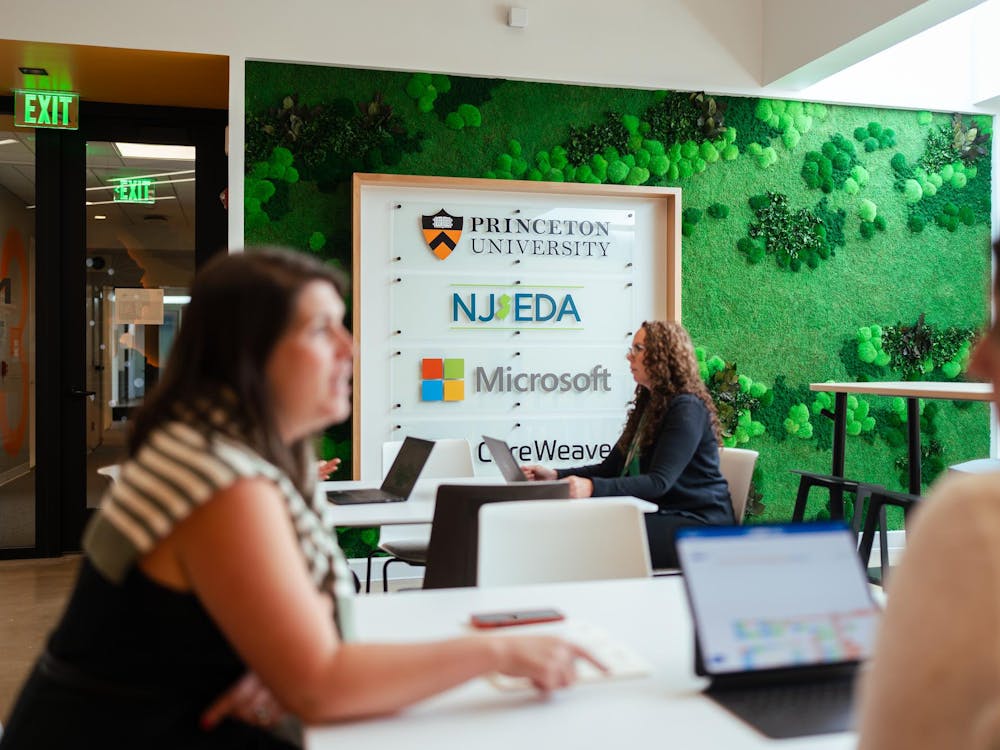
NJ AI Hub marks first anniversary with inaugural startup cohort
Zihan (Frank) XuFourteen selected start-ups receive weekly workshops, reverse pitches, corporate introductions, among other guidance over 12 weeks. The “AI accelerator” helps to test each company’s technology and fast-track its path to commercialization.
Fourteen selected start-ups receive weekly workshops, reverse pitches, corporate introductions, among other guidance over 12 weeks. The “AI accelerator” helps to test each company’s technology and fast-track its path to commercialization.
Three Princeton alumni awarded 2026 Fields Medal
Clara DochertyThe three alumni who received the medal are Yu Deng GS ’15, John Pardon ’11, and Jacob Tsimerman GS ’11.
The three alumni who received the medal are Yu Deng GS ’15, John Pardon ’11, and Jacob Tsimerman GS ’11.

Major gift from Leinweber Foundation to strengthen theoretical physics research
Daphne Lewis and Haeon LeeThe University is joining a national network of institutions advancing theoretical physics research, following the major gift. The foundation has committed over $165 million to top fundamental science research institutions during a period of uncertainty for research funding.