



The students selected for the program, which is open to Princeton undergraduates in their junior year, spend the final three semesters in college completing their majors and taking courses in public policy. They develop a familiarity with career opportunities in the federal government and spend the summer after their junior year in a federal government internship.
After earning their bachelor’s degrees, students are admitted to the Wilson School’s two-year Master in Public Affairs program. After completing their first year of graduate study, the students work for two years in the federal government in placements provided by the SINSI fellowship, then return the Wilson School to finish their last year of study. The SINSI program was created in February 2006 to raise awareness about careers in government service among University students.
“The Woodrow Wilson School program is only about two and a half years long, and I believe that moving on to the graduate M.P.A. program will truly give me a chance to continue on that track of learning that began in [the] Wilson School,” Roache said, explaining why she decided to apply to the program.
Usman said the program’s benefits are what caused him to apply.
“The program will give me a window to see how public policy truly works in the real world and experience realistic problems beyond the confines of the classroom,” he explained.
“We had an outstanding and diverse pool of applicants this year for the SINSI scholarship program,” Wilson School professor Barbara Bodine explained in the news release. Bodine, the program director, said, “These SINSI scholars exemplify Princeton’s ethos of ‘in the Nation’s service’ and ‘in the service of all Nations.’ ”
This year’s selected students cited varied reasons for choosing a career in public service.
“I got interested in public policy following the September 11 attacks,” Roache said. “I remember watching the news and seeing confusion everywhere, with news anchors confusing Afghans and Arabs, and not understanding the situation of the region.”

Rosenbaum explained that her inspiration came from her early interest in health and medicine.
“Morally, bringing medical care to underprivileged communities drives me in my work with health policy,” said Rosenbaum, who said she sees medical school as a possibility.
Usman, who is a native speaker of Arabic and Kiswahili and has lived in Africa and the Middle East, said that his background and roots made him feel like he had a real connection with the issues of diplomacy and foreign policy.
“I feel that a career in foreign policy would allow me to fully utilize my diverse skills as an individual,” Usman explained.
Jean-Pierre said her interest in mental health policy arose after her family suffered the tragedy of the earthquake in Haiti last year.
“I realized that governments after major disasters do not prioritize mental health issues, and I wanted to help bring light to the emotional anguish that victims in major tragedies experience that needs to be addressed just as much as the physical needs of the people,” explained Jean-Pierre in an e-mail. She added that in the future she would also like to work on policies that help prevent suicide and depression in the young adult population.

Rhode could not be reached for comment on Sunday.
Rhode, Roache, Rosenbaum and Usman are students in the Wilson School. Jean-Pierre is an English concentrator and is obtaining certificates in Spanish, American studies and African-American studies, while Rhode is a certificate candidate in Chinese language and culture and in Near Eastern studies and Arabic. Roache is a certificate candidate in Near Eastern studies, Arabic language and culture, and Persian language and culture. Rosenbaum is pursuing certificates in African-American studies and Near Eastern studies, language and culture. Usman is a certificate candidate in Near Eastern studies.
Read More
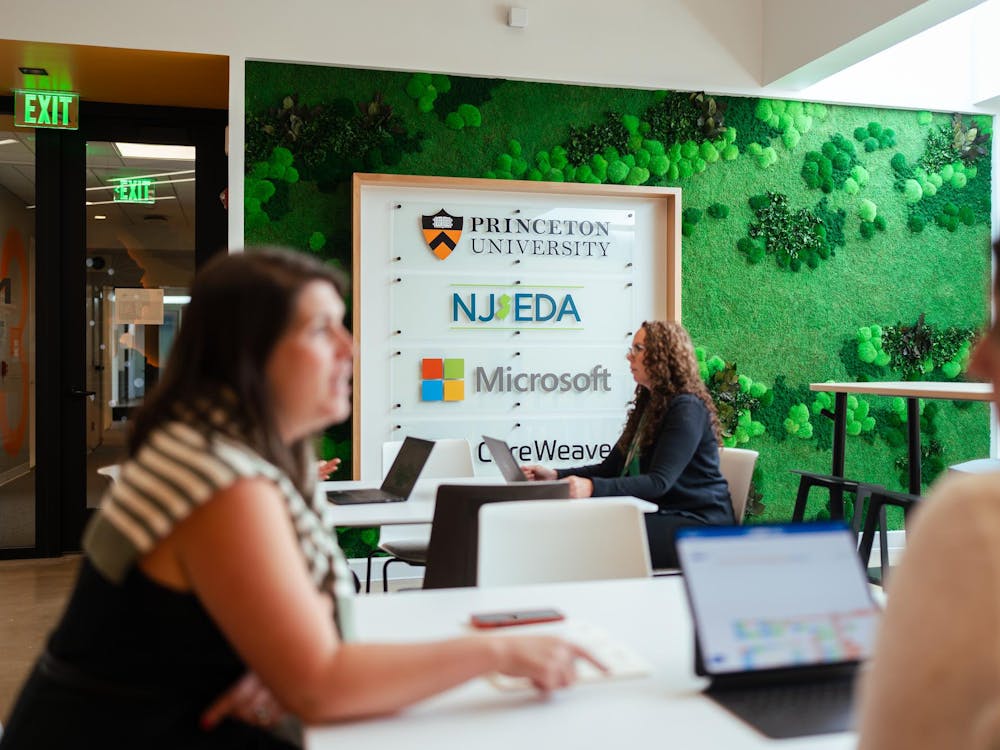
NJ AI Hub marks first anniversary with inaugural startup cohort
Zihan (Frank) XuFourteen selected start-ups receive weekly workshops, reverse pitches, corporate introductions, among other guidance over 12 weeks. The “AI accelerator” helps to test each company’s technology and fast-track its path to commercialization.
Fourteen selected start-ups receive weekly workshops, reverse pitches, corporate introductions, among other guidance over 12 weeks. The “AI accelerator” helps to test each company’s technology and fast-track its path to commercialization.
Three Princeton alumni awarded 2026 Fields Medal
Clara DochertyThe three alumni who received the medal are Yu Deng GS ’15, John Pardon ’11, and Jacob Tsimerman GS ’11.
The three alumni who received the medal are Yu Deng GS ’15, John Pardon ’11, and Jacob Tsimerman GS ’11.

Major gift from Leinweber Foundation to strengthen theoretical physics research
Daphne Lewis and Haeon LeeThe University is joining a national network of institutions advancing theoretical physics research, following the major gift. The foundation has committed over $165 million to top fundamental science research institutions during a period of uncertainty for research funding.