



Three years ago, Sethi began researching the molecular mechanisms of bone metastasis, the means by which breast cancer tumor cells spread to the bone. His findings, published online last Thursday in the journal “Cancer Cell,” identify the protein and series of reactions that cause bone metastasis.
Sethi said he hopes that the research will be especially helpful for cases where it is most needed. “There is one subtype [of breast cancer] that we don’t have good therapy for,” Sethi explained, referring to the need for treatments for triple-negative breast cancer. “The work that I did is focused on that and helps to delineate some of the pathways that are active during this type of breast cancer.”
With a fellowship from the New Jersey Commission on Cancer Research, Sethi began working in 2008 with Yibin Kang, an associate professor in the molecular biology department, to pursue thesis research on bone metastasis.
Their research has identified the destructive protein, which they named “Jagged1,” that causes breast cancer to disrupt normal bone growth. Jagged1 acts as an activator to a circular pathway, a series of molecular reactions that disrupts the normal process of bone repair. This disruption allows malignant tumor cells to invade the bone.
In 2009, Kang’s lab published a report that suggested this breakdown of bone releases the TGF-beta protein, which signals tumor cells to produce more Jagged1, causing a “vicious cycle” of cancerous bone destruction.
Both Kang and Sethi agreed that this discovery supports the seed and soil hypothesis, which examines why certain tumors, seen as “seeds,” can grow in certain cancerous conditions, or “soils.”
Sethi and Kang worked with two scientists from the pharmaceutical firm Merck & Co., which developed an experimental treatment to neutralize Jagged1.
Designed to block the destructive pathway by inhibiting its essential enzyme gamma secretase, the drug has resulted in dramatically reduced bone damage in animal experiments.

The pharmaceutical company Amgen has expressed interest in developing the drug for clinical trials.
If the gamma secretase inhibitor proves effective, Kang expl-ained, it will lead to an increased ability for doctors to prescribe type-specific treatment. If a patient’s tumor has a high level of Jagged1, the doctor could prescribe a targeted treatment immediately rather than prescribing a less effective chemotherapy treatment.
Kang added that all the different cancer processes must be considered for treatment.
“We should not only try to just mow down the bad weeds,” Kang said. “We have to also target the soil to make the soil less hospitable for the tumor to grow, and there are certain drugs being developed for this purpose already. I think that will be the future of medicine.”
Kang began researching bone metastasis in 2005 when he received a $3.8 million Era of Hope Scholar Award from the Department of Defense Breast Cancer Research Program. He had been studying the molecular mechanisms of cancer metastasis since 2000 through funding from the New Jersey Commission on Cancer Research, the Susan G. Komen Breast Cancer Foundation and the American Cancer Society.
Sethi finished his doctorate at Princeton last year and is now earning his medical degree at the University of Medicine and Dentistry of New Jersey, Robert Wood Johnson Medical School.
Read More
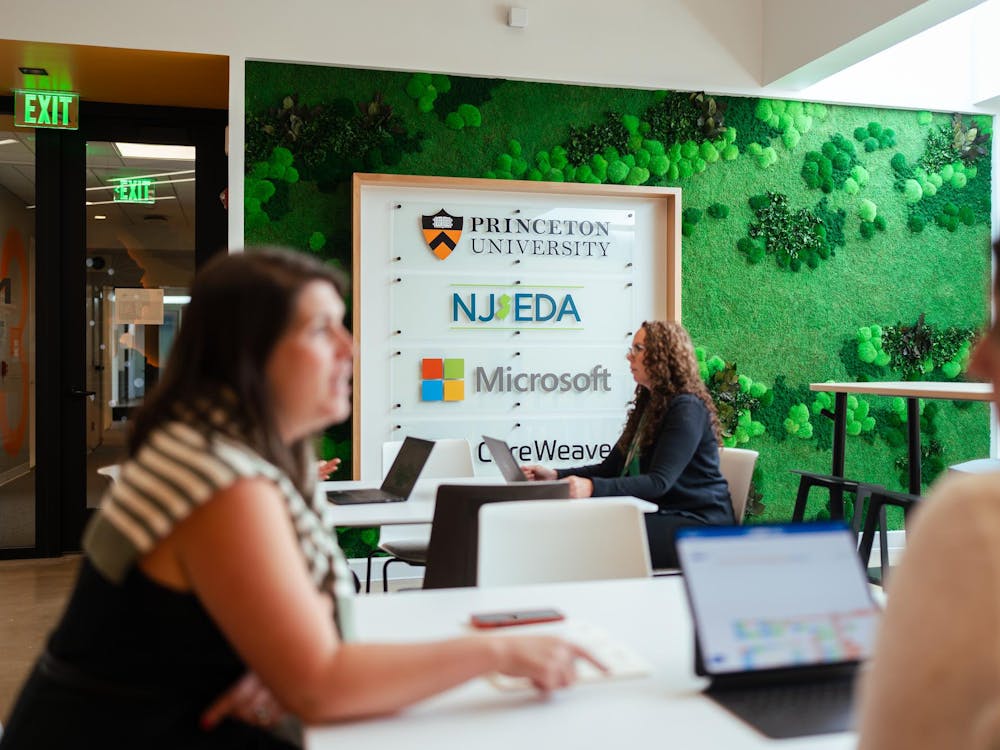
NJ AI Hub marks first anniversary with inaugural startup cohort
Zihan (Frank) XuFourteen selected start-ups receive weekly workshops, reverse pitches, corporate introductions, among other guidance over 12 weeks. The “AI accelerator” helps to test each company’s technology and fast-track its path to commercialization.
Fourteen selected start-ups receive weekly workshops, reverse pitches, corporate introductions, among other guidance over 12 weeks. The “AI accelerator” helps to test each company’s technology and fast-track its path to commercialization.
Three Princeton alumni awarded 2026 Fields Medal
Clara DochertyThe three alumni who received the medal are Yu Deng GS ’15, John Pardon ’11, and Jacob Tsimerman GS ’11.
The three alumni who received the medal are Yu Deng GS ’15, John Pardon ’11, and Jacob Tsimerman GS ’11.

Major gift from Leinweber Foundation to strengthen theoretical physics research
Daphne Lewis and Haeon LeeThe University is joining a national network of institutions advancing theoretical physics research, following the major gift. The foundation has committed over $165 million to top fundamental science research institutions during a period of uncertainty for research funding.