



The University has invested time and resources to develop its international initiatives, encourage students to study abroad and foster research collaboration with institutions worldwide, administrators said at the meeting.
Nancy Kanach, director of the Office of International Programs, presented the findings of an exit survey for the Class of 2010, showing that 48 percent of the class graduated with international experience, which OIP defines as an internship, summer, semester, or research or project work done abroad for at least four weeks.
Kanach added that the percentage of students studying abroad would ideally reach 100 percent.
That goal poses a challenge for the administration, as it is difficult to convince many students to spend semesters abroad, largely due to academic requirements, Kanach said.
Regardless, Kanach said that during 2009, 209 students from 31 academic departments spent a semester abroad in 28 different countries, both at universities with established partner programs with Princeton and at unaffiliated institutions like the Royal College of Music, where students can develop an individual program of study.
Kanach stressed the importance of encouraging students to study abroad, so that “when they leave the ‘bubble’ they are prepared for the world out there.”
Jacqueline Leighton, director of the Davis International Center, also explained the steps taken to increase institutional support for international students, who comprise roughly 10 percent of undergraduates and 38 percent of graduate students.
The center, which recently underwent a major reorganization and moved to a new building, has introduced “priority initiatives” to accommodate a more complex immigration caseload, the integration of international students with their American colleagues and the promotion of intercultural understanding, Leighton said.

Also at the meeting, history professor Jeremy Adelman, director of the Council for International Teaching and Research, spoke about the Global Scholars Program and the Global Collaborative Networks Fund, which attempt to increase the University’s presence overseas and attract international faculty to campus.
The Global Scholars Program offers distinguished international teachers and researchers a three-to-five-year stint at Princeton in order to “internationalize the intellectual lives of the university,” Adelman said. The University is hosting five global scholars this year.
Adelman expressed hope that such exchanges would establish stronger relationships between the University and these scholars’ home institutions.
The Global Collaborative Networks Fund attempts to create collaborative projects between University professors and overseas researchers. Adelman cited one of the most important of these projects as the Five-University Research Collaboration on East Asia Security Cooperation, a network that includes Princeton, Peking University in Beijing, the University of Tokyo, Korea University in Seoul, and the National University of Singapore. The collaboration aims to provide a forum to discuss East Asian security issues, including the implications of the rise of China and the conflict between North and South Korea.
The CPUC meeting also featured a presentation given by Graduate School dean William Russel and Jed Marsh, vice provost for institutional research, detailing the results of a triennial survey of graduate students last given in February to determine their satisfaction with University life. The survey found that graduate students are generally satisfied with their academic lives, but not as much with their social ones, citing a general disconnect with the rest of campus.
Marsh said that the survey results serve “as a reminder that graduate education is a complex and dynamic enterprise,” adding that “graduate students are a diverse population with distinct needs.”
Read More
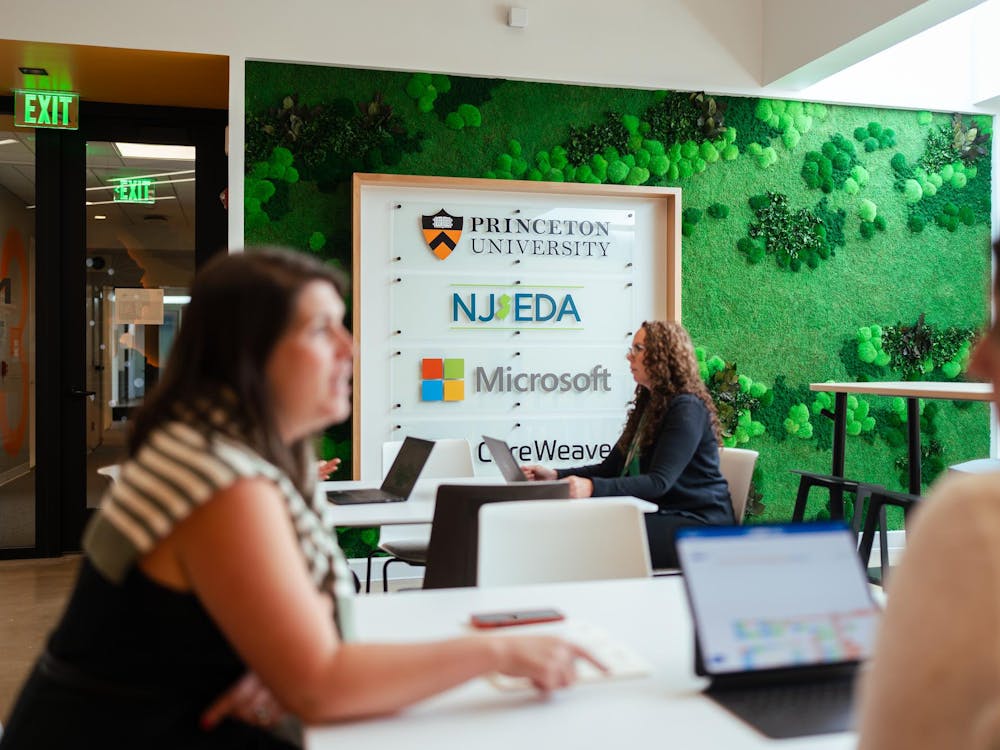
NJ AI Hub marks first anniversary with inaugural startup cohort
Zihan (Frank) XuFourteen selected start-ups receive weekly workshops, reverse pitches, corporate introductions, among other guidance over 12 weeks. The “AI accelerator” helps to test each company’s technology and fast-track its path to commercialization.
Fourteen selected start-ups receive weekly workshops, reverse pitches, corporate introductions, among other guidance over 12 weeks. The “AI accelerator” helps to test each company’s technology and fast-track its path to commercialization.
Three Princeton alumni awarded 2026 Fields Medal
Clara DochertyThe three alumni who received the medal are Yu Deng GS ’15, John Pardon ’11, and Jacob Tsimerman GS ’11.
The three alumni who received the medal are Yu Deng GS ’15, John Pardon ’11, and Jacob Tsimerman GS ’11.

Major gift from Leinweber Foundation to strengthen theoretical physics research
Daphne Lewis and Haeon LeeThe University is joining a national network of institutions advancing theoretical physics research, following the major gift. The foundation has committed over $165 million to top fundamental science research institutions during a period of uncertainty for research funding.