



Walsh attempted to join the local chapter of Freecycle, a national nonprofit organization that allows members to receive free furniture and appliances from other members who choose to give away used items rather than discard them. For reasons unknown to Walsh, however, his application was rejected.
“I’m not sure why they reject anyone ... and why reviewing ‘applications’ takes them weeks,” Walsh said in an e-mail. “It seemed crazy to me that there wasn’t a convenient way for people to participate in the ‘local reusing’ movement right away, very easily.”
After moving to San Diego, Walsh tried joining Freecycle again. This time, the local group approved him after several weeks. The website then began to send him e-mails “mentioning all sorts of faraway inapplicable/uninteresting items,” an approach that he considered “a really poor design.”
Inspired by past conversations with bioethics professor Peter Singer and some of his close friends from Princeton, Walsh decided that he could do better and developed yinyango.org, a website that helps people find local, free, reusable items without memberships or applications.
After trying various layouts and getting feedback from his girlfriend, friends, family members and former coworkers, Walsh announced the launch of the website last month by e-mailing a press release to some environmental and technology blogs.
Walsh is currently applying for grants to finance the costs of the website, said he hopes the website will be recognized for the potential environmental benefits of large-scale reusing. He has calculated that 1 million people participating in the project would have the environmental benefit of removing 3,500 cars for one year.
While the website is far from fulfilling Walsh’s long-term vision, he and his girlfriend have already used Yinyango to furnish most of their apartment, receiving a bed, couches, a microwave, dishware, tables and even plants.
“All that stuff was headed for landfills if people like us didn’t pick it up,” Walsh said.

Singer said in an e-mail that he was happy to find out that Walsh had developed the website.
“It’s shocking how much perfectly good stuff Americans throw out,” Singer said. “You see it at Princeton, especially at the end of the school year, when the dumpster bins are surrounded by perfectly good furniture.”
Singer also recalled his experience working with Walsh as an informal adviser on his thesis. “It’s good to know that Ryan Walsh is behind this,” he said, adding that Walsh was a “lively student, with an inquiring mind.”
Singer added that he continued to exchange e-mails with Walsh after his graduation, discussing the most effective ways to reduce global poverty.
“He’s really interested in doing something that is effective, and although I could not have predicted exactly what he would end up doing, I’m not surprised that he is already having an impact in making the world a better place,” Singer said.
Using web technology to promote a good cause, or to simply make people’s lives easier, has been a long-term interest for Walsh. As an undergraduate, the politics major was part of the team that designed Point, the now-popular campus website.

“For the first couple of years that I was at Princeton, I kept hearing one day too late that ‘the president of Country X just spoke in Richardson yesterday’ or ‘the secretary of state was just here’ or other things like that, and that was always severely disappointing to me,” he said. “I was shocked that there weren’t mechanisms on campus to tell people about the cool upcoming events.”
After learning how to code, Walsh helped create home.princeton.edu, a site that posted information about academic and social events on campus. While adding features to the site, he discovered that another team of students led by Clay Bavor ’05 was working on a similar class project. Walsh got involved with that team, which eventually created point.princeton.edu.
“Ryan is a really creative guy and contributed [to the development of Point] in a lot of ways. He actually came up with the name ‘Point,’ ” Bavor said. Walsh succeeded Bavor to become Point’s second official webmaster.
Walsh is also working on other web projects, including TheIvyLink.com, which he said he hopes will be fully functioning later this month and will eventually serve as “TigerNet on steroids.”
The current TigerNet system, which serves as a portal for discussion and networking among Princeton alumni, “has a lot of room for improvement,” Walsh said. “More people would participate if it was easier to start, more people would benefit from the archives of old discussions if they were easily searchable, and more/better advice would be shared if alumni from other Ivy League schools were invited too.”
Walsh said The Ivy Link will solve these problems by connecting alumni from all of the Ivy League and Seven Sister schools: Vassar, Radcliffe, Barnard, Wellesley, Bryn Mawr, Mount Holyoke and Smith.
Read More
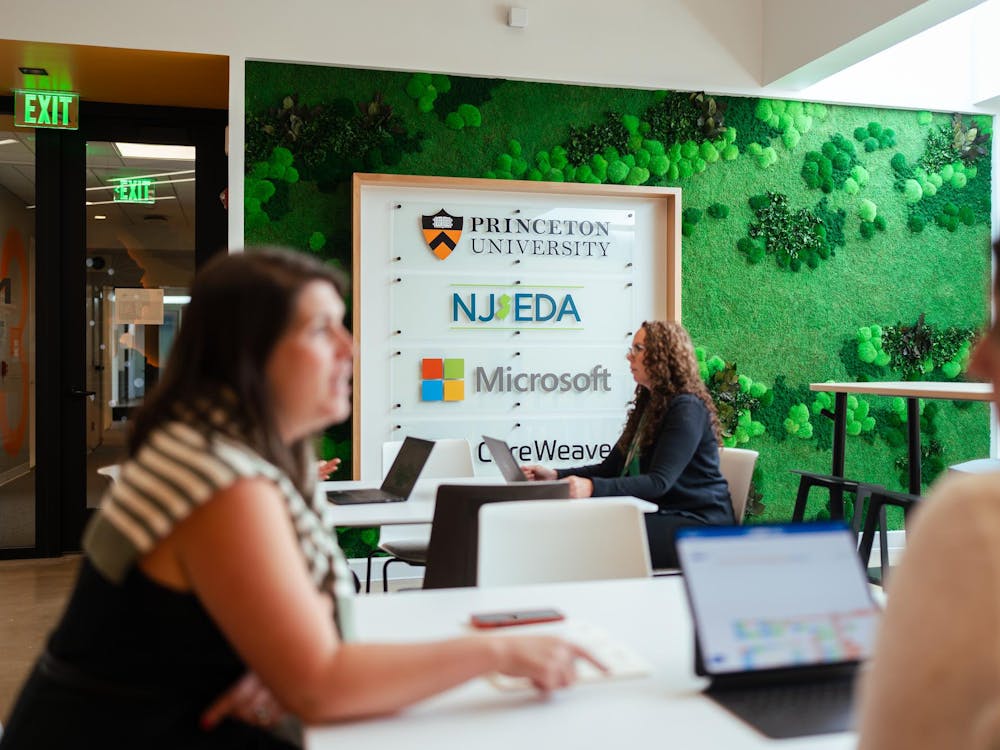
NJ AI Hub marks first anniversary with inaugural startup cohort
Zihan (Frank) XuFourteen selected start-ups receive weekly workshops, reverse pitches, corporate introductions, among other guidance over 12 weeks. The “AI accelerator” helps to test each company’s technology and fast-track its path to commercialization.
Fourteen selected start-ups receive weekly workshops, reverse pitches, corporate introductions, among other guidance over 12 weeks. The “AI accelerator” helps to test each company’s technology and fast-track its path to commercialization.
Three Princeton alumni awarded 2026 Fields Medal
Clara DochertyThe three alumni who received the medal are Yu Deng GS ’15, John Pardon ’11, and Jacob Tsimerman GS ’11.
The three alumni who received the medal are Yu Deng GS ’15, John Pardon ’11, and Jacob Tsimerman GS ’11.

Major gift from Leinweber Foundation to strengthen theoretical physics research
Daphne Lewis and Haeon LeeThe University is joining a national network of institutions advancing theoretical physics research, following the major gift. The foundation has committed over $165 million to top fundamental science research institutions during a period of uncertainty for research funding.