



In focused precept discussions, students, including 30 from Princeton, explored various economic, social and political problems facing the world. Speakers addressed ideas such as leadership and the American Dream.
Conference participants gathered in McCosh 50 on Saturday morning to listen to the first two keynote speakers: Rep. Rush Holt (D-N.J.) and Rob Falzon, treasurer of Prudential Financial, Inc., which sponsored the conference.
Keeping with the theme of the conference, Falzon spoke about leadership in the financial crisis, telling students that the crisis will "challenge your job search and fundamentally change your careers."
"Leadership is highly dependent on vision," Falzon continued, comparing vision to a compass without which leaders cannot navigate.
Falzon also emphasized the need for new leaders "to step up and change their strategies.”
“[They] need to anticipate and help shape what the market will look like, and then plan accordingly," he said.
Following Falzon's talk, Holt discussed the idea of the "American Dream."
He began by posing two central questions for students to answer: "To whom does the American dream belong? Does it belong to all of us or to a privileged few?" and "Are we a nation of individuals or are we a community?"

Holt also posed the question, "What should leading students at leading universities do to affect our world?"
In an interview, he later said that students ought to "take advantage of the positions [they] have to help the nation debate on these issues by agreeing on the facts ... our inability to debate the big issues [is] based on the disagreement on the facts."
Students then split up into eight precepts of roughly 20 students each to discuss relevant topics in greater depth.
Grecia Barboza, a sophomore from Columbia University, attended the Politics and Government precept, which was run by the third keynote speaker of the day, Mayor of Los Angeles Antonio Villaraigosa. Barboza said that Villaraigosa "was very personal and I really felt like I got to know him.”
Villaraigosa delivered the final speech on Saturday afternoon following the discussions which focused on a personal passion of his: education reform. He called education "the preeminent challenge of the world," and he stressed the growing importance of a college education and the need to set high expectations for all students.
Throughout his speech, Villaraigosa often returned to what he deemed the "Seven P's," or seven keys to success: policy, politics, people, priorities, persistence, passion and philosophy. Villaraigosa maintained that embracing the Seven P's would lead to efficiency and therefore success.

Villaraigosa ended his talk on a positive note, speaking directly to the students.
"I believe so much in this generation,” he said. “You're using your skills for good and for change ... you are why I'm optimistic."
In addition to listening to the speakers and attending precepts, students also went to recruiting sessions held by Prudential and IBM, the event sponsors, and used free time to meet each another. "I met a lot of people — it's good for networking," Barboza said.
"It's absolutely wonderful because you get to meet new people ... It's wonderful to share ideas," noted Brandon Tomasso, a sophomore from Brown University.
The summit had been in planning since January, when Princeton's delegation successfully placed its bid to host the event, conference chair Stephen Stolzenberg ’13 said.
Around 20 Princeton students attended the 10th Ivy Council meeting at Yale last February.
Stolzenberg said he was happy with how the conference turned out.
"The goal is to give the Ivy Council a chance to do something to bring people together," he said. "When you bring people together and let them have common experiences, it's not just common knowledge of other people ... [but] perhaps [it] is what we can do to get involved now and inspire others."
Read More
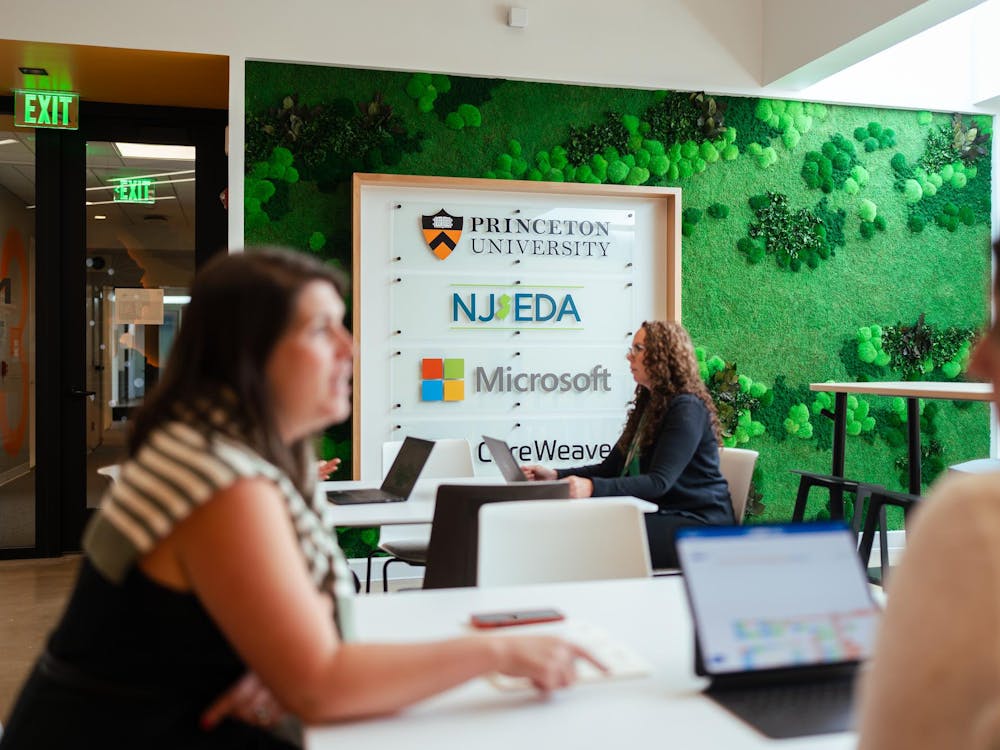
NJ AI Hub marks first anniversary with inaugural startup cohort
Zihan (Frank) XuFourteen selected start-ups receive weekly workshops, reverse pitches, corporate introductions, among other guidance over 12 weeks. The “AI accelerator” helps to test each company’s technology and fast-track its path to commercialization.
Fourteen selected start-ups receive weekly workshops, reverse pitches, corporate introductions, among other guidance over 12 weeks. The “AI accelerator” helps to test each company’s technology and fast-track its path to commercialization.
Three Princeton alumni awarded 2026 Fields Medal
Clara DochertyThe three alumni who received the medal are Yu Deng GS ’15, John Pardon ’11, and Jacob Tsimerman GS ’11.
The three alumni who received the medal are Yu Deng GS ’15, John Pardon ’11, and Jacob Tsimerman GS ’11.

Major gift from Leinweber Foundation to strengthen theoretical physics research
Daphne Lewis and Haeon LeeThe University is joining a national network of institutions advancing theoretical physics research, following the major gift. The foundation has committed over $165 million to top fundamental science research institutions during a period of uncertainty for research funding.