



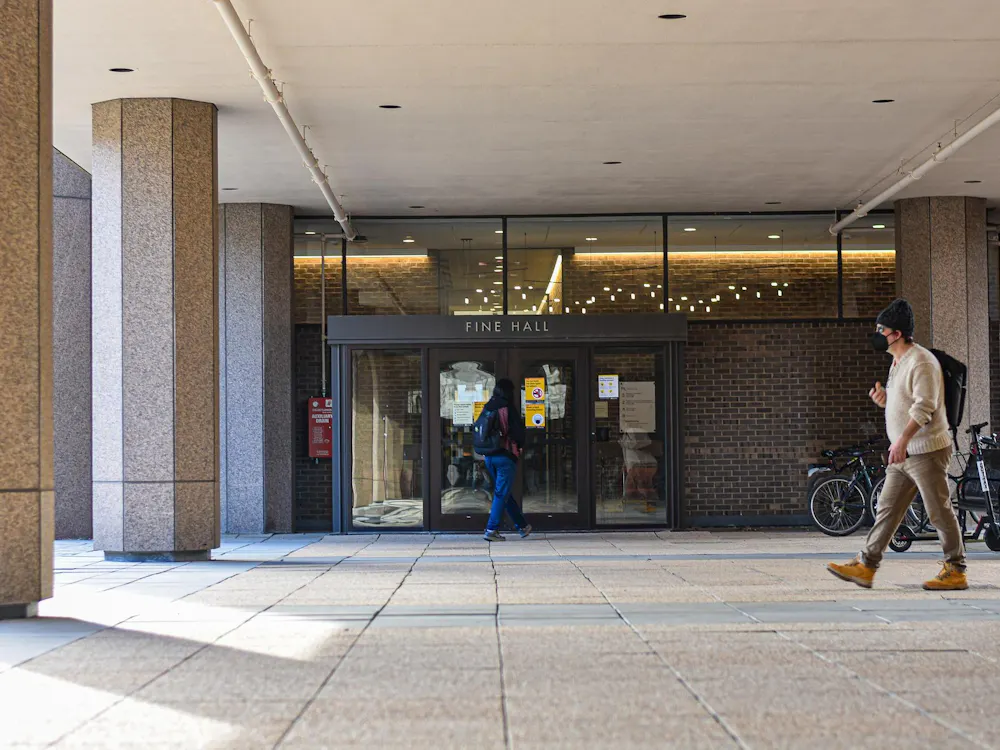
Heading from Firestone down Washington Road, you will find offices and classrooms awash with light above the gothic arches of McCosh and 1879 halls. A bit further down the road, lights are conspicuously left on in the highest offices of Fine Hall.
Walking west, nearly all the lights in Whig Hall — renovated in 2009 — remain on, as do the lights in many offices on the north wall of New South Building.
Wawa is one of the rare lighted buildings on this walk that is still in use at this hour.
University spokeswoman Emily Aronson cautioned in an e-mail that “while you may have seen lights on in some scattered rooms ... it could have been that someone was working late.”
She added that individuals are encouraged through “ongoing sustainability messaging” to turn off lights, though doing so “is partly individual personal responsibility.”
Administrators also noted that the University is retrofitting its most energy-consuming buildings with more efficient lighting to reduce its carbon footprint and that installation of integrated motion sensors to reduce heating, cooling and lighting costs are ongoing. Yet buildings that have recently undergone construction, such as Whig Hall, have lights that often stay on through the night.
“We are keenly aware of the buildings that need lighting work,” Sustainability Manager Shana Weber said.
Weber explained that the campus’s 50 highest energy-using buildings have been targeted for energy reduction as part of the University’s energy master plan, which aims to reduce greenhouse gas emissions to 1990 levels by 2020. Efficient lighting systems have been installed in Sherrerd Hall, the new Frick chemistry building and MacMillan Building, according to Weber.

As part of the University’s energy plan, lighting retrofits “will, over the next few years, reach most of the campus [and] include occupancy and daylight sensors and more efficient bulbs,” Weber added.
Weber also noted that buildings requiring less energy will not immediately show improvement.
But Chrissy Badaracco ’12, co-president of Greening Princeton, a student organization committed to environmental sustainability, said that the current efforts are not enough.
“We definitely think it is an excessive use of energy on campus,” she said.
Greening Princeton has asked the administration why some buildings leave lights on at night, Badaraco said, explaining that the group was told that “the lights in New South must stay on at night for security reasons.”
New South is one building that now features low-energy light-emitting diodes, at least in its newly constructed dance studios, Aronson noted. She added that LEDs have also been installed in Thomas Laboratory and MacMillan.

Furthermore, integrated motion systems lower energy use in unoccupied rooms in Computer Science Building, Robertson Hall and Frist Campus Center and will be used in “new construction and renovation projects ... wherever appropriate,” Aronson added.
One other success story Aronson mentioned was the 74 percent reduction in energy used to light tents at Reunions this year, which was achieved by switching from incandescent light bulbs to compact fluorescent light bulbs.
Many of Princeton’s peer institutions are also implementing energy-saving light systems, and some have taken steps that the University has not.
Harvard, for example, has used light-control systems extensively on its campus. According to a Harvard press release from the summer of 2009, the motion-sensing system installed in its garage was expected to save roughly $400,000 each year and pay for itself by 2012. Similar light-control systems are used elsewhere on its campus, including in its graduate school.
Andy Laplume, a Harvard buildings manager who oversaw another project to install light-sensor systems in libraries and offices in 2009, said in a press release that the renovation “could result in saving two or three hours of electricity every day [per office].”
Stanford has similar light-reduction systems, which it claims reduce energy use by 20 percent in some buildings, according to the school’s sustainability website.
Massachusetts Institute of Technology recently introduced its Pledge Effort, aimed at making students aware of the environmental impact of their actions. A survey of its own buildings for after-hours energy use determined that only 15 percent of its lights were kept on at night, compared with its estimate of 25–40 percent based on surveys at other institutions.
Weber said that reducing emissions in existing buildings on the Princeton campus is not easy or quick. But, looking forward, “efficient lighting and water conservation technologies are some of the first actions short of full renovation that can yield immediate results,” she said.
Read More

NJ AI Hub marks first anniversary with inaugural startup cohort
Zihan (Frank) XuFourteen selected start-ups receive weekly workshops, reverse pitches, corporate introductions, among other guidance over 12 weeks. The “AI accelerator” helps to test each company’s technology and fast-track its path to commercialization.
Fourteen selected start-ups receive weekly workshops, reverse pitches, corporate introductions, among other guidance over 12 weeks. The “AI accelerator” helps to test each company’s technology and fast-track its path to commercialization.
Three Princeton alumni awarded 2026 Fields Medal
Clara DochertyThe three alumni who received the medal are Yu Deng GS ’15, John Pardon ’11, and Jacob Tsimerman GS ’11.
The three alumni who received the medal are Yu Deng GS ’15, John Pardon ’11, and Jacob Tsimerman GS ’11.

Major gift from Leinweber Foundation to strengthen theoretical physics research
Daphne Lewis and Haeon LeeThe University is joining a national network of institutions advancing theoretical physics research, following the major gift. The foundation has committed over $165 million to top fundamental science research institutions during a period of uncertainty for research funding.