



“It has been extraordinary to see the participation of alumni, parents and friends in this effort,” Justin Harmon ’78, assistant vice president for development, said in an e-mail, adding that the campaign expects to raise the remaining $500 million by the end of the campaign.
“We don’t set precise year-to-year targets for campaign giving, but we do anticipate that our volunteers and donors will feel the momentum of the last two years of Aspire and will want to participate,” he said.
The Aspire campaign focuses on six main areas: Annual Giving, Engineering and a Sustainable Society, Exploration in the Arts, New Frontiers in Neuroscience, Citizenship and the World, and The Princeton Experience.
Harmon noted that the most recent example of the campaign’s success was last year’s Annual Giving campaign, which raised $48.6 million — the third-highest total in its history — with 60.8 percent of undergraduate alumni participating.
He added that the last Annual Giving campaign also drew the largest number of alumni donors ever and a record number from all constituencies.
“These numbers reflect the fact that members of the extended Princeton community have continued to support the University with remarkable loyalty and generosity, in good times and in bad,” he said.
Major alumni contributors expressed optimism that the University would meet its goal despite the country’s economic condition.
“I have no doubts that Aspire will meet its ambitious target, despite a long economic depression (yes, depression) and high uncertainty and anxiety amongst businesses and investors,” William Powers ’79, who donated $10 million to the University’s football program in November 2006, said in an e-mail.

Thomas Barron ’74, who donated $4.5 million with his wife Currie to support the Princeton Environmental Institute in 2008, also expressed confidence in the campaign’s ultimate success.
“I am totally impressed with the Aspire campaign and remain completely confident that the University will reach its fundraising goal,” Barron said.
The next steps in the campaign involve extending its scope even further, Harmon said.
“This is a phase in the campaign when we want to include as many alumni, parents and friends in our outreach as possible, which both allows us to engage more people who care about Princeton and also to respect differences in their ability to participate,” he explained.
Harmon noted that the campaign has already contributed to several significant projects on campus.
“We are constructing the neuroscience and psychology complex; the second cohort of Bridge Year students has set off; four new global scholars have been announced; Emily Carter has been named the founding director of the Andlinger Center for Energy and the Environment; and more,” Harmon explained.

Barron encouraged alumni and others affiliated with the University to continue donating.
“To meet the campaign goal, Princeton needs to simply reconnect with the many who have a debt to Princeton — a debt that honestly can ... never be repaid,” he said. “Those in debt include alums, parents, spouses, foundations, corporations and, yes, even governments. From time to time Princeton needs to call in these obligations.”
Mark Wilf ’84, who donated $5 million with his wife Jane to fund programming at the Center for Jewish Life as well as a new dormitory that bears his name, said that his experience with the campaign has been pleasant.
“The Office of Development was extremely easy and gracious to work with,” he said. “Everyone I’ve dealt with across the entire giving process has been very professional and very accommodating in terms of trying to match what my needs as a donor were to the goals of the campaign.”
Correction: Due to an editing error, an earlier version of this article cited Justin Harmon ’78 as saying the campaign would finish ahead of schedule when, in fact, he said the campaign expects to reach its goal by its end date.
Read More
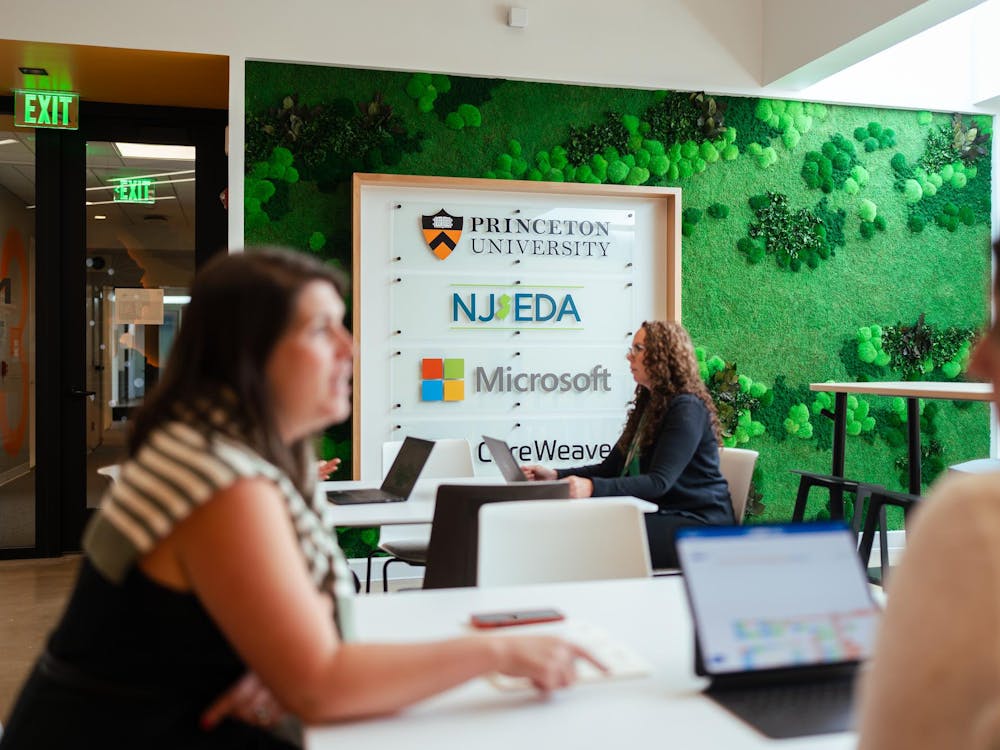
NJ AI Hub marks first anniversary with inaugural startup cohort
Zihan (Frank) XuFourteen selected start-ups receive weekly workshops, reverse pitches, corporate introductions, among other guidance over 12 weeks. The “AI accelerator” helps to test each company’s technology and fast-track its path to commercialization.
Fourteen selected start-ups receive weekly workshops, reverse pitches, corporate introductions, among other guidance over 12 weeks. The “AI accelerator” helps to test each company’s technology and fast-track its path to commercialization.
Three Princeton alumni awarded 2026 Fields Medal
Clara DochertyThe three alumni who received the medal are Yu Deng GS ’15, John Pardon ’11, and Jacob Tsimerman GS ’11.
The three alumni who received the medal are Yu Deng GS ’15, John Pardon ’11, and Jacob Tsimerman GS ’11.

Major gift from Leinweber Foundation to strengthen theoretical physics research
Daphne Lewis and Haeon LeeThe University is joining a national network of institutions advancing theoretical physics research, following the major gift. The foundation has committed over $165 million to top fundamental science research institutions during a period of uncertainty for research funding.