



While senators grilled Supreme Court nominee Samuel Alito '72 over his judicial philosophy and affiliation with a University alumni group, students at his alma mater seemed more concerned with final exams and papers than with the fate of their fellow Princetonian.
Several students interviewed had not heard of Alito, though those who have followed the hearings expressed a range of views. On campus, as across the country, opinions fell largely along partisan lines.
Some students said they stand by Alito, citing his judicial knowledge and experience as reasons for their support.
"He seems like a strong candidate ... He has demonstrated strong leadership and judicial knowledge," Brendon Luby '09 said. He and the two other students at his table outside Café Viv had just been discussing the cover photo of USA Today, which showed Alito's wife crying as she walked out of the hearing room "because the Democratic senators were giving him such a hard time," he added.
The harsh questions posed by Democratic senators did not concern Wyatt Yankus '09, treasurer of College Republicans, who argued that much of the criticism Alito has received is unfounded.
"I think the Democrats have had a hard time. They've been trying to paint Alito as being some sort of elitist, as a supposed member of some sort of elitist organization, but it's not working because it's not true ... I just don't think that charge can stick to him," Yankus said.
Other students conceded that Alito was a qualified candidate, but worried about his ideology.
"I think he is a better choice than Harriet Miers because he's more competent and more experienced than her," Sara Viola '08 said. "I'm not worried about his capacity to be an informed and competent judge. I am just worried about the decisions he'll make."

Others voiced similar concerns about his stance on abortion, his rulings related to corporate behavior and his membership in the Concerned Alumni of Princeton University (CAP).
"I do not support the nomination of Samuel Alito because I think that he subscribes to an extremist conservative ideology, and that his ideology would necessarily influence his rulings as a Supreme Court justice," College Democrats president Julia Brower '08 said in an email.
Bower noted that, though Alito has said he respects precedent as a general principle, he has not agreed to describe Roe v. Wade as "settled law."
Elizabeth Shutkin '07, president of the Organization of Women Leaders (OWL), declined to make a statement about Alito's position on abortion because OWL is a nonpartisan organization.

Shutkin did add, however, that, "there are a number of issues that he needs to really address, such as his stance on how he treats women and minorities, due to his membership in CAP."
At the same time, she added, "it is exciting to think that there could be an alum on the Supreme Court."
Abortion has been one of the hottest topics at the confirmation hearings in Washington, but Asheesh Siddique '07, coeditor of the Princeton Progressive Nation, said he thinks the issue has been "overemphasized."
"My main concern is his attitude on judicial-economic issues, where he's shown that he's a friend of corporate power and an enemy of the people," Siddique said in an email. "I hope Princeton doesn't embrace him, because he stands for very disturbing things, [such as] hostility to women's rights, civil rights and the dignity of the working men and women of America."
Aurelien Fraisse GS said he had his doubts about Alito's honesty on the CAP issue.
"He tends to say things one day and then later he says something else," Fraisse said. "He basically changes his mind just to get a job ... He said he wanted to support the military in the Vietnam War, but [CAP] had a lot of different ideals," referring to the group's alleged opposition to coeducation and affirmative action.
Read More

Lawsuits filed against University after cybersecurity incidents
Shaun KaraniMultiple lawsuits have been filed against Princeton in the wake of a widespread cybersecurity breach.
Multiple lawsuits have been filed against Princeton in the wake of a widespread cybersecurity breach.

Israeli consulate visits Princeton to discuss experience of Jewish students, follows Tsurkov release
Luke GrippoFor the first time since the 2024 “Gaza Solidarity Encampment” at Princeton, Yuval Donio Gideon, head of the Public Policy Department of the Consulate General of Israel in New York, met with University administrators and campus rabbis to discuss the experience of Israeli and Jewish students on campus.
For the first time since the 2024 “Gaza Solidarity Encampment” at Princeton, Yuval Donio Gideon, head of the Public Policy Department of the Consulate General of Israel in New York, met with University administrators and campus rabbis to discuss the experience of Israeli and Jewish students on campus.
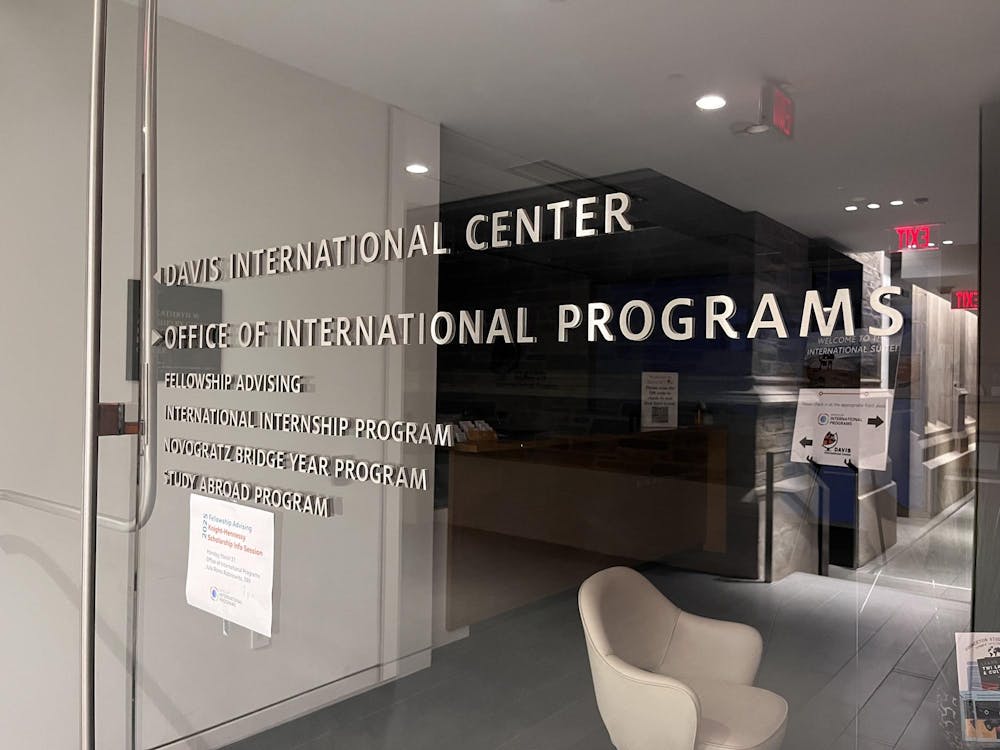
Trump administration announces new travel, visa restrictions in last days of semester
Luke GrippoNew travel restrictions announced by the Trump administration could impact international students returning to campus after break.
New travel restrictions announced by the Trump administration could impact international students returning to campus after break.