



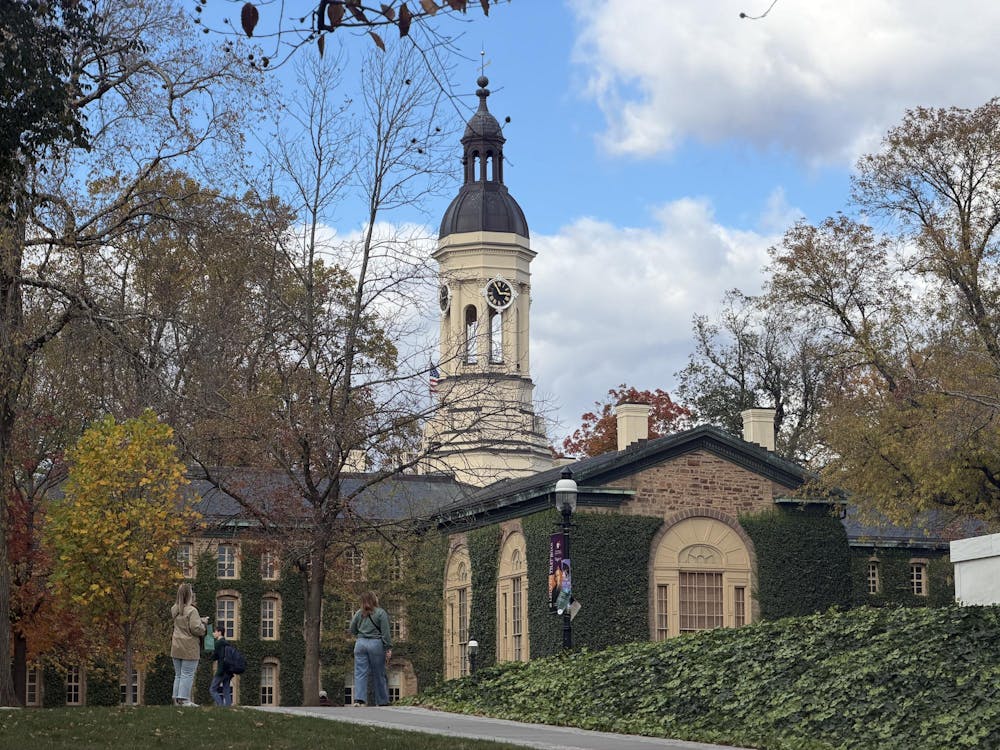
For the first time since the 2024 “Gaza Solidarity Encampment” at Princeton, Yuval Donio Gideon, head of the Public Diplomacy Department of the Consulate General of Israel in New York, met with University administrators and campus rabbis to discuss the experience of Israeli and Jewish students on campus.
In the three semesters since Gideon’s last visit, the Trump administration has suspended $210 million of research grants to Princeton, ostensibly over an antisemitism investigation (some of the funding was restored over the summer, and the University has repeatedly said it had never received clear rationale from the government). A talk by Naftali Bennett, the former prime minister of Israel, was repeatedly disrupted by pro-Palestine protesters. And Elizabeth Tsurkov GS, a dual Russian-Israeli citizen, was freed from captivity in September after being kidnapped by an Iraqi militia group in 2023.
Gideon met with Vice President for Communications and Government Affairs Gadi Dechter and Vice Provost for International Affairs and Operations Aly Kassam-Remtulla, two top Nassau Hall officials. He also met with Rabbi Eitan Webb, the co-director of Princeton University Chabad House, and Rabbi Gil Steinlauf ’91, the executive director of the Center for Jewish Life.
Gideon said he left the meeting with Dechter and Kassam-Remtulla aware of the “the conviction that the leaders of the University had in reassuring that Israeli students and Jewish students alike should feel welcomed and safe,” as well as their openness to discussions to achieve that.
Gideon’s visit to Princeton comes at the end of a two-year long effort to visit the regional Ivy League schools — specifically Cornell, Columbia, and the University of Pennsylvania — among other schools in the five-state region. His visit to Princeton immediately succeeds his visits to Ohio State University, Youngstown University, Case Western University, and Oberlin College.
“We have many kinds of cooperations between Israel and universities and American universities. We try to facilitate, or to make contacts, or to open the doors,” Gideon said. “Eventually, it’s not us who make the connections. It’s the universities, each one to another one, but we try to identify opportunities and make the right contacts for universities.”
In discussing how the University has handled recent events regarding collegiate conflicts over issues about Israel-Palestine, such as the disruptions at Naftali Bennett walkout, Gideon had nothing but praise for University President Christopher Eisgruber ’83 and his administration.
“I respect tremendously a lot of efforts that’s been done by the University to combat the racism and antisemitism that occurred on the campus,” Gideon said. “What we’re aiming for here is really to understand how it looks today, and to which extent those measures were really fruitful.”

In the three discussions Gideon had, however, he said Elizabeth Tsurkov was not brought up.
In an interview with the ‘Prince,’ Webb cast Princeton as a university uniquely situated in the national spotlight for the Israeli government to be interested in, considering the events surrounding Tsurkov.
“There’s only one Israeli national on any college campus in the United States of America that was kidnapped, beaten, tortured for two years, and that one came from Princeton,” Webb said.
While Webb called the exact reasons for the consulate’s interest in Princeton and Gideon’s visit “nebulous,” he also said that the discussions he and others had with Gideon had positive implications, even at the administrative level.
“I can’t imagine [the conversation] wasn’t: ‘What are you doing for the safety of our people... Would you go to bat for them if something like that happened again?’” Webb said.
“The world does revolve around trust, does revolve around relationships, does involve our friendships,” he added. “We get a lot done by creating trust and by building, doing, the hard work of just relationship.”

Steinlauf called his meeting “a useful opportunity to establish a connection.”
“Yuval’s office contacted me to let me know he would be visiting campus and wanted to connect with me in my role as Executive Director of the CJL,” Steinlauf said. “He said he wanted to hear how the Jewish community at Princeton has been doing, particularly since October 7, and to learn whether his office could be helpful in any way.”
Their conversation “focused on the campus climate, the experiences of Jewish students, and the kinds of conversations happening on campus about Israel and the war,” Steinlauf said, adding that these conversation requests from Israeli officials are normal.
While explaining that he has not seen the same amount of antisemitism at Princeton as on other campuses, Steinlauf expressed to Gideon his belief that the Israeli government could do better in explaining the complexity of the political climate of Israel, including perspectives against the war in Gaza.
“More broadly, meetings like this can help Israeli officials listen to what campus communities are experiencing, understand how students are engaging the issues, and learn what might help foster more constructive dialogue and understanding in a university setting,” Steinlauf wrote.
“It makes sense for them to travel around to go and try to get their finger on the pulse… as it relates to them, what’s going on, and how they should interpret [the situations on campuses],” Webb said.
While future meetings with Gideon have not been discussed, he expressed hope that they will talk again soon, citing the meetings he had as “a useful channel for all sides.”
“We didn’t speak about a date for coming back, although I hope it will be sometime soon,” Gideon said.
Luke Grippo is an assistant News editor for the ‘Prince.’ He is from South Jersey, and typically covers University and town politics, on a national, regional, and local scale. He can be reached at lg5452[at]princeton.edu.
Please send any corrections to corrections[at]dailyprincetonian.com.
This piece has been updated to include the word "diplomat" in the title in lieu of "consulate."
Read More
Two Princeton professors win 2027 American Chemical Society awards
Kimberly HutchinsonPrinceton chemistry professors David MacMillan and Paul Chirik were named 2027 American Chemical Society national award winners for their contributions to the field of chemistry.
Princeton chemistry professors David MacMillan and Paul Chirik were named 2027 American Chemical Society national award winners for their contributions to the field of chemistry.

Federal court blocks elimination of duration of status for international students
Luke GrippoA federal court has temporarily stopped the Department of Homeland Security from implementing its new final rule that would limit how long international students and exchange visitors can stay in the country. The next update on the case is set for Oct. 2.
A federal court has temporarily stopped the Department of Homeland Security (DHS) from implementing its new final rule that would limit how long international students and exchange visitors can stay in the country. The next update on the case is set for Oct. 2.

Preview: Football returns to action for 2026 season
Alex Beverton-SmithPrinceton football will commence their season on Sept. 19 against the Bryant Bulldogs.
Princeton football will commence their season on Sept. 19 against the Bryant Bulldogs.