



Stephen Forrest, an electrical engineering professor, and Dudley Saville, a chemical engineering professor, were elected to the National Academy of Engineering, joining 15 other University faculty members already in the Academy.
Membership in the National Academy of Engineering is one of the highest honors in the engineering field, and 77 new members were elected this year. The academy seeks "to promote the technological welfare of the nation by marshaling the knowledge and insights of eminent members of the engineering profession," according to an NAE press release.
Those chosen for membership have shown "unusual accomplishment in the pioneering of new and developing fields of technology," and have made "important contributions to engineering theory and practice," the release said.
"The election of these two outstanding professors highlights the distinction of our engineering faculty at Princeton," said Maria Klawe, dean of the School of Engineering and Applied Science, in a press release. "Since our engineering school is relatively small, it is quite an achievement if just one of our faculty is elected in a particular year. To have two members of the faculty elected into this elite body in one year is indicative of the high quality of our faculty."
Manipulating the small
Saville was elected to the academy for "advancing our understanding of electrokinetic and electrohydrodynamic processes and their application to the assembly of colloidal arrays," the NAE statement said.
Saville said he was "interested in understanding how to manipulate small objects and fluids on a small-length scale."
In his research, he has worked on "reaching into" fluids and grabbing hold of and moving colloidal particles, less than a few microns in size, he said.
When Saville began his research other scientists were also working on the same problem, but Saville started exploring a unique method of particle manipulation, he said.

He thought "it would be interesting to discover a way to reach in electrically."
"When we started this, nobody else was doing this kind of thing," he said. "I don't like to be crowded."
Saville earned his bachelor's and master's degrees in 1954 and 1959 from the University of Nebraska, and his Ph.D. in 1966 from the University of Michigan. He came to the University in 1968.
Saville has experimented extensively with colloidal crystals, repeating arrays of microns arranged into patterns.
Ryan Hayward '99, an undergraduate working with Saville's research group on his senior thesis, discovered that light could be used to produce crystal patterns by moving particles into positions on light-activated areas. Hayward's research was published in the journal Nature. Hayward's work was "one of the best senior theses I've ever had," Saville said.
In 1996, Saville's research group carried out an experiment on the space shuttle Columbia that examined the stability of liquid bridges, testing the Taylor-Melcher principle.

"We've worked on figuring out how to make this model behave — its limitations, how to improve it," Saville said.
Saville's work will allow for "guided self-assembly," allowing scientists to influence natural processes, and colloidal arrays can also be used to study biological fluids for diagnostic purposes. Saville's work also can be applied in optical communications, the development of light-transferring devices.
Shedding light on LEDs
Forrest was elected to the academy for his "advances in optoelectronic devices, detectors for fiber optics, and efficient organic LEDs for displays," the NAE statement said.
Forrest — who was unavailable for comment this week — graduated from the University of California, Berkeley, in 1972, and received his doctorate from the University of Michigan in 1979. He came to the University from the University of Southern California in 1992.
At USC, Forrest was the director of the national Center for Integrated Photonics Technology and a professor of electrical engineering and materials science. At the University, he directed the Center for Photonics and Optoelectronics Materials from his arrival through 1997. He became chairman of the electrical engineering department in 1997, and held that position until 2001.
Forrest's research interests include integrated optoelectronic transmitters, "consisting of lasers, waveguides, and semiconductor optical amplifiers," Forrest said in a webpage description of his research. Multiple devices are brought together in a single chip, and Forrest strives to find "means to reconcile the divergent materials requirements of different devices in a simple and high-performance manner."
Forrest also works with his research group on organic thin film optical devices, developing integrated organic devices. One such device has vertically stacked, full-color light-emitting devices that could be used in flat panel displays.
In these devices electrically excited molecules emit red, green or blue light, corresponding to the composition of the layer of the device they are in.
"After more than fifty years of research in organic semiconductors, there is still much that is unknown about their basic properties," Forrest wrote on the website.
Continued research in the area could drastically change the way current electronic devices operate. Forrest's team, as he wrote, might usher in "an entirely new generation of optoelectronic devices."
Read More
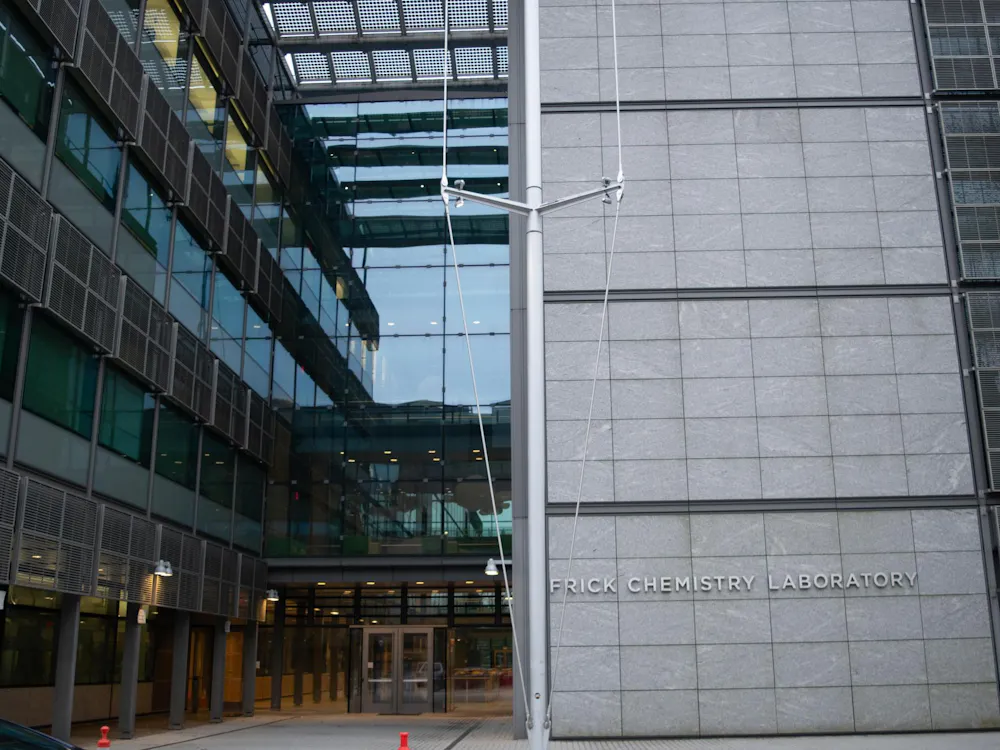
Two Princeton professors win 2027 American Chemical Society awards
Kimberly HutchinsonPrinceton chemistry professors David MacMillan and Paul Chirik were named 2027 American Chemical Society national award winners for their contributions to the field of chemistry.
Princeton chemistry professors David MacMillan and Paul Chirik were named 2027 American Chemical Society national award winners for their contributions to the field of chemistry.

Federal court blocks elimination of duration of status for international students
Luke GrippoA federal court has temporarily stopped the Department of Homeland Security from implementing its new final rule that would limit how long international students and exchange visitors can stay in the country. The next update on the case is set for Oct. 2.
A federal court has temporarily stopped the Department of Homeland Security (DHS) from implementing its new final rule that would limit how long international students and exchange visitors can stay in the country. The next update on the case is set for Oct. 2.

Forbes renovation scope still undecided as Hobson prepares to open
Gus Vogel and Daphne LewisAs Forbes students prepare to become the first cohort to live in Hobson College next year, specifics on Forbes' own renovation remains unsettled by the University nearly six months after the University announced it was accepting consultant bids for a campus-wide dorm renovation plan.
As Forbes students prepare to become the first cohort to live in Hobson College next year, specifics on Forbes' own renovation remains unsettled by the University nearly six months after the University announced it was accepting consultant bids for a campus-wide dorm renovation plan.