



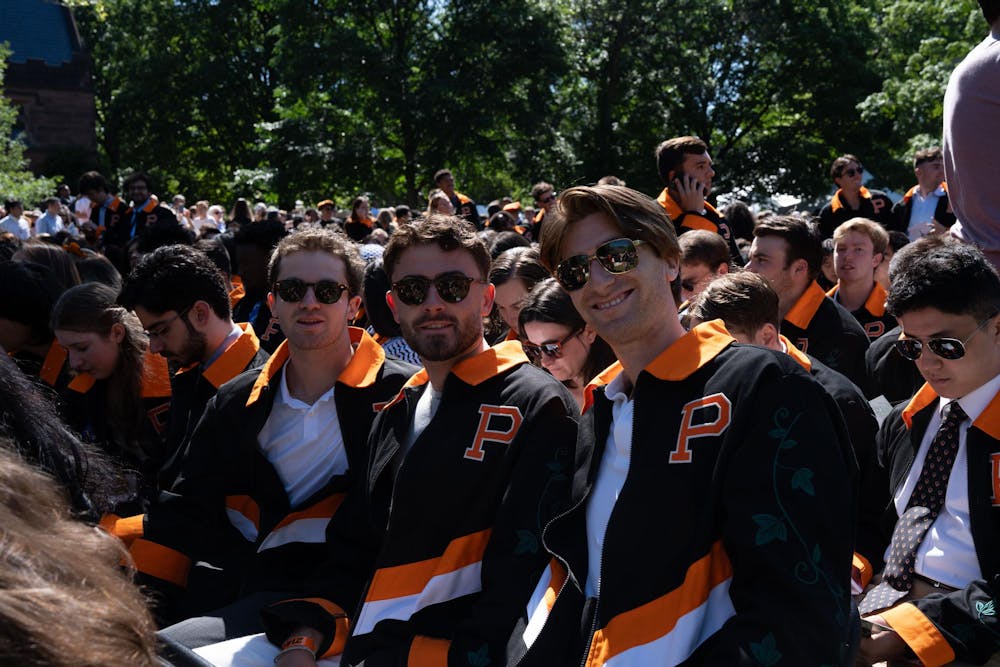
For more than a century, Princeton seniors have donned “beer jackets” to protect their clothes during Reunions and commencement celebrations, typically with elaborate designs chosen by a class-wide contest. Now, with a selection process marred by accusations of generative AI use, the Class of 2026 may have written its own spot in Princeton history.
After two rounds of voting, the Class Jackets Committee announced the winning design by Samuel Henriques ’26 last week. Almost immediately, members of the Class of 2026 accused the jacket, featuring a snarling tiger surrounded by roses, of being created by generative AI. By Saturday, that design had been replaced.
“[FreeFood] AI Slopbowl at class 2026 jacket,” read the subject line of a FreeFood listserv email from Derek Geng ’26, accusing the design of being AI-generated about 40 minutes after the announcement. The following day, Margaret Miao ’26 started a petition calling for transparency on whether the designs were created with AI, which received over 600 signatures.
“Our class jacket symbolizes a member of our class, and I don’t think a generative AI program is a member of our class,” Miao said in an interview prior to the design change.
One of her main motivations for starting the petition was to highlight contest rules that barred AI use, which were only made clear to jacket artists, including Miao. In the final round of ranked choice voting, artists were also asked to sign a form that their design did not incorporate AI-generated content.
The email, from Class of 2026 Vice President Sol Choi ’26, also said that designs would “undergo AI detection,” before being confirmed for the next round. It was unclear how AI use would be detected.
When asked whether Henriques’s design passed AI detection, Choi referred the ‘Prince’ to the email announcing the replacement design and said the Class of 2026 Council would not be commenting further.
The email announcing the new winning design by Zavier Foster ’26 called his design the “highest-ranked eligible jacket design,” suggesting Henriques’s design was disqualified. However, the email did not acknowledge any disqualification or explain why the original design was deemed ineligible.

The ‘Prince’ was not able to independently verify whether one or both of Henriques’ designs were created in part or in whole with generative AI. The initial announcement had included Henriques’ original design alongside a modified version made by Henriques and the jacket committee. Some students pointed to visual artifacts that can be characteristic of AI image generators, such as variation in the jacket’s shape and irregular coloring. Henriques did not respond to the ‘Prince’ despite multiple requests for comment.
Most seniors were happy about the change in design, though some students said the communication from Class Council about the decision wasn’t transparent.
“I feel pretty good about the design being changed after the first design was disqualified, but I think the situation was handled very poorly given the fact that there was no official statement,” wrote Jacob Jackson ’26.
Emma Jean Hermacinski ’26 also wrote that she was glad to see the original design disqualified after student outcry.
“It’s heartening to see that our voices matter in an age where AI slop feels inescapable,” she wrote.
Most seniors reached by the ‘Prince’ also said that they viewed the use of AI as problematic, regardless of whether the design won the initial contest.

“I do think it matters that the first design was made with AI because I do believe it undermines the other students’ entries that were labored over with hours of care,” wrote Abigail Girma ’26. “I also think it speaks to an increasingly frightening trend of the human eye being unable to differentiate between artwork that is artificially generated from that which isn’t.”
Olivia Lechner ’26 wrote that she was worried about the impact an AI-generated design would have on the legacy of the class.
“Everyone at Reunions talks about the seniors’ jacket, and it would have been pretty sad for the whole alumni network to know we didn’t even get our own design,” she wrote.
Miao said she was satisfied with the Class Council’s decision and hopeful for its impact on future class jackets.
“I hope this sets a precedent for the next few years on transparency,” she said in an interview. “Glad that now we have a design that we can confidently say is made from a member of our class.”
Though this is the first time the class jacket contest has had explicit rules governing generative AI use, it remains to be seen how those rules will evolve as the technology changes.
Class jackets will be distributed to seniors during Senior Checkout on Wednesday, April 29, and Thursday, April 30.
Vitus Larrieu is a senior News writer for the ‘Prince.’ He is from Pensacola, Fla. and typically covers community activism, the state of higher education, and construction and architecture.
Please send any corrections to corrections[at]dailyprincetonian.com.
Read More

NJ AI Hub marks first anniversary with inaugural startup cohort
Zihan (Frank) XuFourteen selected start-ups receive weekly workshops, reverse pitches, corporate introductions, among other guidance over 12 weeks. The “AI accelerator” helps to test each company’s technology and fast-track its path to commercialization.
Fourteen selected start-ups receive weekly workshops, reverse pitches, corporate introductions, among other guidance over 12 weeks. The “AI accelerator” helps to test each company’s technology and fast-track its path to commercialization.
Three Princeton alumni awarded 2026 Fields Medal
Clara DochertyThe three alumni who received the medal are Yu Deng GS ’15, John Pardon ’11, and Jacob Tsimerman GS ’11.
The three alumni who received the medal are Yu Deng GS ’15, John Pardon ’11, and Jacob Tsimerman GS ’11.

How Charles Plohn ’66 brought his classmates together on the shelves
Nikki HanFor decades, Charles J. Plohn, Jr. ’66 has been collecting books published by members of his class. With nearly 700 titles in this collection, Plohn is attempting to find his library a permanent home.
For decades, Charles J. Plohn, Jr. ’66 has been collecting books published by members of his class. With nearly 700 titles in this collection, Plohn is attempting to find his library a permanent home.