



Nancy Collins '91 may have all the credentials of the "Organization Kid" in a grownup form — a Princeton A.B. degree, a five-year stint at J.P. Morgan, a master's in development economics from Oxford and a Harvard M.B.A. — but she certainly doesn't fit the stereotype. In fact, most of what Collins does these days is hiking off the beaten path. As president and co-founder of Global Adrenaline, an adventure travel business for young professionals, Collins organizes and attends challenging educational trips to Africa, Asia and beyond.
Global Adrenaline, as Collins and two other founders named it, takes small groups hiking, mountain climbing and kayaking in more than 20 countries throughout the world. Targeting people ages 25 to 50, the organization uses both professors and experts from the United States and local guides to make each experience — from scaling Mt. Everest up to its base camp in Tibet to trekking along the Inca Train to Machu Picchu — both adventurous and educational.
Though starting an adventure travel business might seem an unusual detour for someone with Collins' educational background, Collins said she always knew that she wanted to do this.
"I had always known that this was something I might want to do," she said. "When I was planning and organizing trips for fellow students [in graduate school], I saw that there was a need for a company that would organize trips for people like us — young and intellectually curious."
The trips, which run from $1,000 to $6,000 depending on their length, target young professionals and graduate school students. Though most trips are for groups of eight to 15 people, Global Adrenaline also helps plan smaller trips, like adventure honeymoons.
The company is not simply a whim. In looking at its inner framework and its mission, one finds traces of all the things Collins has learned throughout her long journey to Global Adrenaline's founding.
Having grown up in a military family, for instance, has proven a useful experience for Collins.
"The fact that we moved around every couple of years probably has something to do with my love of traveling," she said. "And the fact that I'm not afraid of just picking up and moving and trying something new."

If Collins hadn't trusted her own instincts and ignored others' plans for her, she would never have ended up at Princeton. After applying to schools and getting accepted to all of them, Collins had a tough choice to make.
"I got into Harvard, but definitely felt better about Princeton," she said. "People kept telling me I had to go to Harvard . . . I remember thinking, 'I don't know how I'm going to do it [to turn down Harvard and choose Princeton], but I knew in my gut that Princeton was the place for me.
"I've never, ever regretted that decision. It was the best choice I ever made."
A member of the varsity women's swim team at the University and winner of its award for sportsmanship and dedication, Collins gave up the sport in her senior year to co-chair Project '91, her senior class' fundraising campaign. She was also bicker chair of Cap and Gown Club.
After Princeton, Collins spent five years with J. P. Morgan in New York City and Australia. She loved it, but knew it wasn't going to be a lifelong career for her. It was there, she said, that she realized she was "a lot more suited to working toward helping people than corporations."
She applied for a master of science in development economics program at Oxford and an M.B.A. program at Harvard, and chose Oxford after both offered her admission. There, she won the D'Agliano Prize for the best thesis in her department.

"When I finished that, I wondered what I was going to do," Collins said. So she finally did what everyone had told her to do 10 years earlier: She went to Harvard.
The M.B.A. program at Harvard afforded Collins opportunities that continued to shape what she would eventually do as a lifetime career. In the summers between academic years, she worked for the International Rescue Committee, performing humanitarian relief on an economic level — planning hospitals, negotiating supply contracts and preparing budgets for communities in Kenya, Tanzania, Burundi and Macedonia.
For Collins, development economics with the World Bank seemed the obviousway to mesh her abilities and interests, and after Harvard, she was accepted into the bank's highly selective Young Professionals Program. Somehow, though, the job that should have been perfect for Collins wasn't the right fit.
"It's a really neat place with really wonderful goals," she said. "For me, there was definitely a lot of bureaucracy I'd never seen before."
With the World Bank, Collins had neither the sense of efficiency that she had with her job at J.P. Morgan nor the feeling of directly helping others that she had at the International Rescue Committee.
It was then that she decided to launch Global Adrenaline.
"It just became evident that if I was ever going to do something different, now was the time," she said. "At a certain point in time, you have to make a commitment and do what you're going to do."
With two friends, Collins founded the company, which was officially incorporated in Feb. 2001. The first trip, to the Himalayas, ran in April 2001, and since then, Global Adrenaline has grown to fit its name. It now offers trips in Africa, Asia, Australia, New Zealand, Latin America, the Antarctic and the Arctic.
Collins' classmate Erin Nicholson '91 has also worked for the company for the past year.
From the start, Global Adrenaline has been immensely conscious of its impact on the environments it explores. Collins is devoted to "responsible, low-impact tourism," she said.
"There are 6,000-plus different adventure travel suppliers in the U.S.," Collins said. "Some people do it in a responsible way, some do not. It's very easy when you're camping to make choices that are environmentally conscious."
Stemming from Collins' background in development economics, Global Adrenaline supports local economies in any way possible.
"Companies like ours can choose to stay in big chain hotels or in locally-owned hotels. We stay in smaller, family-owned hotels to directly channel money into the local economy," Collins explained. "If you go on a trip with us, your money is actually going to end up in the hands of local people and it's going to make more of a difference."
Also, Global Adrenaline always hires local guides in addition to the experts and professors they hire to lead their trips.
"Local guides know a lot about their history and culture. They have a lot of pride in their countries and really want to share their culture," Collins said.
The result, she said, is a better tour with cultural flavor.
Collins' economic savvy has also bolstered the company following Sept. 11 and the economic downturn. Because of the various trips' geographical diversity and the range of people the trips appeal to, the company's growth has slowed only a little in the past year, Collins said.
As customer testimonials flood in — one wrote, "The itinerary and guides were excellent, but above all, Global Adrenaline attracted a great bunch of people . . . I'll never forget celebrating my birthday with them at 17,200 ft on Everest's base-camp!" — Collins' company continues to gain strength.
And Collins continues to benefit from the off-the-beaten-path instinct that once led her to Princeton.
Read More

Princeton University Orchestra and men’s ultimate frisbee team named in University’s latest hazing report
Andrew ArthurTwelve students in the Princeton University Orchestra and Men's Ultimate Frisbee team were found responsible for hazing violations in the University's latest Campus Hazing Transparency Report. Sanctions ranged from Dean's warnings to disciplinary probation.
Twelve students in the Princeton University Orchestra and Men's Ultimate Frisbee team were found responsible for hazing violations in the University's latest Campus Hazing Transparency Report. Sanctions ranged from Dean's warnings to disciplinary probation.

Murray-Dodge Café celebrates 50th Anniversary, drawing over 260 students
Hifza KaleemOn Wednesday, Murray Dodge Cafe celebrated its 50th anniversary, drawing more than 260 students to celebrate with free cookies and merchandise.
On Wednesday, Murray Dodge Cafe celebrated its 50th anniversary, drawing more than 260 students to celebrate with free cookies and merchandise.
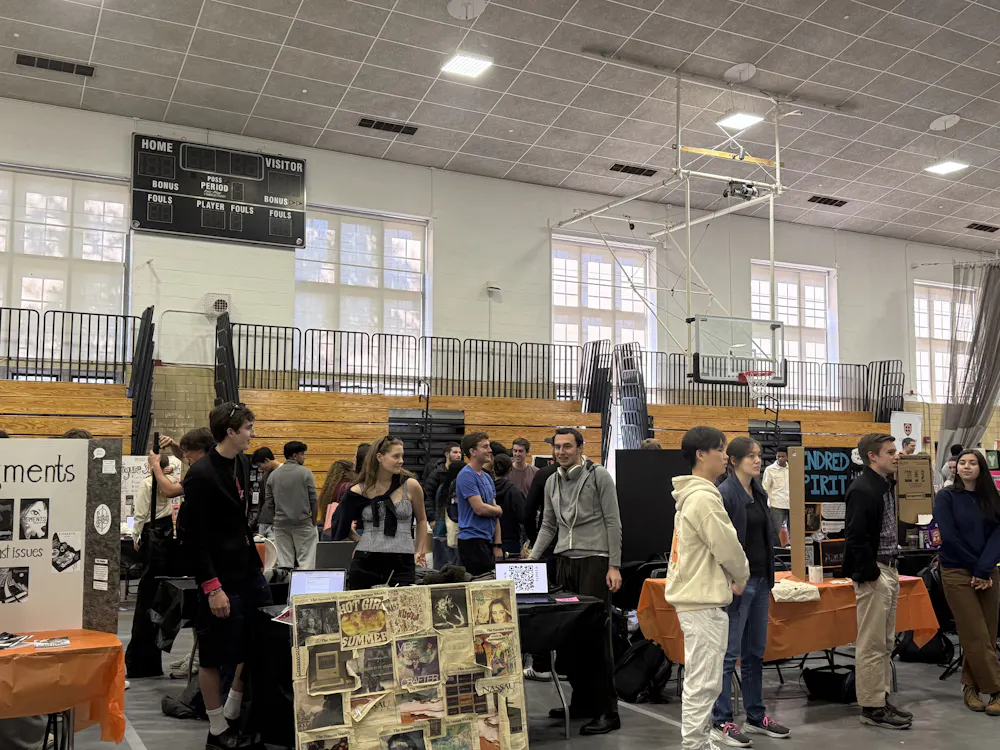
Students share mixed reactions as mandated officer and treasurer trainings return to in-person format
David EstradaThe University's student organization officers and treasurers returned to mandatory in-person training this fall after years of online sessions. Student reactions found parts of the training redundant or tedious, though most agreed the sessions were important.
The University's student organization officers and treasurers returned to mandatory in-person training this fall after years of online sessions. Student reactions found parts of the training redundant or tedious, though most agreed the sessions were important.