



Princeton University played an important role in the life of Ansley Johnson Coale '39, from his days as an undergraduate through his tenure as professor emeritus.
Coale, the William Osborne Church Professor of Public Affairs and Professor of Economics, emeritus, died Nov. 5 at Pennswood Retirement Home in Pennsylvania. He was 85.
Coale received his bachelor's, master's and doctorate degrees in economics from the University, and joined the faculty in 1959.
He was a demographer, serving as head of the University's Office of Population Research from 1959 through 1975, president of the Population Association of America in 1967-68 and president of the International Union for the Study of Population from 1977-81.
Over the course of his career, Coale published more than 125 books and articles, several of which proved to be influential demographic works.
His book "Population Growth and Economic Development in Low-Income Countries," written with J. Edgar Hoover in 1958, laid the groundwork for much of modern demographic research by introducing the concept that a slowing population will enhance economic development.
In 1966, Coale's book "Regional Model Life Tables and Stable Populations" established a framework for estimating mortality and fertility among populations in which data was scarce.
Coale was also a noted mathematician and taught radar at the Massachusetts Institute of Technology during World War II.

He held honorary degrees in several fields from Princeton, the University of Pennsylvania, the University of Liege and the University of Louvain, and was a member of the National Academy of Sciences, the Academy of Arts and Sciences and the National Philosophic Society.
As a professor emeritus, he contributed volumes to academic life at the University not only directly, but also indirectly through his teaching and in his role as senior thesis adviser.
He was a familiar figure on campus, both in the lecture hall and as a member of the community who pedaled his bicycle across campus and could often be seen on the University squash courts.
He is survived by his wife Sarah, two sons, three grandchildren and by the impact of almost half a century upon the Princeton community.
Read More

Princeton University Orchestra and men’s ultimate frisbee team named in University’s latest hazing report
Andrew ArthurTwelve students in the Princeton University Orchestra and Men's Ultimate Frisbee team were found responsible for hazing violations in the University's latest Campus Hazing Transparency Report. Sanctions ranged from Dean's warnings to disciplinary probation.
Twelve students in the Princeton University Orchestra and Men's Ultimate Frisbee team were found responsible for hazing violations in the University's latest Campus Hazing Transparency Report. Sanctions ranged from Dean's warnings to disciplinary probation.

Murray-Dodge Café celebrates 50th Anniversary, drawing over 260 students
Hifza KaleemOn Wednesday, Murray Dodge Cafe celebrated its 50th anniversary, drawing more than 260 students to celebrate with free cookies and merchandise.
On Wednesday, Murray Dodge Cafe celebrated its 50th anniversary, drawing more than 260 students to celebrate with free cookies and merchandise.
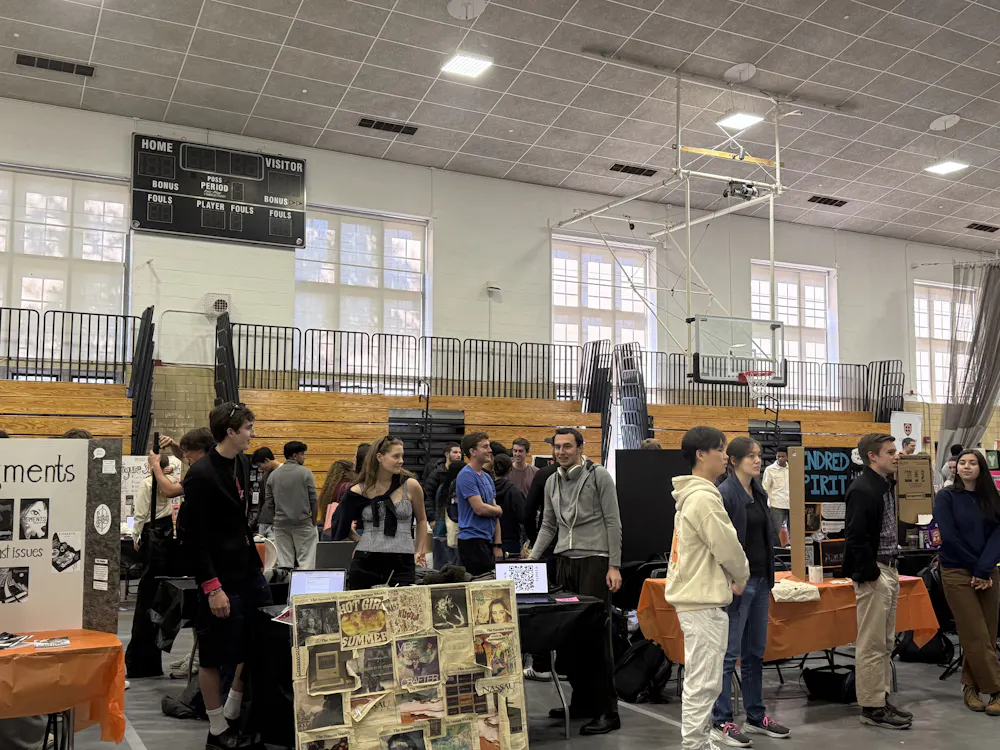
Students share mixed reactions as mandated officer and treasurer trainings return to in-person format
David EstradaThe University's student organization officers and treasurers returned to mandatory in-person training this fall after years of online sessions. Student reactions found parts of the training redundant or tedious, though most agreed the sessions were important.
The University's student organization officers and treasurers returned to mandatory in-person training this fall after years of online sessions. Student reactions found parts of the training redundant or tedious, though most agreed the sessions were important.