



The following is a guest contribution and reflects the authors’ views alone. For information on how to submit a piece to the Opinion section, click here.
On Oct. 4, a letter we wrote in solidarity with Jane Doe and regarding Title IX and sexual misconduct policy at Princeton was adopted unanimously by the Undergraduate Student Government senate. That letter expressed serious concerns about the ways we see Princeton failing to protect survivors of sexual misconduct, assault, and violence, and its tendency to prioritize its own image over students’ safety. We called on Princeton to commit itself to solidarity with survivors of sexual misconduct and to create real systemic change.
As is standard for USG letters, we requested a “substantive response” addressing our concerns. On Oct. 7, we received a response from Vice Provost for Institutional Equity and Diversity Michele Minter, who quoted a statement by University spokesperson Michael Hotchkiss. It exhibited more of the same failures — crafted to avoid accountability and shift the burden of responsibility for campus safety onto students, thereby giving a cursory treatment to our criticisms of Princeton’s sexual misconduct policies.
The University’s inadequate strategy for preventing sexual misconduct on campus and obstinance in the face of criticism might cause students to declare, “we keep us safe.” But we demand better: Princeton, you must keep us safe.
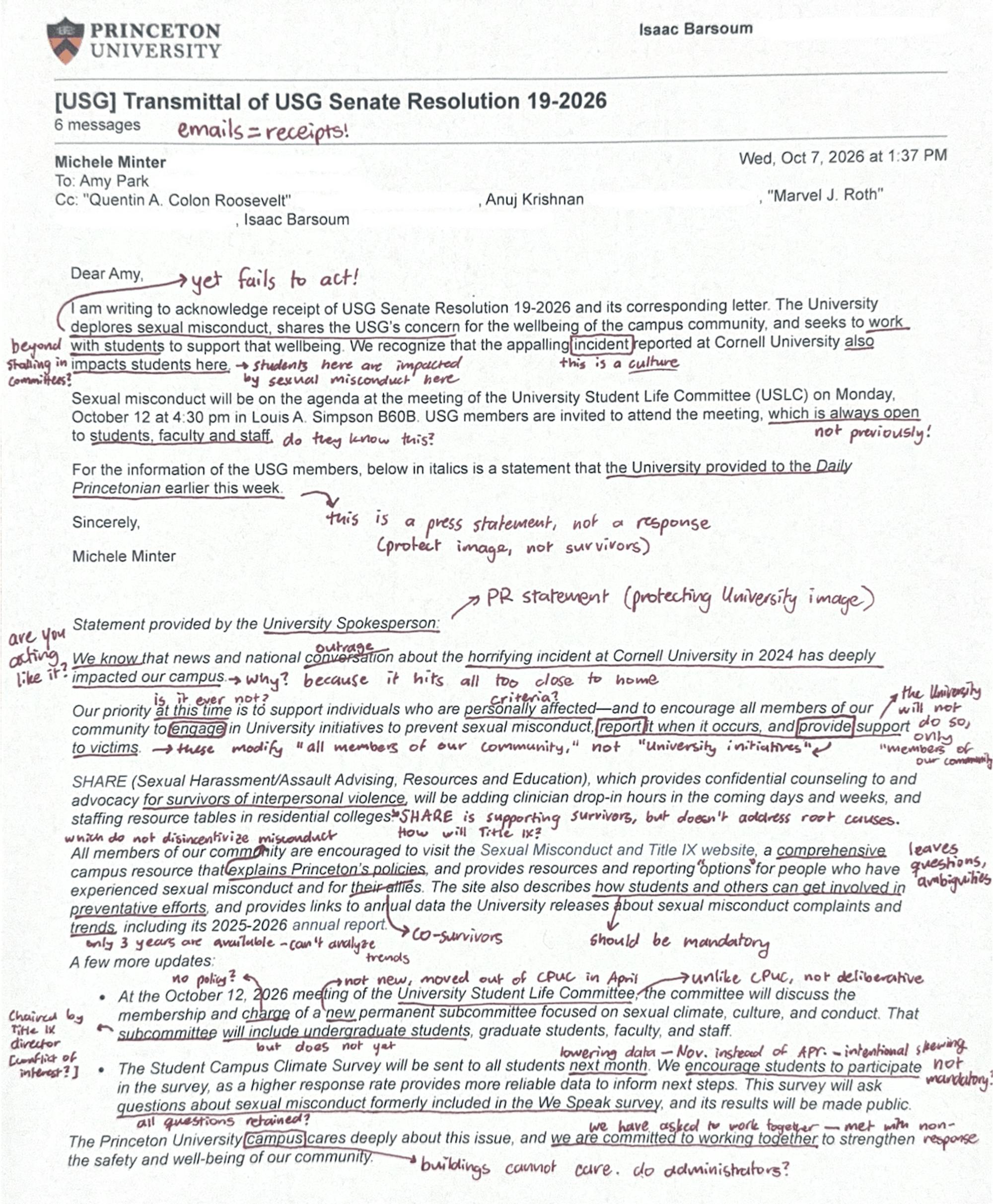
The email from Michele Minter, marked with red pen by Isaac Barsoum and Marvel Jem Roth.
Courtesy of Marvel Jem Roth ’28
Minter told us in her email that “The University deplores sexual misconduct, shares the USG’s concern for the wellbeing of the campus community, and seeks to work with students to support that wellbeing. We recognize that the appalling incident reported at Cornell University also impacts students here.” In his statement, Hotchkiss wrote that “We know that news and national conversation about the horrifying incident at Cornell University in 2024 has deeply impacted our campus.”
This framing — that Jane Doe’s case is just a one-off, “appalling” or “horrifying” incident at Cornell that has shaken students — deflects from legitimate criticisms of the sexual misconduct landscape at Princeton. According to the WeSpeak 2022 survey report, 28 percent of all undergraduate women and 33 percent of all LGBTQ+ undergraduates experienced sexual misconduct during the 2021–22 academic year at Princeton. The “appalling incident” at Cornell impacts students here especially because it reminds them that Cornell is not all that different from Princeton, and that a case like Jane Doe’s could happen — and may have already happened — here, too. Jane Doe’s case should not be treated as an outlier, but rather a product of a failing system that Cornell and Princeton alike, alongside their peers, have created and enabled.
Minter then wrote that the University Student Life Committee would discuss sexual misconduct on Oct. 12, and that these meetings are “always open to students, faculty, and staff.” Before this meeting, the USLC has been closed to students, faculty, and staff, except by invitation. This is an attempt to rewrite history to make the recent transfer of the Ad Hoc Committee on Sexual Climate, Culture, and Conduct from the more open, deliberative CPUC to the USLC — an advisory committee of the faculty — appear more public and transparent. There is no evidence the USLC meeting was advertised to the campus community beyond Minter’s email to us and our own email to the student body. We hope that the USLC and its subcommittees will remain open to students, faculty, and staff after this meeting — but even then, its shortcomings are glaring.

At Monday’s USLC meeting, the co-chairs of the USLC Subcommittee on Sexual Climate shared a slideshow stating that their subcommittee would work to create a “positive campus climate around sexual misconduct” — careless language we find inappropriate and deeply offensive. When we questioned this clause, Director of Gender Equity and Title IX Administration Randy Hubert, who serves as co-chair of the subcommittee, initially defended it. Only when a faculty member of USLC concurred that the language was poorly written did the administrators begin to listen to our concerns.
The subcommittee is also not officially responsible for making or proposing policy around rape and sexual misconduct. When we asked whether policy was within the purview of the subcommittee, Vice President for Campus Life W. Rochelle Calhoun said yes. But as long as the written responsibilities of the subcommittee do not include policy, there is no guarantee it will deal with policy at all.
In response to our clarifying email on whether the University viewed the press statement as filling the role of the “substantive response” we requested, Minter wrote that “questions and concerns regarding Title IX and sexual misconduct are important and complex issues that merit input from students, faculty, and staff, and which do not lend themselves to a quickly-drafted response.” But when it comes to sharing written information about a subcommittee formed in April, the administration did not care to ensure its own language was careful in the way it dealt with these “important and complex issues.”
At USLC, the Title IX office exhibited in plain view its unwillingness to listen to and collaborate with students, as well as the carelessness with which it approaches language. The language we use to discuss and make policy about these issues matters, and the lack of care with which it has been handled is unacceptable.
Minter concluded her original email by providing the aforementioned statement by University spokesperson Michael Hotchkiss originally sent to the ‘Prince.’ This statement, that is, was a public relations endeavor rather than a true response. Minter, for her part, began her presentation at the USLC meeting by reading part of that statement verbatim. In both instances, Minter hid behind the polished language of the Office of Communications, another sign of the University’s unforgivable cowardice.
To be frank, we did not ask for a recycled press statement, but rather a substantive response explicitly addressing our requests. We did not receive that.

“Our priority at this time is to support individuals who are personally affected — and to encourage all members of our community to engage in University initiatives to prevent sexual misconduct, report it when it occurs, and provide support to victims,” wrote Hotchkiss in his statement.
This sentence is carefully crafted, but reveals the reality of the situation: Community members are asked to “engage in University initiatives to prevent sexual misconduct” — mostly limited to various trainings — to “report” sexual misconduct “when it occurs,” and to “provide support to victims” themselves. That is, in his statement, Hotchkiss indicates, however unintentionally, the truth: The onus is on community members, rather than the University, to support survivors in the aftermath of sexual misconduct. The University, having shifted that responsibility from itself, will remain focused on the maintenance of its image.
To conclude his statement, Hotchkiss wrote that “the Princeton University campus cares deeply about this issue.” But Princeton’s campus — its buildings, gardens, statues, plazas — do not feel, and neither, apparently, do its administrators. A campus cannot care. But its administrators should.
Princeton can hide behind press statements, but we see through them. To the survivors reading this: We believe you, and unlike our hallowed halls, we care. To the University, we will continue fighting for you to keep us safe, and we have no intention to stop.
It is past time for Princeton, all of higher education, and the federal Title IX system to begin caring about and to stop failing survivors. It is past time for change.
Isaac Barsoum is an associate Opinion editor from Charlotte, N.C. majoring in politics. He serves as the U-Council Chair in the Undergraduate Student Government and cares deeply about supporting survivors of sexual misconduct, unlike Princeton’s buildings or, apparently, administrators. He can be reached at isaac[at]dailyprincetonian.com.
Marvel Jem Roth is a junior from Los Angeles, majoring in economics. She serves as the Treasurer of the Undergraduate Student Government, stands with survivors of sexual misconduct, and is still awaiting a substantial response from the University administration. She can be reached at marvel[at]princeton.edu.
Please send any corrections to corrections[at]dailyprincetonian.com.
Read More
First spaghetti, now us: how AI is consuming Princeton’s physical campus
HoJin KwakAt Princeton and in the larger world beyond, AI has breached containment from the digital world — and we, as a student body and academic institution, are both complicit and victim.
At Princeton and in the larger world beyond, AI has breached containment from the digital world — and we, as a student body and academic institution, are both complicit and victim.
Divestment and moral education
Ian MannNot every petition will result in divestment. Many have already failed. Nonetheless, it is our responsibility to explore them anyway, to “wrestle with the great questions of human existence.”
Not every petition will result in divestment. Many have already failed. Nonetheless, it is our responsibility to explore them anyway, to “wrestle with the great questions of human existence.”

P-O-L-A-R-I-Z-A-T-I-O-N: Toward a more nuanced orientation
Simon RileyThe University prides itself on raising new leaders in the service of humanity. Leadership does not begin with an inability to acknowledge the other side of the conversation. It begins, rather, with curiosity and discussion. To hone these skills on campus, orientation should teach tolerance, not dogma.
The University prides itself on raising new leaders in the service of humanity. Leadership does not begin with an inability to acknowledge the other side of the conversation. It begins, rather, with curiosity and discussion. To hone these skills on campus, orientation should teach tolerance, not dogma.