



When was the last time you thought about the unrealistic AI-generated video of Will Smith eating spaghetti? I don’t remember exactly how old I was, but I’m sure it was a long time ago, because in my memory I’m still short and stout. I also remember that, back then, we all laughed at the video, reveling in the knowledge that AI wasn’t as intelligent as we feared it could be. Boy, were we wrong.
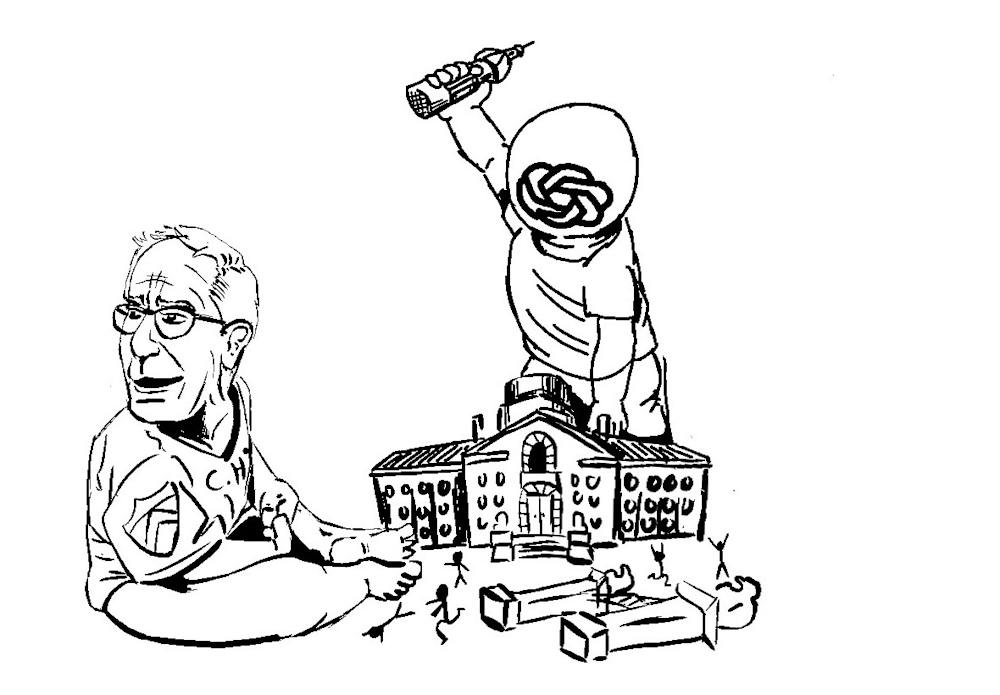
For the past few years, “artificial intelligence” has been the buzzword in research labs, big business conferences, every wannabe start-up founder’s resume, and now on college campuses. Even so, AI began purely as a tool relegated to the digital world. But somewhere along the way, AI quietly pushed past our screens and into the material world. We must draw attention to and stop the gradual yet soberingly sudden influx of AI’s physical presence on our campus, before it is too late.
AI has infiltrated so far into the cultural zeitgeist at Princeton that it is now regularly languishing in the physical spaces on our campus, primarily for advertising.
From club posters to Yeh College’s weekly itineraries, AI is now a part of how student organizations and even college staff reach out to one another. The coincidence that Yeh College, one of the newest residential colleges, uses an AI-generated poster to advertise its events is so perfect I could see it as a metaphor for the newest generation, if the idea wasn’t so depressing.
“AI this” and “AI that,” so what? Who cares? Given that every member of the Class of 2030 had to discuss “Reader, Come Home,” we’re sick of hearing how AI undermines human intelligence. But what about human culture? It’s one thing to Claude your way through a problem set, but it’s another thing for AI to be the mouthpiece by which we communicate with other people.
We can explore dystopian futures all we want, but our current reality is one where slop generated by AI can — by cutting corners and sacrificing artists — sneak its way into spaces where we may not know it’s present, devaluing human voices even without the intention to. Which leads me back to what made me realize how utterly bizarre our current situation is: The Lost Book Project.
About a month ago, back when I was blissfully unaware of the horrors of problem sets and unwashed forks in RoMa, I was sitting in my room skimming through the dozen free books I’d gotten as part of Princeton’s Analog Classroom pilot program, “designed to encourage more focused, screen-free engagement with course readings,” when I came across a copy of H.G. Wells’ “The Time Machine” that looked a little off.
In front of a burnt orange background was a strange drawing of the eponymous Time Machine: something that looked like a toilet seat on top of Santa’s sleigh, drawn with bold, black lines that stretched from thick to thin, merging and separating from one another on a whim, or more accurately, at random. One of the arched skis at the front of the sleigh curved level to the top of the seat before its tip impossibly merged with the ski on the other side. In that moment, I felt an all too familiar fluttering in my mind as I asked the question that’s been asked a million times in the last few years: Is this AI?

I didn’t want to believe that Princeton, the same school I would have given almost anything to attend just a few months before, would support plastering slop all over the outside of a genre-defining piece of science-fiction, and more importantly, human-made art. The inside, it turned out, was also littered with AI illustrations. I searched online for edition after edition of “The Time Machine” with a similar cover, until I found the publisher: The Lost Book Project. I encourage you to visit their website — thelostbookproject.com — yourself, to see the extent to which the entire site is overrun with AI, and how Princeton’s Analog Pilot program must have been either unaware of or apathetic about their non-human origins to have purchased these books in bulk.
When classes started the following week, one of my classmates brought up how one of the AI generated images, to paraphrase, “captured the mysterious vibe of the distant future.” Maybe she knew the image was AI; maybe she just said something for participation points. Either way, an AI image that was never part of the original human work influenced her perception of the book.
The presence of AI had a noticeable effect in a space Princeton tried to make purely analog. At Princeton and in the larger world beyond, AI has breached containment from the digital world — and we, as a student body and academic institution, are both complicit and victim. By allowing AI to so directly affect our conversations with one another, our University culture is getting muted and mixed with that same bland flavor of cartoon characters with all of their dazed smiles, muted colors, and indecisive outlines.
We lose so much humor, creativity, and, most importantly, Princetonian intention in how our culture manifests on campus. We are massively underreacting to the way AI slop pervades our daily lives. The University’s inaction and, in some cases, clear participation in this phenomenon is hastening a contemporary dystopia where the line between human and digital hand disappears completely, leaving only ourselves to preserve what makes Princeton, Princeton.
Princeton has shown that the same standard it expects of the work of its students does not apply to itself in the face of convenience. If the institution will not hold itself accountable, the responsibility unfairly but necessarily shifts to us, the student body.
If you’re promoting a club or running an event, reach out to artistic members, dust off the old Canva account, put marker to paper, and create something human. If you’re teaching a course, it’s time to eliminate AI from the physical mediums we study as well as from our digital environment. Do anything to stop the gradual spread of AI on our campus before it replaces our voices, our art, and our thoughts altogether. Our campus and culture are worth more than any amalgamation of data can produce.
HoJin Kwak is a contributing Opinion writer from Old Tappan, N.J. majoring in nothing for now. He can be reached at hjk[at]dailyprincetonian.com. Email me if you want a free poster made.
Read More

We wrote USG’s Title IX letter. Princeton’s response continues to fail survivors
Isaac Barsoum and Marvel Jem RothPrinceton can hide behind press statements, but we see through them. To the survivors reading this: We believe you, and unlike our hallowed halls, we care. To the University, we will continue fighting for you to keep us safe, and we have no intention to stop.
Princeton can hide behind press statements, but we see through them. To the survivors reading this: We believe you, and unlike our hallowed halls, we care. To the University, we will continue fighting for you to keep us safe, and we have no intention to stop.
Divestment and moral education
Ian MannNot every petition will result in divestment. Many have already failed. Nonetheless, it is our responsibility to explore them anyway, to “wrestle with the great questions of human existence.”
Not every petition will result in divestment. Many have already failed. Nonetheless, it is our responsibility to explore them anyway, to “wrestle with the great questions of human existence.”

P-O-L-A-R-I-Z-A-T-I-O-N: Toward a more nuanced orientation
Simon RileyThe University prides itself on raising new leaders in the service of humanity. Leadership does not begin with an inability to acknowledge the other side of the conversation. It begins, rather, with curiosity and discussion. To hone these skills on campus, orientation should teach tolerance, not dogma.
The University prides itself on raising new leaders in the service of humanity. Leadership does not begin with an inability to acknowledge the other side of the conversation. It begins, rather, with curiosity and discussion. To hone these skills on campus, orientation should teach tolerance, not dogma.