



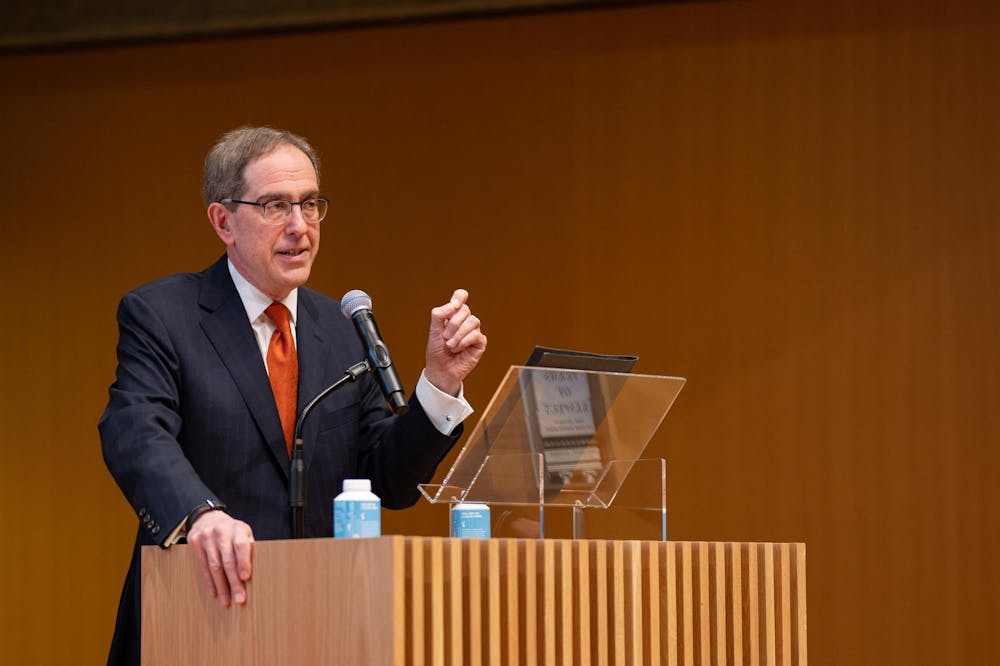
“Terms of Respect,” the 2025 University President Christopher Eisgruber’s 2025 book, claims in its subtitle that “colleges get free speech right.” And, in a required orientation event on Aug. 25, he attempted to convince the Class of 2030 that Princeton does too.
In a panel discussion with Summer Lopez GS ’08, a co-CEO of PEN America, Eisgruber outlined Princeton’s “time, place, and manner” restrictions, which dictate the context of expression at Princeton, not the content. However, looking around Richardson, where some of the Class of 2030 watched the discussion on a livestream, I noticed that many of my peers were exercising their own freedom to not pay attention.
This shouldn’t come as a surprise. This event was the seventh required lecture or panel in the first five days of Orientation. I can imagine that those who chose to scroll, sleep, or otherwise ignore the event felt that they had spent more than enough time being spoken at.
Freshmen should be willing to engage with the values of their home for the next four years — but the University should also meet them where they are. In order to truly welcome new students to free expression at Princeton, the administration must reevaluate the format in which it attempts to engage us.
Princeton’s own “Statement on Freedom of Expression” declares that “fostering the ability of members of the University community to engage” in free expression “is an essential part of the University’s educational mission.” This orientation event, in its failure to clearly and engagingly communicate about free speech at Princeton, fell short of that objective. If free speech is so important as to earn a spot in the precious first few days on campus, why isn’t that value important enough to be effectively communicated to freshmen?
First of all, though bringing guest speakers to campus is a great way to have students engage with new ideas, doing so for an event specifically about life at Princeton takes away the chance for guests to really apply their expertise. Because of the panel format, neither Lopez’s professional perspective nor concrete explanation of Princeton’s free speech policies could be properly communicated. It seemed Eisgruber and Lopez focused on their discussion more than on educating students, which was ostensibly the event’s purpose. In order to actually address Princeton’s free speech policy, a more concise, Princeton-focused session involving student discussion is necessary. The dual aims of practical explanation of a school policy and engagement with the same ideas in the real world both fell short in this panel.
I didn’t leave Richardson that day with a deeper understanding of free expression at Princeton or in the “real world.” Before the panel, I’d mostly assumed that the ways in which I’ll express myself on campus wouldn’t interfere with University policy. The panel did little to confirm or challenge my assumptions; the ambiguous discussion only left me with a general impression that Princeton values free speech.
Free speech is not a vague, philosophical ideal. It governs the way we engage everywhere on campus, from our dining halls to our precepts. Orientation should give these policies the concrete emphasis that Eisgruber claims they receive in practice. Since every student will express themselves countless times while here, they should understand how free expression actually plays out on campus.

Looking into Princeton’s Statement on Freedom of Expression, I discovered that it was adopted in large part from a similar statement written at the University of Chicago. Curious to understand how free speech played a part in their orientation, I spoke to one of my friends, Charlie Hackett, a freshman at UChicago. He described a much livelier picture of engagement with this part of coming to campus.
“They had us read a few articles about free speech and the university’s history,” he said. UChicago freshmen were given concrete examples of the school’s dedication to free expression: communist and right-leaning speakers not being cancelled despite protests, and a time when “the university refused to penalize [protestors] for anything, even if they were being rude.”
By grounding the discussion in interesting school-specific history and asking students to engage through answering questions, instead of having them sit through yet another lecture, UChicago prompted genuine consideration of what it means to have free speech on campus. Hackett noted that “whenever we’re in a discussion, I think it’s clear, everyone understands the university’s policy.”
At UChicago, concrete examples brought the power of the free speech policy to life. Though most students are unlikely to run into the “time, place, and manner” restrictions, free expression on campus is an ideal of activity, not of passive acceptance. To reduce free speech to “yet another panel” is to take a fundamental part of life on a college campus and make it boring for most of the freshman class.
If Eisgruber wants new students to care about free speech as much as he claims to, he should encourage a deeper level of engagement with the policy, including discussions about University history — like those at UChicago — with the goal of reaching a concrete understanding of expression on campus. In doing so, he would break the monotony of lectures during early orientation, and perhaps truly encourage our consideration of the campus’ intellectual community.
Princeton’s orientation centered around dumping massive quantities of information onto freshmen, and our fatigue was evident in this event especially. The administration shouldn’t let free speech be just another talk.

Contributing Opinion Writer Eli Berk is a freshman from Brookline, Mass. Despite not learning much about free speech during orientation, he plans to continue exercising his free expression anyways. He can be reached at eberk[at]dailyprincetonian.com.
Read More

A journey to Antioch over lunch in Princeton
Efe SivisTo assist local archaeologists, Princeton should overlay its 1930s excavation plans onto a current map of Antakya. That way, the resources can be utilized by the organizations that need them most, like the Hatay Archaeology Museum, Hatay Mustafa Kemal University, and the region’s heritage authorities.
To assist local archaeologists, Princeton should overlay its 1930s excavation plans onto a current map of Antakya. That way, the resources can be utilized by the organizations that need them most, like the Hatay Archaeology Museum, Hatay Mustafa Kemal University, and the region’s heritage authorities.

Princeton isn’t Cornell. The conditions for sexual violence endure nonetheless
Daily Princetonian Editorial BoardThe Editorial Board argues that though Princeton’s social life may look different from Cornell’s in important ways, one important commonality remains. The conditions for sexual violence endure and permeate campus life even without the centrality of institutions like fraternity.
The Editorial Board argues that though Princeton’s social life may look different from Cornell’s in important ways, one important commonality remains. The conditions for sexual violence endure and permeate campus life even without the centrality of institutions like fraternity.

Letter to the Editor: Broadline distributors are not responsible for declining nutrition
Benjamin Garcia de FigueiredoWhile food nutrition is indeed declining, broadline distributors are not the primary culprit — and we should make sure to be honest about that fact.
While food nutrition is indeed declining, broadline distributors are not the primary culprit — and we should make sure to be honest about that fact.