



The following is a guest contribution and reflects the author’s views alone. For information on how to submit a piece to the Opinion section, click here.
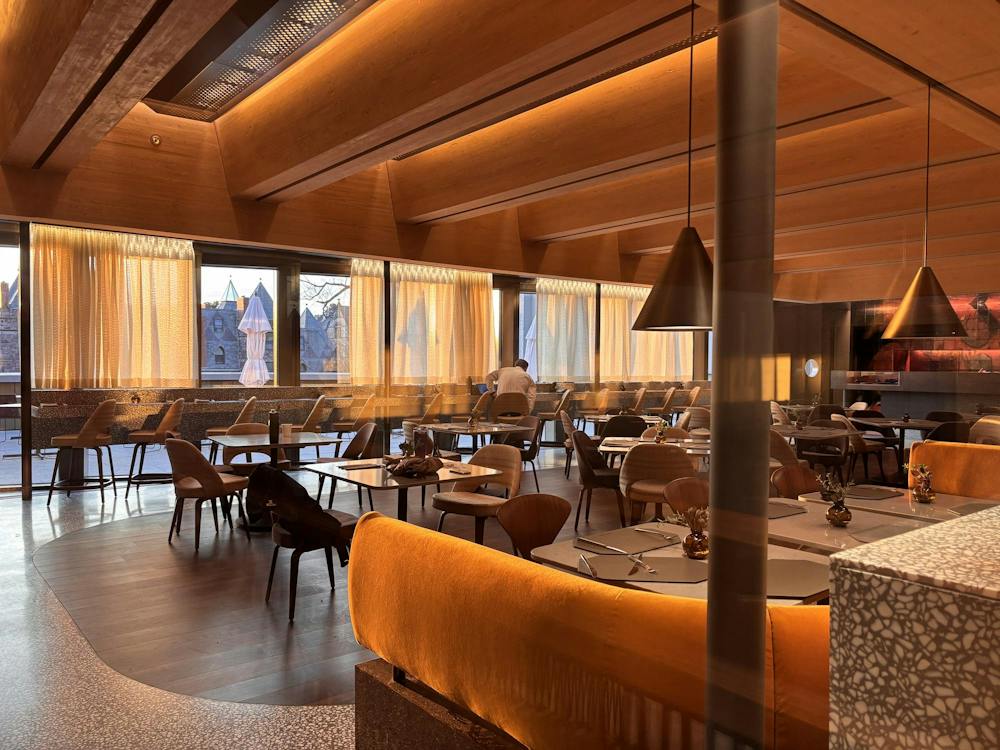
I recently had lunch at Mosaic, the restaurant on the upper floor of the Princeton University Art Museum. On the menu, I read a note: “Like its namesake, every element at Mosaic is thoughtfully placed to form a larger composition.” Its namesake lies below: Roman and early Byzantine mosaics of stone and glass, made between the second and sixth centuries A.D. to adorn the floors of homes in Antioch and brought to Princeton in the 1930s.
I suspect few diners around me knew that the city they came from in southern Türkiye — now known as Antakya — was almost entirely reduced to rubble by earthquakes three and a half years ago. Even fewer of them may have known that Princeton holds one of the most detailed records of what lies beneath that city’s streets: the field books, plans, and thousands of photographs from the excavation it led there in the 1930s. As Antakya rebuilds, what Princeton can best contribute is knowledge. It could map these records onto today’s city and share them with the archaeologists and institutions working there.
Between 1932 and 1939, Princeton led an international consortium that excavated ancient Antioch. The region was then part of French-mandated Syria, and finds were divided between the excavators and the local authorities under a system known as partage. About half of the mosaics stayed in Antakya and are now in the Hatay Archaeology Museum. The rest went to the institutions that funded the dig: Princeton, the Louvre, the art museums of Baltimore and Worcester, Harvard, and Dumbarton Oaks. At Princeton, they are displayed in the Art Museum, McCormick Hall, Firestone Library, and the School of Architecture, while the excavation records are kept by the Department of Art and Archaeology. I have seen this dispersal with my own eyes: Antioch mosaics in Dumbarton Oaks in Washington, and a huge one of the sea goddess Tethys in Harvard Business School.
The excavation was a product of its time. As the archaeologist A. Asa Eger notes, the Princeton team’s prize was Byzantine Antioch; the city’s later layers were barely documented. Working through the Great Depression, amid disputes with landowners and political uncertainty, the team lifted mosaics quickly, and today only a handful of the some 300 mosaics can be traced to a specific room of a specific house. When Hatay left French-mandated Syria and joined Türkiye in 1939, the legal basis for the excavation ended. World War II began months later.
On Feb. 6, 2023, two earthquakes struck southern Türkiye and northern Syria, killing tens of thousands of people. Hatay, whose capital is Antakya, was among the hardest-hit provinces. The old city, with its narrow streets, courtyard houses, bazaars, churches, mosques, and synagogue, collapsed. In total, over 3,000 buildings caved in.
Now, Türkiye is rebuilding the city on a vast scale. The Habib-i Neccar Mosque, considered one of the first Islamic places of worship in Anatolia, has been rebuilt, the historic Long Bazaar is reopening in stages, the restoration of the Greek Orthodox church and the synagogue is underway, and the city center is set to be completed by 2028.
As a new city rises on top of an ancient one, new foundations can help uncover Roman, Byzantine, and Ottoman remains, which local archaeologists are excavating alongside the construction. It makes sense for Princeton to lend a hand, as it holds some of the best records of what lies underground: the 1930s field books, maps and site plans, and thousands of photographs of both the dig and the city at the time.
The University has already worked to open this archive to the world. Alongside some 40 mosaics, thousands of small objects, and tens of thousands of coins came to Princeton, and for years much of the collection sat uncataloged in boxes and trays, hard to access even for Princeton’s own scholars. In 2015, Princeton inventoried the collection, began digitizing the archive, and has since put most of the excavation records online. Its stated goal was an online “Center for Antioch Materials” where scholars worldwide could collaborate.
Now is the time to extend that goal to Antakya itself. The online archive is organized by a grid system devised by the 1930s team, so when a foundation is dug in Antakya today, it is very difficult for a local archaeologist to answer a simple question: What did Princeton find beneath this street? To assist these local archaeologists, Princeton should overlay its 1930s excavation plans onto a current map of Antakya. That way, the resources can be utilized by the organizations that need them most, like the Hatay Archaeology Museum, Hatay Mustafa Kemal University, and the region’s heritage authorities.
Mosaic’s menu could also give this history a place. It is already excellent: an heirloom tomato tartine with peaches, whipped ricotta, and black garlic; a tomato and watermelon gazpacho; a shakshuka. But the cuisine of the city the mosaics came from is among the world’s most distinctive. Hatay has been a UNESCO City of Gastronomy since 2017, and Antakya’s künefe, protected by a geographical indication, was ranked the world’s best dessert by the food guide TasteAtlas. Chef Eric Dantis bringing a taste of this cuisine to his menu would lend Mosaic new depth and help the restaurant live up to its name even more. This is just one way that the University can pay homage to the culture of its mosaics’ origin.
Throughout its history, Antakya has been destroyed by earthquakes many times, and each time it was rebuilt by people who remembered what the city had been. Princeton preserves an important part of that memory. The most valuable thing it can do is share it in a way that helps the city rebuild.
Efe Sivis, Ph.D., is a visiting scholar in the Department of Near Eastern Studies. He can be reached at info[at]efesivis.com.
Please send any corrections to corrections[at]dailyprincetonian.com.
Read More

Princeton isn’t Cornell. The conditions for sexual violence endure nonetheless
Daily Princetonian Editorial BoardThe Editorial Board argues that though Princeton’s social life may look different from Cornell’s in important ways, one important commonality remains. The conditions for sexual violence endure and permeate campus life even without the centrality of institutions like fraternity.
The Editorial Board argues that though Princeton’s social life may look different from Cornell’s in important ways, one important commonality remains. The conditions for sexual violence endure and permeate campus life even without the centrality of institutions like fraternity.

Letter to the Editor: Broadline distributors are not responsible for declining nutrition
Benjamin Garcia de FigueiredoWhile food nutrition is indeed declining, broadline distributors are not the primary culprit — and we should make sure to be honest about that fact.
While food nutrition is indeed declining, broadline distributors are not the primary culprit — and we should make sure to be honest about that fact.

Princeton University, speak out against the South Brunswick data center
Elif CamThe New Jersey Department of Environmental Protection is currently considering whether to grant an air permit to the data center, which will be located on a site that was owned by Princeton University until 2024.
The New Jersey Department of Environmental Protection is currently considering whether to grant an air permit to the data center, which will be located on a site that was owned by Princeton University until 2024.