



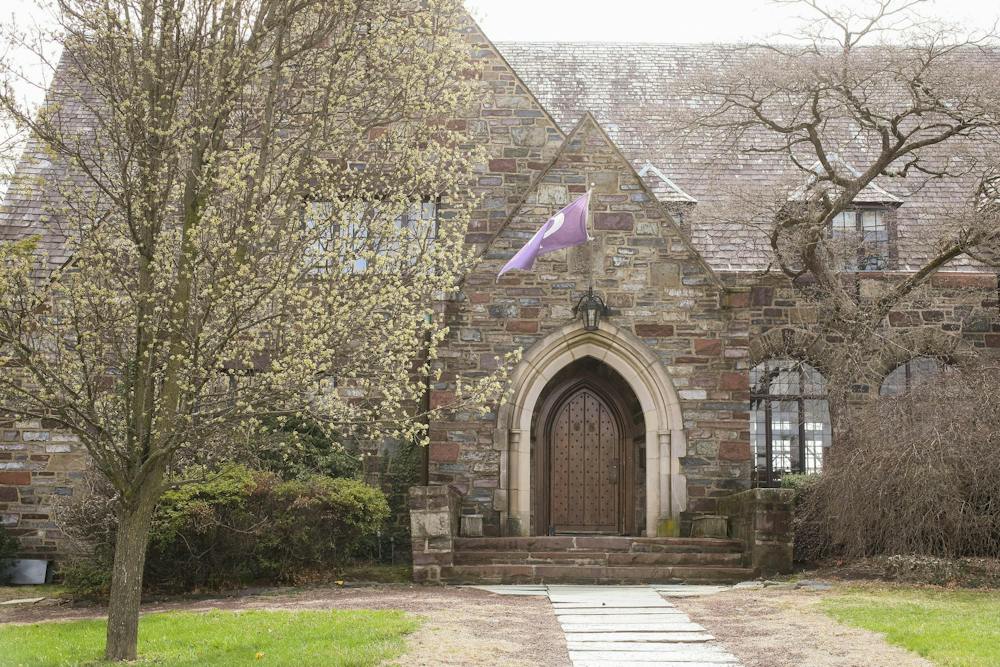
Cloister Inn’s leadership is no longer committed to a set reopening date. During this indefinite closure, the eating club is working to raise money for a major renovation called “Re-Imagine Cloister” and attract student interest, Mike Jackman ’92, chair of the club’s graduate Board of Trustees, wrote in a statement to The Daily Princetonian. Since the sign-in club’s closure in June 2025, its Graduate Board had previously hoped to reopen in Fall 2027 or 2028.
“We’re taking this one year at a time,” Jackman wrote.
Cloister closed after generating losses for several years. In its filing for the 2024–25 fiscal year, which covers its final year of operations, Cloister reported $793,006 in revenue and $840,370 in expenses, a deficit of $47,364. Its net assets fell from $87,428 for the 2023–2024 fiscal year to a mere $22,799 — an almost 74 percent decrease. By comparison, Colonial Club, another sign-in club, only decreased by 11.48 percent from the 2023-2024 fiscal year to the 2024-2025 fiscal year; Quadrangle Club, another sign-in club, increased by almost 12 percent. Colonial ended the 2024-2025 fiscal year with $2.2 million in net assets; Quadrangle had $1.5 million.
Less than half of the club’s 2024 revenue came from member charges for meals and use of the clubhouse; contributions, which typically comprises alumni donations, made up more than a third. By the year’s end, the club’s $364,519 in assets, mostly the clubhouse itself, barely exceeded its $341,720 in liabilities.
A ‘Prince’ analysis last December found that the club’s net assets fell by nearly $250,000 a year on average between fiscal years 2021–22 and 2023–24. That analysis also reported that Cloister took a $90,000 loan from Cannon, Cap and Gown, Charter, Ivy, Tiger Inn, and Cottage in the spring of 2025 to pay overdue bills, putting up the clubhouse as collateral.
The year after Cloister’s closure, 111 students were left without immediate eating club placements after the February admissions period, differing from the previous year when all 1,263 students seeking admission to a club were placed. Former Interclub Council Vice President Sofia Marina ’26 told the ‘Prince’ at the time that Cloister’s closure contributed to the students left without admission by creating an even lower number of seats available in eating clubs.
Last December, the club set an initial fundraising goal of $650,000 to cover the next 10 to 12 months, during which they would plan their goals. It also targeted a fundraising range of $3 million to $5 million for construction. Jackman declined to share specific figures, but wrote to the ‘Prince’ the club raised enough to partner with its architect, Joseph K Oppermann Architect, to develop renovations to the club’s house, which was presented at alumni forums during Reunions 2026 and revised following feedback.
“Big capital projects … take time, and there’s still work to be done before we actually begin major construction,” Jackman wrote.

Two conditions must be met before Cloister resumes operations, he wrote. The first is that a sufficient number of students must want to join, and the second is that the club must “execute on enough of the Re-Imagination to present those students with a clubhouse that will help enable the experience they demand.”
“We have ambitious plans that will take multiple years to fully execute, but if a group of students from among the many not already in clubs were to emerge and be willing to accept a clubhouse that is partway through the re-imagination and choose to collaborate with us to complete the re-imagination, we would consider resuming operations sooner,” Jackman added.
To pay for the renovations, Cloister still receives annual support in “various amounts” from other eating clubs to cover Cloister’s reduced operating costs, allowing alumni donations to go entirely toward the renovation. Cloister has also sold parking spots at its club for the 2026–27 academic year at an annual rate of $1,250, according to an email sent to the student body.
Jackman wrote that the loans from other clubs are “not payable until some time after Cloister resumes operations.”
Two additional hurdles still remain for the club as it plans its renovation; the first is the Princeton Municipality Planning Board, which must which must approve changes to the historic property. While the club has not yet begun coordinating with the Board, Jackman added that some planned elements of the renovation do not require the board’s review.
The second hurdle is deciding how the admissions process will work — in eating club vernacular, whether the club will be sign-in or Bicker. This has not been decided, Jackman explained, but the process will be developed closer to reopening and will “no doubt include engagement” from the students forming the first post-renovation class of the club.

“We’ve sought input from young alumni and current students on various topics over the past year,” Jackman wrote. “For years we have seen the sign-in and bicker systems cycle through ups and downs. More recently, Charter and Quad have experienced success with the newer concept of selective sign-ins.”
“Regardless of the mechanics, ensuring that the membership includes those students most interested in the success of the club will feed and sustain an exciting club vibe,” he added.
Jackman framed the renovation as a response to unmet demand, pointing to the many students who will not get into a club during the normal February admissions period.
“It’s disheartening to me that there are students who will miss out on the undergraduate club experience … not by choice but because they could not find a fit,” he wrote.
While the University has not observed a direct effect from Cloister’s closure on Campus Dining plan enrollment for this academic year, Campus Dining has added extra seating and additional stations during peak hours to address a general “increase in meal plan holders,” University spokesperson Michael Hotchkiss wrote in a statement to the ‘Prince.’
The University is “generally aware” of Cloister’s plans, according to Hotchkiss, but has no formal role in them. However, he wrote that the University recognizes that the clubs form a “meaningful part of the dining and social experience for many Princeton students.”
“The financial health and viability of the open clubs is particularly important, so that students have the option of joining a club without having to participate in a selection process,” Hotchkiss added.
Jackman wrote of the Board’s commitment to rejuvenating Cloister’s social atmosphere.
“For nearly three decades, Cloister was one of the most popular clubs on the Street. We’re keen to recapture that spirit as we re-imagine Cloister to provide a clubhouse that underpins that experience,” he wrote.
Daphne Lewis is a senior News writer for the ‘Prince.’ She is from Washington, D.C.
Please send any corrections to corrections[at]dailyprincetonian.com.
Read More

Fragile play, handled with care: Theatre Intime’s ‘The Glass Menagerie’
Mia MazzeoAssistant Prospect editor Mia Mazzeo reviews Theatre Intime’s adaptation of Tennessee Williams’ “The Glass Menagerie."
Assistant Prospect editor Mia Mazzeo reviews Theatre Intime’s adaptation of Tennessee Williams’ “The Glass Menagerie."

‘You were supposed to protect us from this’: Backlash grows over Princeton Nurseries data center
Lucy HarperA 341,000-square-foot data center is being built less than a mile from university research facilities. It’s on land that Princeton University used to own.
A 341,000-square-foot data center is being built less than a mile from university research facilities. It’s on land that Princeton University used to own.

New thrift pop-up comes to town: Princeton’s pop-up vintage Market
Marley Hartnett-CodyStaff writer for The Prospect Marley Hartnett-Cody covers last weekend's vintage market hosted by Princeton Council of the Arts and Funk Daddy Vintage.