



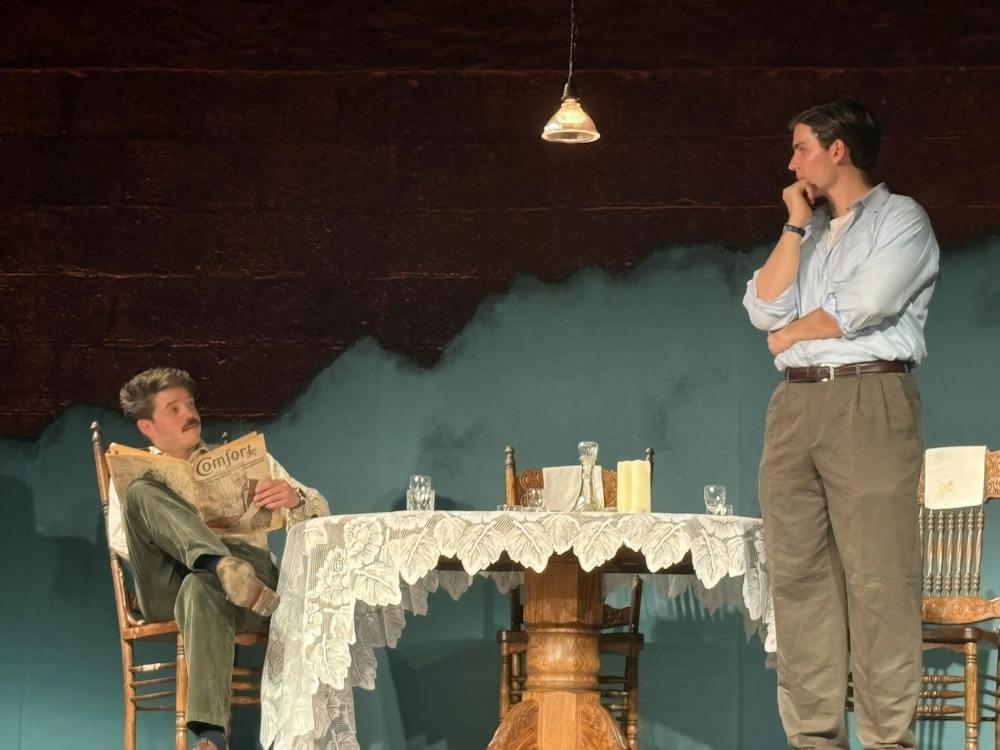
How does one adapt a tragic memory that has been cycled for over 80 years? This was the question Christie Davis ’27 faced when it came to helming Theatre Intime’s production of Tennessee William’s seminal 1944 play “The Glass Menagerie,” which ran from Thursday to Sunday at Hamilton Murray Theater.
Best known for his Pulitzer Prize-winning play “A Streetcar Named Desire,” Williams is no stranger to deconstructing the American dream and aesthetics of the Deep South. In “The Glass Menagerie,” Williams takes us on a trip down to St. Louis, where we follow the memories of Tom Wingfield, played by Xander Constantine ’27. Yearning for adventure, Tom seeks to escape his mundane warehouse job and cramped apartment he shares with his overbearing mother, Amanda, and painfully shy little sister, Laura.
The play itself is told through Tom’s retrospective, with Constantine frequently pausing to narrate these scenes from Tom’s memory years in the future. Davis distinguishes between the two perspectives by portraying Tom, the narrator, with glasses and Tom, the character, without them. Although subtle, I appreciated how this choice not only emphasized the separation but also framed narrator Tom as older and wiser.
Although Tom is the sole breadwinner for his family, he is deeply conflicted about staying tied down, dreaming of one day joining the Merchant Marines and going on an adventure. When the weight of this responsibility becomes too much and the family begins to argue, Amanda asserts that Tom is allowed to leave once Laura is married off and provided for. In response, Tom brings home Jim O’Connor, played by Connor Odom ’27. Tom hopes his charming coworker and high school friend will be a potential gentleman caller for his sister. Laura is shocked to find that the very man she was secretly in love with during high school will now be joining her for dinner.
Living her whole life deeply ashamed of her limp, Laura chose instead to live in a world of her own imagination, consumed by a collection of glass animal figurines. But when she and Jim are left alone together that night, he treats her as an equal, taking genuine interest in her and her glass menagerie. Jim allows Laura to come out of her shell.
As Davis shared in an interview with The Daily Princetonian, previous productions have “typically infantilized [Laura] in a lot of ways, mainly because she happens to be the character with a physical disability.” Hoping to portray Laura’s character in a new, unseen light, Davis paid extra attention to this scene with Jim. “We tried to push against that a little bit in this production by making her desires for romantic love or greater sexual experience a bit more obvious.”
After reassuring her that she should not feel inferior, Jim initiates a kiss, one Laura passionately returns. Davis noted she intentionally added the reciprocated second kiss, something not explicitly included in the original script. This intentional script adjustment was a fascinating detail. It embodies the refreshing themes the cast and crew wanted to execute, emphasizing Laura’s desires and newfound confidence.
After this tender moment, Jim snaps back to reality and anxiously tells Laura he has a fiancée. Before he leaves, Jim accidentally breaks the horn off Laura’s favorite glass unicorn, which she then gives to him as a souvenir of their night together. Just like the unicorn, Laura lost her peculiarity for a moment and tasted normality but was still broken in the end. Both Laura and Amanda are devastated, and Tom, unable to bear the weight of the night and the hardships he knows will follow, leaves them once and for all. The play ends with Tom informing the audience he is still haunted by the memories of his mother and sister –– plagued to this day by the guilt he holds for leaving them destitute.

Although Constantine takes center stage as the narrator, it was Madeline Paxson GS who delivered the standout performance of the night as Amanda Wingfield, expertly balancing the vivaciousness of a former southern belle with the despair of a forlorn mother. From her subtly brash gestures to her morose facial expressions, Paxson’s performance added a sullen dimension to Amanda’s character, illuminating the anxiety lingering under the facade of her infectious southern accent.
On top of conveying Amanda’s intense emotions, Paxson had to fully embody Amanda’s pervasive feminine charm. In an interview with the ‘Prince,’ Paxson said she found herself pitching up her voice during warm-ups and dressing more like Mrs. Wingfield in the months leading up to the production. “One of the challenges we actually talked about over the summer was [Amanda’s] lightness that I don’t necessarily inhabit. I’m very tall, I take up space, and I’m not the most proper person. I think that finding ways to embody that was all very helpful.”
Paxson was certainly not the only one on set taking extra steps to elevate this adaptation. In preparation for the production, Davis read “Tom: The Unknown Tennessee Williams” by Lyle Leverich, a whopping 676-page biography of the famous playwright, to better understand how his own experiences shaped “The Glass Menagerie.” “It was surprising to me how many of the details in the script were autobiographical, not necessarily that they mapped onto a series of events, but how the Wingfields were the neighbors he had growing up, so he took that name,” Davis said.
This deeper understanding of William’s life was a massive influence on the way Lucy Grunden ’27 approached her portrayal of Laura, based on William’s sister Rose, who was diagnosed with schizophrenia, given a lobotomy, and later institutionalized. “There’s a really dark history there. Which means there’s so much guilt and love for [Tom’s] sister, and that is totally inspired by his real situation,” Gruden commented.
Grunden’s exceptional talent particularly shone through during her scene with Odom. The two shared the stage alone for the majority of the second act, and it was by far the most gripping part of the show. Grunden noted that the script cites this moment as “the climax of [Laura’s] secret life.”
Gruden’s eager voice and physicality with Odom become more evident as Laura grows more comfortable, masterfully conveying her character’s mix of nerves and excitement. This attention to detail made Laura feel remarkably real and, consequently, made Jim’s departure all the more heart-wrenching. Despite the audience laughing throughout the play at Tom’s quips and Amanda’s overbearing nature, the room was dead silent during this scene. According to Gruden, Saturday night’s audience felt the most intense and thoughtful. “It allowed us to really dive into the emotional elements more,” Grunden remarked.

Delivering a solemn and thoughtful production, Davis and her cast executed William’s vision with immense care and a refreshing spin. The efforts the actors took to embody their characters and the research they conducted beforehand certainly shone through during the production, resulting in a beautiful show –– as radiant and full of dimension as a small glass figurine.
Mia Mazzeo is an assistant Prospect editor and a member of the Class of 2029. She can be reached at mm4755@princeton.edu.
Please send any corrections to corrections[at]dailyprincetonian.com.
Read More
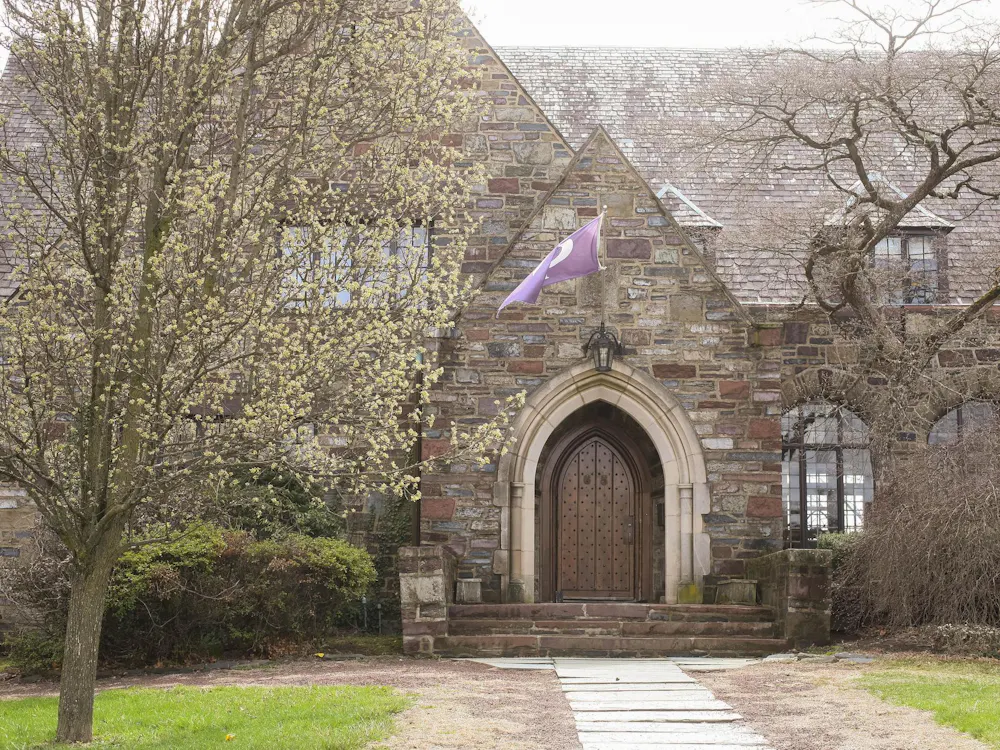
Cloister to remain closed indefinitely amid financial struggles and renovation planning
Daphne LewisCloister Inn, a Princeton eating club whose operations have been temporarily suspended following financial conerns, is working to raise money for a major renovation called “Re-Imagine Cloister.”
Cloister Inn, a Princeton eating club whose operations have been temporarily suspended following financial conerns, is working to raise money for a major renovation called “Re-Imagine Cloister.”

‘You were supposed to protect us from this’: Backlash grows over Princeton Nurseries data center
Lucy HarperA 341,000-square-foot data center is being built less than a mile from university research facilities. It’s on land that Princeton University used to own.
A 341,000-square-foot data center is being built less than a mile from university research facilities. It’s on land that Princeton University used to own.

New thrift pop-up comes to town: Princeton’s pop-up vintage Market
Marley Hartnett-CodyStaff writer for The Prospect Marley Hartnett-Cody covers last weekend's vintage market hosted by Princeton Council of the Arts and Funk Daddy Vintage.